Sewer Line Repair in Broward County
We repair sewer lines for Broward County homeowners, from a single cracked section to a full run of failed cast iron. Every job starts with a recorded camera inspection, and the footage is yours. Spot repair, lining, pipe bursting or open trench, quoted against what the camera found. We Fix It Right the First Time or It's Free.
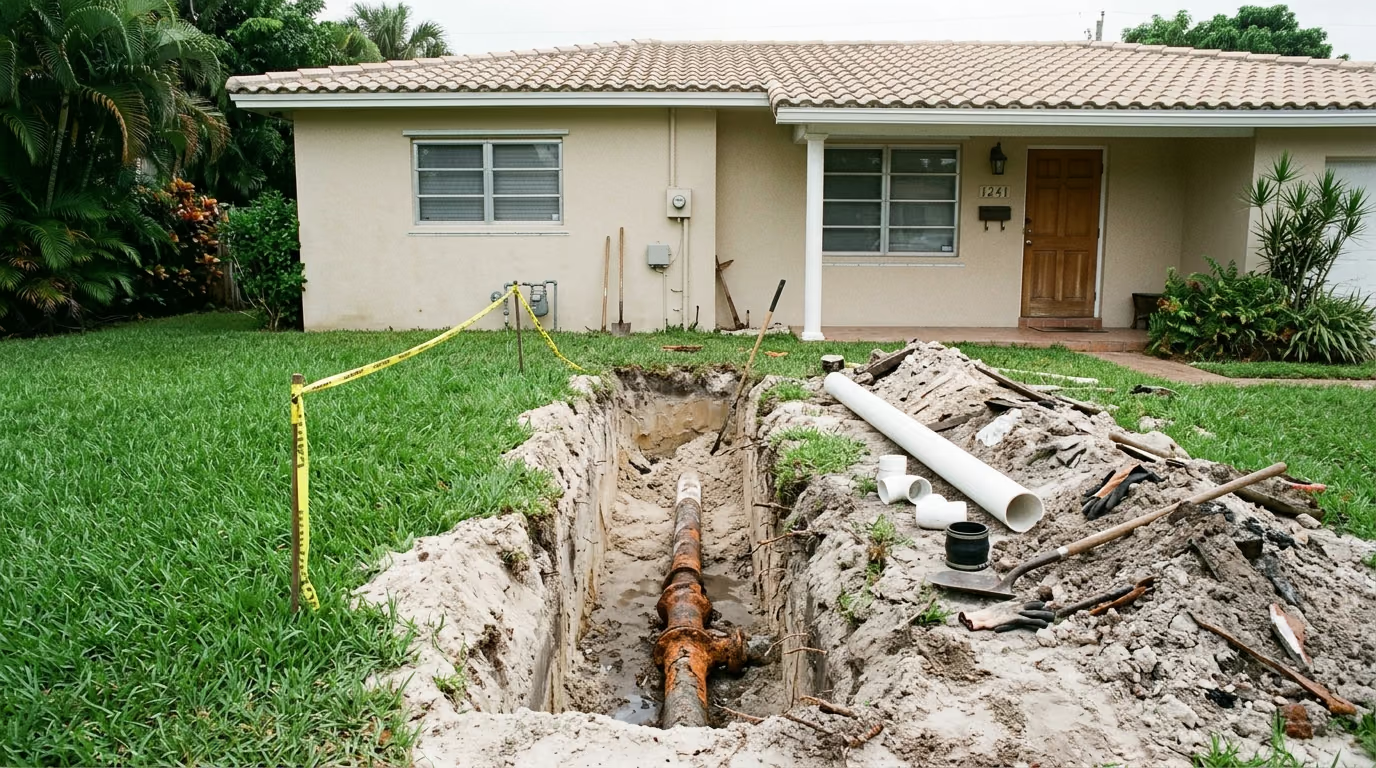
What does sewer line repair in Broward County include?
Sewer line repair in Broward County includes five steps in a fixed order: clearing the line if it is blocked, a recorded camera inspection with a surface locate, a written quote itemized into excavation, materials, restoration and permits, the repair itself (spot repair, lining, pipe bursting or open-trench replacement, depending on what the footage allows), and a camera run of the finished work. The order is the point. A slow drain can be lint on a rough cast iron wall or a section of pipe that has lost its bottom, and no description of the symptom over the phone separates the two. The camera does, and the homeowner keeps the recording.
- Clear the line if it is blocked. A camera cannot see through standing water or a root mat, so cabling or jetting comes first. Reported South Florida ranges run $200 to $450 for a cable and $400 to $900 for hydro jetting.
- Camera-inspect and locate. A self-leveling camera head on a push rod travels the line from a cleanout while a footage counter records distance. A surface locator picks up the sonde in the head, so the defect gets a spray-painted mark on the lawn with a depth beside it. Reported range: $150 to $400, about an hour on site.
- Quote against the footage, itemized into excavation, materials, restoration and permits, so a second contractor can bid the same job from the same recording.
- Repair: spot repair, sectional or full-length lining, pipe bursting, or open-trench replacement.
- Re-scope the finished work. On pipe bursting, Florida’s Building Code, Plumbing Chapter 7, requires it: the completed section shall be inspected internally by video camera survey and approved by the code official.
Access is through an existing exterior cleanout where one exists. Many pre-1975 Broward houses were built without one, and on those the camera and the cable go in through a pulled toilet or, less usefully, a roof vent. Installing a cleanout on a house that lacks one is a small job that makes every future service call cheaper and faster, and it is usually worth adding to the first visit.
The step most often skipped in this trade is the second one. A quote written before anyone has seen the line prices the contractor’s uncertainty, and uncertainty is expensive. A plumber on a public forum put it this way, without flattering the trade: “No one can give you a price for this. I’ve seen sewer repairs cost $5000 and I’ve seen them cost $40,000.” That spread is real before a camera run and much narrower after it, because length, depth, material, grade and the specific defect are then known conditions rather than guesses.
The step most often skipped by homeowners is asking for the file. A recording can be shown to a second contractor for an independent read, which is the simplest defense against a diagnosis that doubles as a sales pitch. Every inspection we run is recorded, the homeowner watches the monitor with us, and the file leaves with them.
How do they fix a broken sewer line?
A broken sewer line is fixed by one of five methods, chosen from camera footage rather than from the symptom: a spot repair that cuts out the broken section and couples new PVC to the sound pipe either side, a sectional liner cured over a single defect, a full-length cured-in-place liner for a corroded pipe that still holds its shape and grade, pipe bursting that pulls new HDPE through the old line, or open-trench replacement of the run. Which one applies depends on whether the pipe around the break is sound, whether the grade is correct, and what sits above it.
| Defect on camera | Usual repair |
|---|---|
| Blockage, pipe sound | Cable or hydro jetting |
| Roots at a joint, pipe round | Jet, then seal the joint by lining or replace the section |
| Single crack, wall sound either side | Spot repair or sectional liner |
| Corroded and scaled, still round and graded | Full-length lining |
| Offset joint | Excavate and re-couple, or pipe bursting |
| Belly or back-pitch | Replacement (grade cannot be lined out) |
| Channeled or collapsed cast iron | Replacement of the affected run |
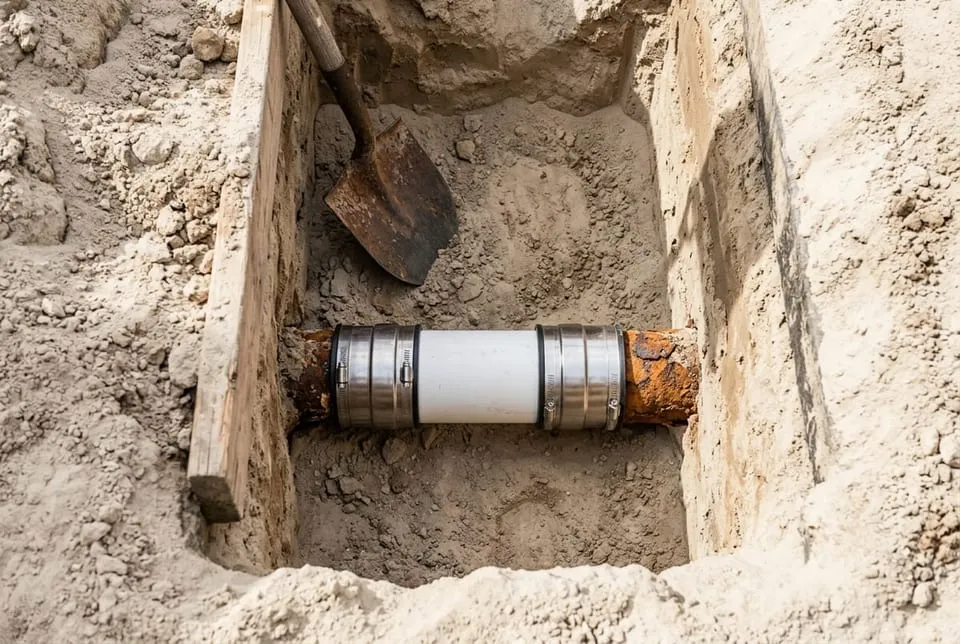
Spot repair is the cheapest outcome on the board. The locate puts a mark on the ground, a small excavation exposes the section, the broken length is cut out, and a new PVC piece is joined to the old pipe at each end with stainless shielded couplings. On a shallow yard line the restoration is sod. The photograph above shows exactly that joint: white PVC between two rust-crusted cast iron ends, band clamps visible, in sandy Broward fill.
Sectional and full-length lining leave the old pipe in the ground and cure a resin-saturated sleeve inside it. The result is jointless, which matters because roots enter at joints and cracks. Lining preserves the existing grade, including a wrong one, so a belly or a back-pitched run cannot be lined out, and a liner cannot cure across the step of an offset joint. A working plumber on a trade forum wrote the gate in one line: “You can only do trenchless if your sewer line has correct pitch and is mechanically sound.”
Pipe bursting pulls an expander head through the old line, fracturing it outward while drawing new pipe in behind. Florida’s Building Code specifies the replacement pipe as HDPE, SDR 17, conforming to ASTM F714, and requires the completed section to be camera-surveyed and approved by the code official. It needs entry and exit pits and enough soil around the pipe to absorb the fragments, which makes it rarely practical under an interior slab.
Open-trench replacement is the answer when there is no sound host pipe to work inside, when grade has to be corrected, or when cast iron has lost its bottom along more than one section. Florida’s Building Code lists ABS, cast iron, copper or copper-alloy, PVC and PP as conforming materials for a building sewer on filled or unstable ground, the clause that describes most of Broward’s sandy fill and high water table, and permits PVC DWV in SDR26, SDR35, SDR41, PS50 or PS100. SDR 35 PVC is therefore an approved residential sanitary spec here, and it is what goes back in the trench.
Is it cheaper to repair or replace a sewer line?
Repair is cheaper than replacement when the camera finds one named defect in otherwise sound pipe: a single crack, roots at one joint, or a corroded-but-round line that can be lined. Replacement becomes the cheaper path when defects are spread along the run, when the line has lost grade, or when cast iron has channeled in more than one section, because the cost of opening the ground twice exceeds the cost of doing the whole line once. The decision is made from footage. A quote that rests on the pipe looking old rather than on a located defect is the one to question.
Fifty-year-old cast iron looks alarming on video. It is dark, rough and heavily scaled, and it is easy to read that as terminal. Surface corrosion is the expected condition of the material at that age and does not by itself indicate lost wall. A plumber on a public forum, reading exactly that kind of footage, wrote: “Looks like a sag in the line between 15’ and 34’. Or it may be very flat and needs to be flushed and jetted. I didn’t see any cracks, offsets, or root intrusion.” That is an old pipe reported as serviceable, with one specific concern at a specific distance and an explicit list of what was ruled out.
The reported cost stack across South Florida work and homeowner accounts, from cheapest to most expensive:
| Scenario | What it involves | Reported range |
|---|---|---|
| Cleaning or jetting a blockage | No excavation; cable or hydro jetting through a cleanout | $200–$900 |
| Camera inspection | Scoping the line, locating and depth-marking the defect | $150–$400 |
| Spot repair, shallow yard line | Small excavation, cut out and replace a section, backfill and sod | $1,500–$4,000 |
| Spot repair, deep or under hardscape | Shoring, larger machine, driveway or paver rebuild | $4,000–$9,000 |
| Under-slab repair inside the house | Floor demolition, containment, plumbing, concrete and floor rebuild | $6,000–$18,000 |
| Full lateral replacement to the main | Long trench, possible right-of-way work, permits and restoration | $10,000–$30,000 |
These are reported ranges, not our prices, and the point of the table is the shape of it. The two cheapest rows involve no digging. Everything below them is priced by access and reinstatement rather than by pipe, which is why a spot repair on an accessible yard line and a spot repair under a terrazzo floor inside the house can differ by a factor of four for the same length of pipe.
Where repair stops being the cheaper choice is a matter of what the footage shows either side of the defect. A cracked section of PVC is a cut-and-couple. A failing cast iron line rarely has one defect; a line that has lost its bottom in one section usually has thinned wall either side, which turns a spot repair into a conversation about the whole run. Cast iron is rated at 50 to 75 years of service by the Cast Iron Soil Pipe Institute, and regional contractor reporting puts the practical figure in South Florida’s damp sandy fill at 40 to 50. Most of Broward’s original cast iron is now past both numbers.
We say which of the two the footage supports, and we say it while the homeowner is looking at the same screen. If one section is the problem, one section is what gets quoted.
How much does it cost to have a sewer line fixed?
Having a sewer line fixed in Broward County costs anywhere from a few hundred dollars for a cleared blockage to five figures for an under-slab or street-side replacement, and almost none of the difference is pipe. Four multipliers set the number: depth, the surface above the pipe, the position of the defect relative to the property line, and the material of the existing line. Reported South Florida figures for cast iron work run $80 to $250 per linear foot, with whole-home cast iron replacement averaging near $10,000 per regional contractor reporting. Where a specific house falls is settled by the camera, which is why the quote comes after the inspection and never before it.
Depth. Below roughly ten feet a trench stops being an excavation and becomes a confined space with a collapse risk. A reply on a public forum put the reason plainly: ten feet of depth is heavy equipment and requires trench collapse protection. Shoring, a larger machine and the crew that goes with them are step changes in price rather than gradual ones.
Surface. Grass is free to put back. A paver driveway, a pool deck, a tiled or terrazzo interior floor, or a stamped-concrete patio each carry a demolition and a rebuild, and on interior work the rebuild frequently exceeds the plumbing. One Florida homeowner was quoted $14,300 for ten feet of under-slab replacement on a 1964 house. That figure is concrete, containment and floor rebuild.
Position relative to the property line. Everything on the private side is between the homeowner and the contractor. Anything in the public right-of-way brings Broward County’s requirements: a Road Cut and Restoration Permit covering the paved area including signage and striping, restoration at the owner’s expense (the County’s permit language states it “will have no responsibility therefore”), and certified as-built drawings signed and sealed by a Professional Land Surveyor registered in Florida. Those are real line items and they do not appear at all on a repair that stops in the yard.
Material. PVC is cut and coupled. Cast iron that has channeled in one place has usually thinned elsewhere.
The spread between bids is the other half of the cost question. One Florida homeowner had 30 feet relined for $4,500 after a first quote of $14,000 for the same job. Two bids differing by that much against the same footage are pricing different jobs, and asking which is usually enough to find out. On any job over about $5,000, get more than one bid, and make the bids comparable:
- One camera inspection, recorded, shared with every bidder
- A written scope naming the defect, its distance from the cleanout, and its depth
- Price split into excavation, materials, restoration and permits
- An explicit statement of what surface is restored and to what standard
- Confirmation of whether the work stops at the property line
- The warranty term, and whether it covers the repaired section or the whole line
To have your line scoped, located and quoted against footage you keep, request a free quote. If a second contractor is already bidding, send them the same file.
Who is responsible for a broken sewer pipe?
The property owner is responsible for a broken sewer pipe from the meter into and within the house. The City of Pembroke Pines Utilities FAQ states it directly: “All water and sewer lines from the meter to and within the dwelling are the responsibility of the property owner.” The City maintains lines on City property only. That FAQ does not publish a precise demarcation point along the lateral between the house and the main, and this page does not invent one. For a specific address, Pembroke Pines Utilities Customer Service answers the question at 954-518-9000, and other Broward cities have an equivalent utilities desk.
What the City’s statement settles is the general division. The fixtures, the drains under the slab and the line running out of the building are the owner’s. What it leaves open is the exact point on the run where responsibility transfers, which is why the surface locate on a camera inspection matters more here than anywhere else in the job. “Somewhere near the street” is a location no utility can act on and no contractor can quote accurately. “Offset at 34 feet, five feet deep, four feet inside the sidewalk” is a location a homeowner can take to the utilities desk and get an answer on.
The sequence, whichever side of the line the problem turns out to be on:
- Have the line camera-inspected with a surface locate, so the defect’s distance and depth are marked on the ground
- Note where the mark sits relative to the property line, the meter and the sidewalk
- Call the city’s utilities customer service with that location and ask whether it falls in their maintenance responsibility
- If it is on the private side, get the repair quoted with permits and restoration itemized separately
- If it crosses into right-of-way, confirm who is pulling the Road Cut and Restoration Permit and who is commissioning the sealed as-builts
Ownership and insurance coverage are independent questions. Establishing that a line is the owner’s does not mean a homeowners policy pays for it; standard policies generally treat corrosion, wear and root intrusion as maintenance rather than sudden accidental loss.
The reason so much of this responsibility lands on Broward homeowners specifically is the age of the pipe. Roughly 35% of South Florida living units built in the 1960s and 1970s went in with cast iron drain lines, per bioresponsecorp.com, and PVC did not become standard in Florida residential construction until the late 1970s. U.S. Census ACS 2024 five-year data, table B25034, puts Hollywood’s median year built at 1969 and Fort Lauderdale’s at 1972, with 74.7% and 66.3% of their units built before 1980. Those houses have original cast iron that is now at or past the 50-to-75-year service life the Cast Iron Soil Pipe Institute publishes, on the owner’s side of the meter.
The Sewer Line Repair Broward field team puts it this way: “Every inspection is recorded and the homeowner keeps the file. A quote written against footage the customer holds has to stand up to a second opinion.”
That is also how the guarantee works in practice. We Fix It Right the First Time or It’s Free: if the section we repaired fails again from the same defect, we come back and redo the work at no charge, and the footage from the first visit is what settles whether it is the same defect.
Frequently asked questions
Why does sewer line repair cost so much?
Almost none of the cost is pipe. It is depth, which past ten feet requires trench collapse protection; the surface above the pipe, whether sod, driveway or an interior floor; and restoration. Work in public right-of-way adds permits, repaving including striping, and a sealed surveyor's as-built.
How do I know a plumber isn't inventing a problem to sell me a big job?
Require a copy of the recorded camera footage. A recording can be sent to a second contractor for an independent read, which removes most of the asymmetry. Some homeowners hire a scope-only inspector who is not part of a plumbing company, which also works.
What happens if the repair doesn't hold?
We fix it right the first time or it's free. If the section we repaired fails again from the same defect, we come back and redo the work at no charge. The camera footage from the original visit is what settles whether a new problem is the same defect returning or a separate one.
Should I get more than one quote for a sewer repair?
Yes, on any job over about $5,000. One plumber noted seeing sewer repairs cost $5,000 and $40,000, and one Florida lining job drew quotes of $4,500 and $14,000. Have every bidder quote against the same recorded camera footage so the bids are comparable.
Related services
- Sewer Line Repair Cost: What You Are Actually Paying ForSewer line repair cost is set by access rather than by pipe. A spot repair on an open ya…
- Broken Sewer Line: What the Signs Look Like in a Florida HomeA broken sewer line shows itself through repeat backups, a persistent sewer smell at flo…
- Sewer Camera Inspection: Cost, Process, and What the Footage ShowsA residential sewer camera inspection typically costs $150 to $400. A camera on a push r…
- Sewer Line Replacement in Broward CountyWe replace failed sewer lines for Broward County homeowners, by open trench or pipe burs…