Sewer Pipe Lining in Broward County
We line sewer pipes for Broward County homeowners by curing a resin sleeve inside the existing line through a cleanout, avoiding the trench where the camera shows the host pipe still holds its shape and grade. The inspection is recorded and the footage is yours. A bellied or offset line gets told the truth. We Fix It Right the First Time or It's Free.
What does sewer pipe lining in Broward County include?
Sewer pipe lining in Broward County includes a recorded camera inspection to confirm the host pipe is a candidate, jetting and cutting to clean the bore, a felt or fiberglass sleeve saturated with thermosetting resin pulled or inverted into the pipe through an existing cleanout, inflation against the pipe wall with air or water, curing by ambient heat, hot water, steam or ultraviolet light, reopening of lateral connections with a robotic cutter, and a final camera run of the finished bore. The result is a jointless new pipe inside the old one, with no trench. A residential lateral is usually a one- or two-day job.
Lining is the highest-value repair available to a Broward homeowner with old cast iron, because it removes the part of the job that costs the most: getting to the pipe. Under a paver driveway, a pool deck, or the terrazzo floor of a 1960s house, the excavation and the rebuild are most of a replacement quote. A liner goes in through the cleanout and touches none of it.
The visit, in order:
- Camera-inspect the line and locate each defect on the surface; confirm the pipe is round, graded, and mechanically sound
- Jet the bore back to the pipe wall, and cut any roots or heavy scale, since a liner needs a clean surface to cure against
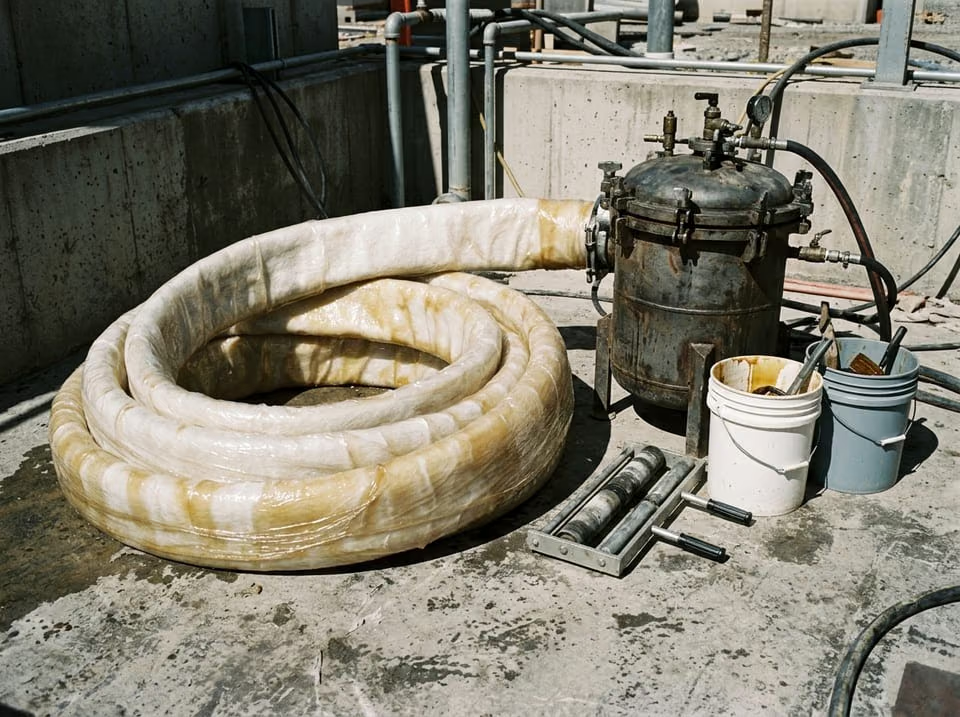
- Stage the liner and inversion drum on the driveway, as in the photograph above, and wet out the sleeve with resin
- Invert or pull the sleeve in, inflate it against the wall, and cure it
- Reopen each lateral connection with a robotic cutter
- Camera the finished bore and hand over the recording
The finished liner is typically 3 to 6 millimeters thick, so a lined 4-inch line loses a little diameter. Because the new surface is smooth where the cast iron it replaced was scaled and rough, flow in practice is generally equal or better.
What the liner is going into is usually original cast iron. Roughly 35% of South Florida living units built in the 1960s and 1970s went in with it, per bioresponsecorp.com, and PVC did not become standard in Florida residential construction until the late 1970s. The Cast Iron Soil Pipe Institute rates the material at 50 to 75 years; regional contractor reporting puts South Florida practice at 40 to 50. U.S. Census ACS 2024 five-year data, table B25034, puts the Hollywood median year built at 1969 and Fort Lauderdale’s at 1972. A pipe from that era that is scaled and pitted but still round is the ideal host, and there are a great many of them under Broward slabs.
The recording is included at both ends because lining has a hard eligibility gate, covered below, and because the finished bore is the only proof the liner covers what it was sold to cover. The homeowner keeps both files.
Can you repair a sewer line without digging it up?
A sewer line can be repaired without digging it up when a camera shows the existing pipe is still round, correctly graded and mechanically sound, because a cured-in-place liner rebuilds that pipe from the inside through a cleanout. It cannot be repaired without digging when the line has a belly, an offset joint or a collapse, since a liner preserves the existing grade, cannot cure across a step, and needs a host pipe to cure against. Eligibility is decided by the pipe rather than by the budget, and the camera settles it before any quote is meaningful.
| Host pipe condition | Can it be lined? | Why |
|---|---|---|
| Corroded, scaled, hairline-cracked, still round | Yes | The liner needs a shape to cure against, not a sound pipe |
| Root intrusion at joints, pipe otherwise intact | Usually | Roots are cut and jetted out first, then the joints are sealed by the liner |
| Bellied or back-pitched section | No | Lining preserves the existing grade, including the wrong grade |
| Offset joint or significant misalignment | No | The liner cannot bridge a step it has to cure across |
| Collapsed or crushed section | No | There is no host pipe left to line |
| Bottom corroded away (channeling) | Case by case | Depends how much wall remains to support the cure |
The rule, as a working plumber stated it on a trade forum: “You can only do trenchless if your sewer line has correct pitch and is mechanically sound.” That sentence is the whole gate. A lining quote issued before the line has been camera-inspected is a quote for something nobody has confirmed is possible.
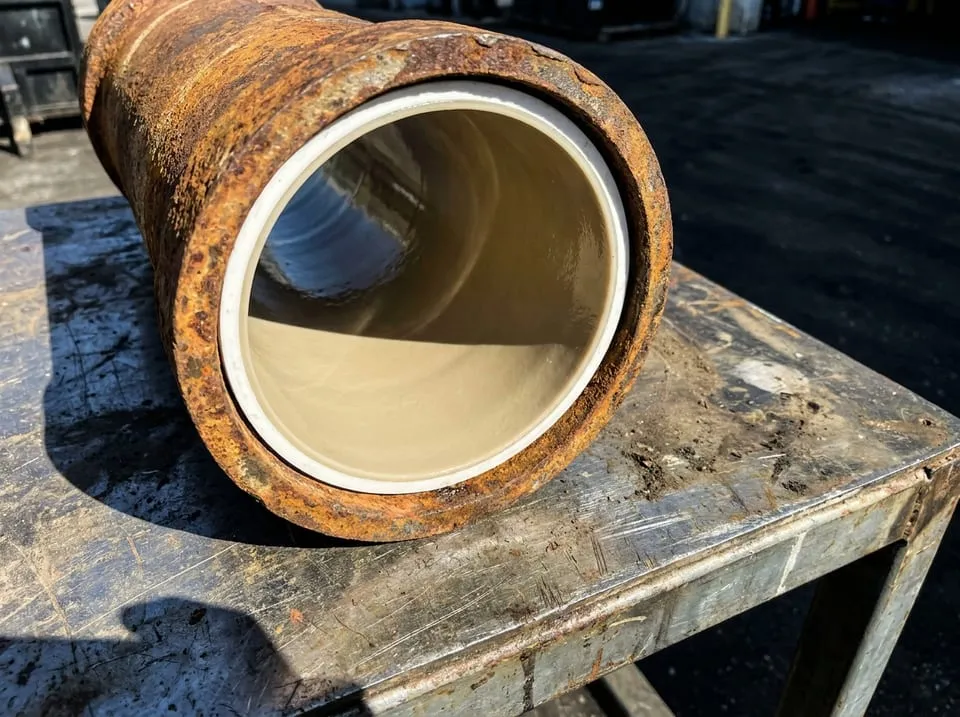
The cross-section in the photograph shows what a successful cure looks like: a smooth, continuous liner bonded inside a heavily tuberculated cast iron host. The host was scaled and pitted and still round, which is exactly the case lining was designed for. Had the host been channeled through, with the invert gone, there would have been nothing along the bottom for the liner to cure against, and that is the case-by-case row in the table.
The belly row is the one homeowners push back on, because a liner sounds like it should fix everything. A belly is a low point in the pipe where solids settle and water stands. A liner cured inside it is a smooth belly. The water still stands, the solids still settle, and the line still slows. The only fix for grade is to correct the grade, which means excavation or, sometimes, pipe bursting. We say replace in that case, and we lose the easier job.
Where lining is not the answer, the other trenchless option is pipe bursting: an expander head pulled through the old line, fracturing it outward while drawing new pipe in behind. It replaces rather than relines, can correct some offsets, and needs entry and exit pits plus enough soil to absorb the fragments, which makes it rarely practical under an interior slab. Florida’s Building Code specifies the replacement pipe as HDPE, SDR 17, conforming to ASTM F714, and requires the completed section to be inspected internally by video camera survey and approved by the code official.
To find out whether your line is a lining candidate, request a free quote. The camera run comes first, and the footage is yours whichever answer it gives.
How much does sewer pipe lining cost, and why do quotes vary so much?
Sewer pipe lining in South Florida is reported at roughly $80 to $250 per linear foot, the same territory as cast iron replacement, because a liner displaces the excavation cost rather than the pipe cost. Quotes vary because access, pre-cleaning, length, cure method and whether the run leaves the property line all move the price, and because some bids cover a different length of pipe than others. One Florida homeowner had 30 feet relined for $4,500 after a first company quoted $14,000 for the same job. In a market with that spread, a single bid is one company’s opinion of what the job is worth.
The homeowner who reported that spread put it in one line: “Pipe relining! No digging and I got 30’ relined for $4.5 grand. Get different quotes first company quoted $14 grand.” A three-to-one difference on identical footage is not explained by materials.
The variables that genuinely move the price:
- Access: whether a usable cleanout exists, or access pits have to be dug
- Length and diameter of the run, and how many lateral connections need reinstating with the robotic cutter
- Pre-cleaning: heavy scale or root mass means jetting and cutting before any liner goes in, reported at $400 to $900 for the jet
- Whether the run leaves the property line, which brings Broward County right-of-way restoration, a Road Cut and Restoration Permit, and as-builts signed and sealed by a Professional Land Surveyor registered in Florida into scope
- Cure method, since UV and steam systems cost more to mobilize than ambient cure
The reported figures, with their sources:
| Figure | Scope | Source |
|---|---|---|
| $80–$250 per linear foot | Cast iron work, South Florida | Regional contractor reporting |
| ~$10,000 | Average whole-home cast iron replacement | Regional contractor reporting |
| $4,500 vs $14,000 | Two quotes for the same 30-foot lining job | Homeowner report |
| $14,300 | 10 feet of under-slab replacement, 1964 Florida house, the excavation a liner avoids | Homeowner report |
| $5,000 to $40,000 | Observed range across sewer jobs | Plumber, public forum |
These are reported ranges, not our prices. The $14,300 row is the reason lining exists as a category: that figure is concrete, containment and floor rebuild for ten feet of pipe under a slab, and a liner through the cleanout touches none of it. Where the host pipe qualifies, the saving is the difference between those two rows.
What makes bids comparable is a written scope against the same recording:
- One camera inspection, recorded, shared with every bidder
- The total lateral length, and the exact length being lined
- Where the liner starts and terminates, and what happens at the connection to the main
- Pre-cleaning, cure method and lateral reinstatement as separate lines
- Whether the price stops at the property line
- The warranty term, and whether it covers the whole line or only the lined section
A plumber described the estimating reality: “No one can give you a price for this. I’ve seen sewer repairs cost $5000 and I’ve seen them cost $40,000.” That is true before the camera run and much less true after it. Get more than one bid on any job over about $5,000, and have every bidder quote against the same footage.
What are the disadvantages of CIPP lining?
The disadvantages of CIPP lining are that it cannot fix grade, cannot cross an offset, cannot cure where there is no host pipe, only protects the length it covers, reduces the bore by the liner’s 3 to 6 millimeter thickness, and, in Florida, has no residential approval path in the Building Code that this page has been able to verify. A liner sold without a camera run, or covering thirty feet of a fifty-foot lateral, is where most of the criticism of lining is earned. Where the host pipe qualifies and the coverage is complete, those disadvantages mostly do not apply.
The sharpest objection comes from within the trade: “If cast iron did not stop those roots what makes you think a liner will?” A cured liner is jointless, and roots enter at joints and cracks, so along the lined run the entry points cease to exist. The objection still lands where coverage is partial: a liner covering thirty of fifty feet leaves twenty feet of original joints, and one terminating short of the connection at the main leaves the most root-prone joint in the system untouched. So the questions that matter are about coverage: total lateral length, where the liner starts and ends, what happens at the connection, and whether the warranty covers the whole line or only the lined section. If those answers are vague, so is the warranty.
The disadvantages, stated plainly:
| Limitation | What it means on a Broward lateral |
|---|---|
| Preserves the existing grade | A lined belly is still a belly; standing water and settled solids remain |
| Cannot cure across a step | An offset joint is excavated and re-coupled or burst, never lined |
| Needs a host to cure against | A collapse, or channeling with the invert gone, has no host |
| Protects only the lined length | Every original joint outside the liner is still a root entry point |
| Reduces the bore slightly | 3 to 6 mm of wall; the smooth surface usually offsets it on scaled cast iron |
| Reinstated laterals are cut edges | The quality of each robotic cut matters, and the final camera run is where it shows |
The code question is the one this page will not fill by guessing. Florida’s Building Code, Plumbing Chapter 7, sets out an explicit path for trenchless pipe bursting: replacement pipe of HDPE, SDR 17, ASTM F714, with the completed section inspected internally by video camera survey and approved by the code official. We have not verified an equivalent residential CIPP approval path in the Florida Building Code, and this page does not assert one. Where a permit is involved, that question belongs to a Broward plans examiner and the answer should be in writing before the resin is mixed.
The commercial disadvantage is the one homeowners meet first: lining is the easier sale, so it gets sold to lines that do not qualify. A liner is a reasonable recommendation for a scaled, pitted, round cast iron pipe from 1969, and a poor one for the same pipe with a sag between 15 and 34 feet. The difference is only visible on camera, which is why we run the camera first, say which case the line is, and hand over the recording either way.
“If the footage shows a belly, we say replace. Lining it would be the easier sale and it would leave the standing water exactly where it is.”
The guarantee applies to the lined run. We Fix It Right the First Time or It’s Free: if the section we lined fails again from the same defect, we come back and redo the work at no charge, and the camera run of the finished bore is the baseline that settles it.
Frequently asked questions
Does relining actually stop tree roots, or will they come back?
A cured liner is jointless, and roots enter at joints and cracks, so along the lined run the entry points stop existing. The failure mode is partial coverage: a liner covering thirty of fifty feet leaves twenty feet of original joints for roots to find.
Can my sewer line be repaired trenchless, or does it have to be dug up?
Eligibility is decided by the pipe, not the budget. As one plumber put it, you can only do trenchless if the line has correct pitch and is mechanically sound. A bellied, offset or collapsed line cannot be lined. Camera footage settles it before any quote is meaningful.
How long does a sewer line replacement take?
A trenchless lining on a residential lateral is usually one or two days. An open-trench yard replacement typically runs two to four days including restoration. Under-slab replacement inside a house takes longer and often means moving out for part of it.
Should I get more than one quote for a sewer repair?
Yes, on any job over about $5,000. One plumber noted seeing sewer repairs cost $5,000 and $40,000, and one Florida lining job drew quotes of $4,500 and $14,000. Have every bidder quote against the same recorded camera footage so the bids are comparable.
Related services
- CIPP Pipe Lining: How It Works, What It Costs, and When It Will Not WorkCIPP lining pulls a resin-saturated felt sleeve into an existing sewer pipe, inflates it…
- Trenchless Sewer Repair Cost and Whether Your Line QualifiesTrenchless sewer repair cost prices against the excavation it avoids, since the method r…
- Cast Iron Pipe Replacement for South Florida HomesWe replace original cast iron drain lines in Broward County homes with PVC to current Fl…
- Sewer Camera Inspection: Cost, Process, and What the Footage ShowsA residential sewer camera inspection typically costs $150 to $400. A camera on a push r…