Sewer Camera Inspection in Broward County
We camera-inspect sewer lines for Broward County homeowners: a recorded run from the cleanout with a surface locate that marks each defect's distance and depth on the ground. You watch the monitor with us and the footage is yours, so any repair quote is written against known conditions. We Fix It Right the First Time or It's Free.
What does a sewer camera inspection in Broward County include?
A sewer camera inspection in Broward County includes a self-leveling camera head on a semi-rigid push rod run the length of the line from an exterior cleanout while a footage counter records distance, a surface locate that picks up the sonde in the camera head and puts a spray-painted mark and a depth on the ground above any defect, a report that names each finding with its distance, and the recorded video handed to the homeowner. It is the cheapest step in sewer work, reported at $150 to $400 and about an hour on site, and it determines every number after it.
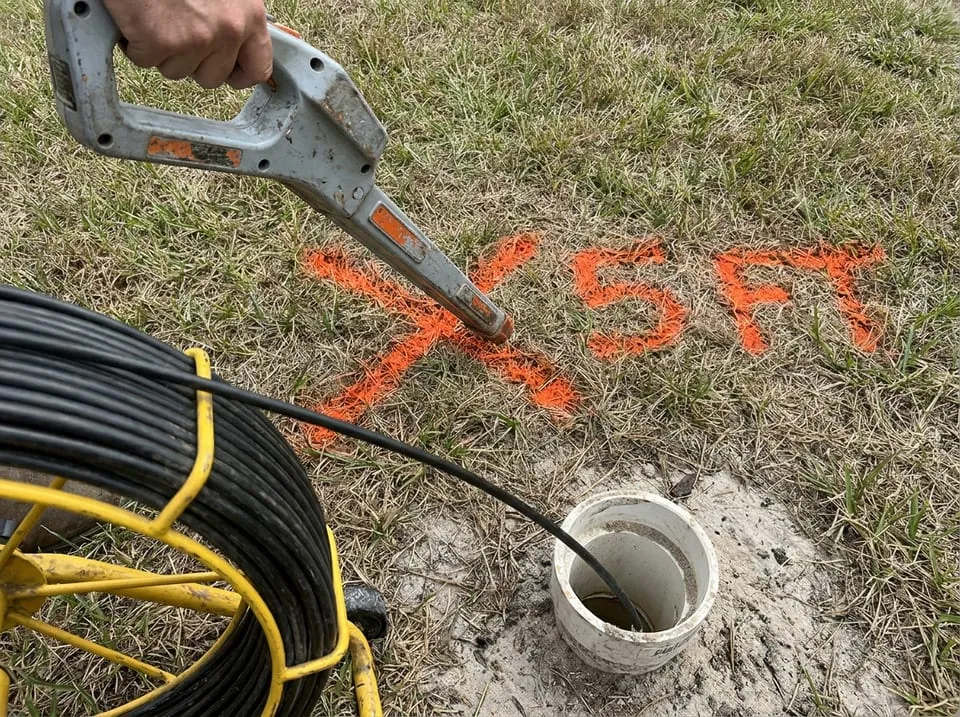
The locate is the half of the job that most often gets left out, and it is the half that saves money. A defect thirty-four feet down the line is useful information. A defect thirty-four feet down the line, five feet deep, four feet inside the sidewalk, is a location a crew can dig to and a utilities desk can rule on. Without the locate, a repair crew digs on an estimate. With it, the trench goes where the pipe is, and the photograph above is what that looks like: a paint mark and a depth figure on the grass with the locator wand over it.
What a report should name:
- Belly or sag: a low section holding standing water
- Offset: sections shifted apart at a joint
- Crack or fracture: a through-wall break, distinct from surface scale
- Root intrusion: roots entering through an existing opening
- Channeling: the bottom of a cast iron pipe corroded into a trough
- Scale: corrosion buildup narrowing the bore
- Collapse: the pipe no longer holding shape
“The line is bad” is not a finding. “Offset at 34 feet, five feet deep” is. So is “no cracks, offsets or root intrusion found,” which is the finding a homeowner with a fifty-year-old line most wants and least often gets in writing.
The order of work matters. A camera cannot see through standing water, a root mat or accumulated solids. On a blocked line, cabling or jetting comes first, at a reported $200 to $900 depending on the method, and the scope follows. Scoping a backed-up line produces footage of the backup and nothing useful.
Access is through an exterior cleanout where one exists. If none does, which is common on pre-1975 Broward houses, entry is through a pulled toilet or a roof vent. A toilet gives good access to the main run; a vent entry is awkward and sometimes impossible past traps and fittings. On a house without a cleanout, installing one is worth doing on the first visit, since it makes every future service call cheaper and faster.
On pipe bursting, Florida’s Building Code makes the post-work camera survey mandatory: the completed section shall be inspected internally by video camera survey and approved by the code official. On that job the final run is an obligation rather than a courtesy, and we treat every repair the same way.
What does a sewer camera inspection actually show?
A sewer camera inspection shows the inside of the pipe in real time and names a defect and its location: a belly or sag, an offset joint, a crack, root intrusion, channeling, scale, or a collapse, each with a distance from the cleanout, and each marked on the surface with a depth. It also shows what is not there, which on a fifty-year-old cast iron line is often the most valuable finding. Rust and scale alone are the expected condition of old cast iron and are not a verdict.
| What the report should say | What it should not say |
|---|---|
| “Offset at 34 ft, 5 ft deep” | “The line is bad” |
| “Belly between 15 ft and 34 ft, holding water” | “It looks old” |
| “Roots entering at a joint, 22 ft” | “There is root damage” |
| “No cracks, offsets or root intrusion found” | (silence on what was ruled out) |
The vocabulary is specific because each word maps to a different repair. A belly is a grade problem and can only be replaced, since a liner preserves the existing grade and cleaning cannot remove standing water from a low point. An offset cannot be lined either, because a liner cannot cure across a step; it is excavated and re-coupled or burst. A single crack with sound wall either side is a spot repair. Roots prove an opening already exists; a widely upvoted forum reply put it as “They can only get inside from a break in the pipe.” Channeling is lost wall along the invert, and channeling across several sections is a replacement. Scale on a round, graded pipe is a jetting job and then nothing.
Fifty-year-old cast iron looks alarming on video. It is dark, rough and heavily tuberculated, and it is easy to read that as terminal. A plumber reading exactly that kind of footage showed what a fair assessment sounds like: “Looks like a sag in the line between 15’ and 34’. Or it may be very flat and needs to be flushed and jetted. I didn’t see any cracks, offsets, or roots. Inside of cast iron pipes look like that and replacing due to rust isn’t a typical reason to replace them unless there’s a visible issue on the outside.” That is an old pipe reported as serviceable, with one specific concern at a specific distance and an explicit list of what was ruled out.
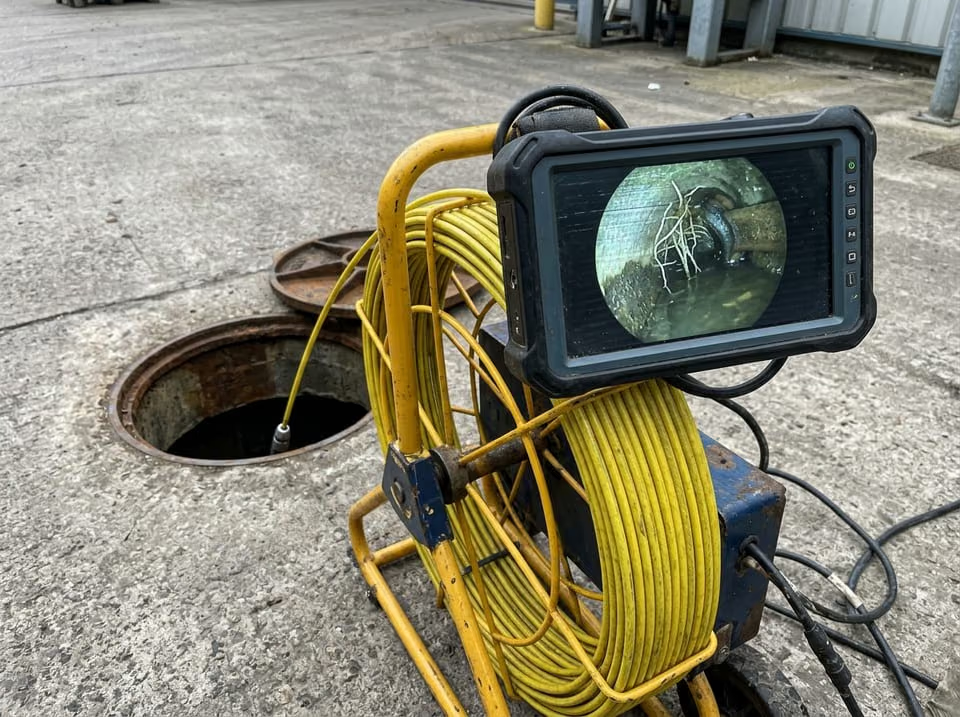
The monitor in the hero photograph shows the other common Broward finding: fine white root hairs pushing through a cast iron joint into standing water. That single frame carries three facts. There is an opening at that joint. There is a low point holding water just past it. And whatever cleaning clears the roots will need repeating until the joint is sealed or the section replaced, because the entry point remains.
Why so much Broward footage looks like that is a matter of age. The Cast Iron Soil Pipe Institute rates cast iron at 50 to 75 years; regional contractor reporting puts South Florida practice at 40 to 50. Roughly 35% of South Florida living units built in the 1960s and 1970s went in with cast iron, per bioresponsecorp.com, and U.S. Census ACS 2024 five-year data, table B25034, puts Hollywood’s median year built at 1969 and Fort Lauderdale’s at 1972. A camera run tells a homeowner which decade the pipe is in, as opposed to which decade the house was built. Two 1968 houses on the same street can be ten years apart in what the line looks like.
How long does a sewer camera inspection take?
A sewer camera inspection takes about an hour on a typical Broward residential lateral when the line is flowing and an exterior cleanout exists. The run itself is a slow push from the cleanout to the connection at the main, with pauses at every joint and defect to record distance, and a second pass with the surface locator to mark each finding on the ground. Pulling a toilet for access, or clearing a blocked line first, adds to the visit. The homeowner watches the monitor throughout and leaves with the recording.
What sets the time:
| Condition | Effect on the visit |
|---|---|
| Exterior cleanout present, line flowing | About an hour |
| No cleanout, entry through a pulled toilet | Adds the pull and reset |
| Roof vent entry | Awkward, slower, sometimes impossible past traps and fittings |
| Line blocked | Cable or jet first, then scope; a camera cannot see through standing water |
| Heavy scale or root mass | Jet first for usable footage |
| Long run to the main, or multiple defects to locate | More time on the locate pass |
The locate pass is the part not to rush. The camera head carries a sonde, and the technician walks the lawn with a receiver until it peaks over the head, then marks the spot and reads the depth. Repeated at each defect, that pass turns “the line is bad” into a set of paint marks a crew can dig to and a utilities desk can rule on. The City of Pembroke Pines Utilities FAQ states that lines from the meter to and within the dwelling are the property owner’s, and the City maintains lines on City property only; where exactly a marked defect falls relative to the sidewalk and the meter is what the homeowner takes to Utilities Customer Service at 954-518-9000.
The hour is also the reason the inspection comes before the quote rather than after it. A quote written before anyone has seen the line prices the contractor’s uncertainty. A plumber described the estimating problem honestly: “No one can give you a price for this. I’ve seen sewer repairs cost $5000 and I’ve seen them cost $40,000.” That spread is real before the run and much narrower after it, because length, depth, material, grade and the specific defect are then known conditions.
Pre-purchase inspections take the same hour and carry more weight. A buyer of a 1977 Florida house asked on a plumbing forum whether to walk away from cast iron under the slab, and the best reply was to get a video inspection to see the current state inside, rather than speculating from the outside. On a pre-1975 house under contract, an hour with a camera can identify a five-figure liability while the contract is still negotiable, and it produces the recording a second contractor, an inspector or a carrier can read.
A cleanout install, where none exists, is the one addition worth making to the first visit. It is a small job, and it turns every future scope and cleaning from a pulled-toilet job into a driveway job.
How much do plumbers charge to use a camera?
Plumbers in South Florida charge a reported $150 to $400 for a residential sewer camera inspection, and the price should include the surface locate, a report naming each defect with its distance and depth, and a copy of the recording. A camera run without the locate is a video of a problem with no address. A camera run without the recording is a diagnosis the homeowner has to take on trust. Both are worth asking about before booking, because the price is the same either way and the value is not.
Where the inspection sits in the reported cost stack across South Florida work and homeowner accounts:
| Scenario | What it involves | Reported range |
|---|---|---|
| Cleaning or jetting a blockage | No excavation; cable or hydro jetting through a cleanout | $200–$900 |
| Camera inspection | Scoping the line, locating and depth-marking the defect | $150–$400 |
| Spot repair, shallow yard line | Small excavation, cut out and replace a section, backfill and sod | $1,500–$4,000 |
| Spot repair, deep or under hardscape | Shoring, larger machine, driveway or paver rebuild | $4,000–$9,000 |
| Under-slab repair inside the house | Floor demolition, containment, plumbing, concrete and floor rebuild | $6,000–$18,000 |
| Full lateral replacement to the main | Long trench, possible right-of-way work, permits and restoration | $10,000–$30,000 |
These are reported ranges, not our prices. The shape of the table is the point: the inspection is the cheapest row and every row below it is priced by what the inspection finds. Depth, surface, position relative to the property line and the material of the pipe are all unknown until someone has seen the line, and a homeowner who spends a few hundred dollars finding out can save the difference between a $1,500 spot repair and a $14,000 quote for a job that turned out to be the wrong one.
What moves the price within the range: whether a cleanout exists or a toilet has to be pulled; whether the line needs cabling or jetting first, which is a separate charge; the length of the run; and whether a full locate pass is included. Some contractors run a camera at no charge as a lead-in to a repair quote; a widely upvoted landscaping-forum reply noted “Some of them will do it for free.” That is fine as long as the recording still leaves with the homeowner. A free scope whose footage stays with the plumber is a sales call.
Two things the fee does not include, and should not: a repair decision made on the spot, and a diagnosis without the footage. If the footage shows a defect, the repair is a separate quote written against the recording with excavation, restoration and permits as separate lines. If it shows an old pipe with no defect, the finding is “no cracks, offsets or root intrusion found,” in writing, and the visit ends there.
To have your line scoped, located and recorded, request a free quote. If you already have a quote from someone else, an independent run against the same line is the cheapest second opinion in the trade.
Should I buy a Florida house that still has cast iron pipes under the slab?
A Florida house with cast iron under the slab is worth buying when a camera inspection before closing shows the pipe round, graded, and free of cracks, offsets and roots, and worth renegotiating when it shows channeling, a belly, or a collapse. The pipe’s age alone is not the answer. A pre-1975 Florida house very likely has original cast iron, now at or past the 50-to-75-year life the Cast Iron Soil Pipe Institute publishes, and the only way to know which decade that pipe is in is to look inside it while the contract is still negotiable.
A buyer of a 1977 Florida house asked the question on a plumbing forum: “These cast iron pipes are under the slab. Should I run? Candidate for lining?” The best reply in the thread was to get a video inspection to see the current state inside, rather than speculating from the outside. That is the whole answer. The outside of the house says nothing about the inside of the pipe.
What the pre-purchase run produces, at a reported $150 to $400 and about an hour:
- A recording of the full lateral from the cleanout to the main, which the buyer keeps
- Each defect named, with a distance and a depth marked on the ground
- An explicit statement of what was ruled out
- A basis for a repair quote, if one is needed, that a second contractor can bid against
- A dated record of the line’s condition, which is worth having with the policy documents afterward
What it can find, and what each finding means for the contract:
| Finding | What it means |
|---|---|
| Scale and rust, pipe round and graded, nothing else | Expected condition of old cast iron; buy, and re-scope at the first symptom |
| One crack or roots at one joint | A planned spot repair or sectional liner, priced from the footage |
| Corroded but round and graded along the run | A lining candidate; a homeowner reported 30 feet relined for $4,500 |
| Belly, offset or collapse | Replacement of the run; a five-figure item to negotiate now |
| Channeling under the slab | The expensive case: one Florida buyer was quoted $14,300 for ten feet under a 1964 house |
That last figure is the reason the inspection belongs in the contract period. The seller in that thread would not negotiate, and the buyer walked. A buyer who finds the same thing after closing owns it. The reported South Florida range for cast iron work is $80 to $250 per linear foot, with whole-home replacement averaging near $10,000, and the under-slab portion is where those figures climb, because the price there is concrete, containment and floor rebuild.
The Florida-specific wrinkle is the carrier. A homeowner in the same forum thread noted that “insurers in Florida will look for any reason to charge more or drop coverage,” and buyers report carriers asking about original plumbing at binding. A recorded run dated before closing is the document that conversation starts from. This page states that as reported experience, not as insurance advice.
The one trust question that comes up on every pre-purchase run is whether the plumber holding the camera has an interest in what it finds. One homeowner’s answer was to hire a scope-only inspector “NOT part of a plumbing company.” That works. The simpler version is to require the recorded file from whoever runs it, since a recording can go to a second contractor for an independent read.
“The homeowner watches the monitor with us and keeps the file. If the line is fine, we say the line is fine.”
Where the footage does lead to a repair, the guarantee applies to it. We Fix It Right the First Time or It’s Free: if the section we repaired fails again from the same defect, we come back and redo the work at no charge.
Frequently asked questions
Should cast iron drain pipes be replaced?
Not automatically. Surface rust and scale are the expected condition of fifty-year-old cast iron and are not a verdict. Replacement is indicated by a named defect: channeling across multiple sections, a belly, an offset, or a collapse. A single crack in sound pipe is repairable.
Can a sinking spot in the yard mean a broken sewer line?
Yes, and it is one of the clearest signs. When a line breaks below grade, sandy fill washes into the pipe and is carried away, leaving a void that settles at the surface. A depression following the line's route toward the street warrants a camera inspection.
How do I know a plumber isn't inventing a problem to sell me a big job?
Require a copy of the recorded camera footage. A recording can be sent to a second contractor for an independent read, which removes most of the asymmetry. Some homeowners hire a scope-only inspector who is not part of a plumbing company, which also works.
Related services
- Sewer Camera Inspection: Cost, Process, and What the Footage ShowsA residential sewer camera inspection typically costs $150 to $400. A camera on a push r…
- Broken Sewer Line: What the Signs Look Like in a Florida HomeA broken sewer line shows itself through repeat backups, a persistent sewer smell at flo…
- Cast Iron Pipe Repair: When Repair Beats ReplacementCast iron can be spot-repaired when the defect is isolated and the surrounding pipe stil…
- Sewer Line Repair in Broward CountyWe repair sewer lines for Broward County homeowners, from a single cracked section to a…
- Sewer Smell in the Bathroom: What Causes It and What to Check FirstA sewer smell in a bathroom almost always means drain gas is escaping into the room inst…