Hydro Jetting in Broward County
We hydro jet main sewer lines for Broward County homes, scouring scaled cast iron, grease and root mass back to the pipe wall instead of boring a hole through it. Every jetting is followed by a recorded camera inspection, and the footage is yours, so you know whether it will come back. We Fix It Right the First Time or It's Free.
What does hydro jetting in Broward County include?
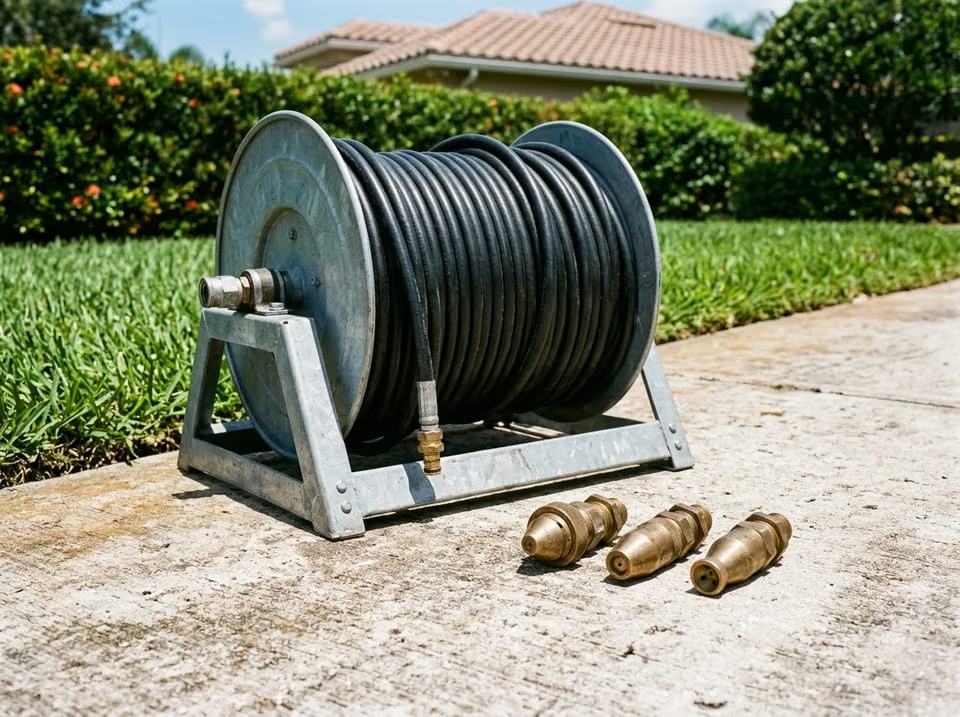
Hydro jetting in Broward County includes setting up a high-pressure water reel at an exterior cleanout or a pulled toilet, running a rearward-facing nozzle the full length of the main line to scour scale, grease and roots off the pipe wall, flushing the debris out, and then a recorded camera inspection of the clean bore with a surface locate for any defect the jet exposed. Cabling and jetting are both called drain cleaning and they do different things. The difference decides whether a line stays clear for a month or a season, and on Broward’s original cast iron it is usually the jet.
| Cable / auger | Hydro jetting | |
|---|---|---|
| What it does | Bores through the obstruction | Scours the full bore to the pipe wall |
| On roots | Removes the mat, leaves the roots | Cuts and flushes the mass out |
| On grease | Punches through | Strips it from the wall |
| On cast iron scale | Little effect | Removes buildup |
| Typical reported cost | $200–$450 | $400–$900 |
| Typical duration of the fix | Weeks to months | A season or longer |
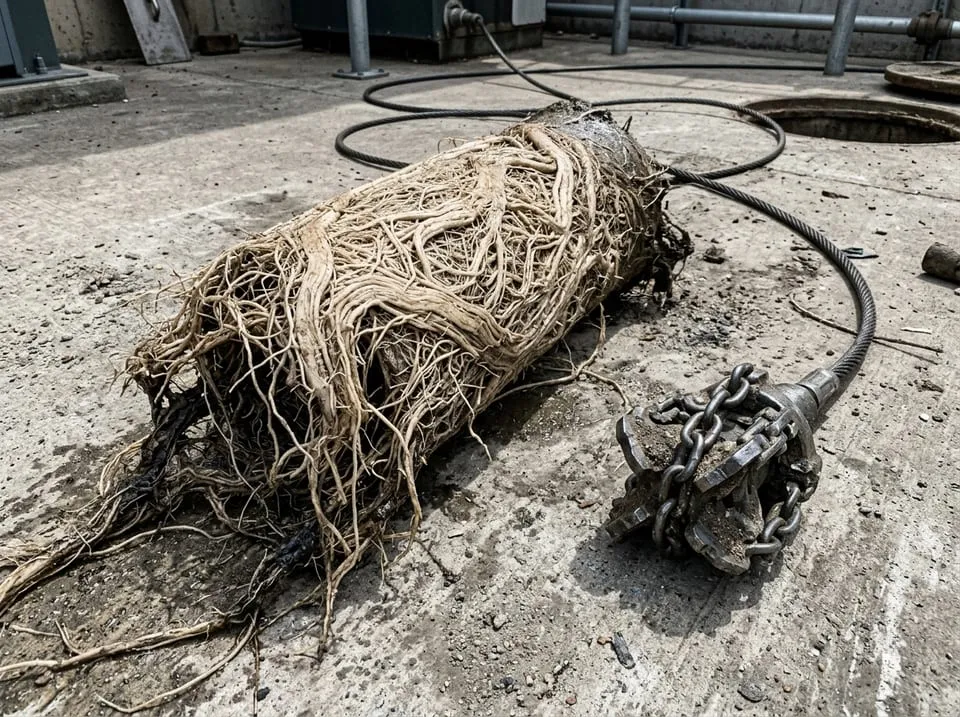
A cable is the right tool for a soft blockage in an otherwise clean line, and it is faster and cheaper. Jetting is the right tool when the pipe wall itself is the problem, which, in pre-1980 Broward housing with original cast iron, it usually is. The root mass in the photograph above is what a jet with a root nozzle brings out of a four-inch line; it still holds the shape of the pipe it was cut from, and a cable would have bored a channel through the middle of it and left the rest.
The visit, in order:
- Confirm the main line is the problem, by checking whether two fixtures interact
- Access through an exterior cleanout, or a pulled toilet on older houses without one
- Jet the run with the nozzle matched to the cause: penetrating for grease and scale, rotating or chain for roots
- Flush the debris to the main and confirm flow at every fixture
- Camera-inspect the clean bore and locate any defect on the surface, at a reported $150 to $400
- Hand over the recording and say whether the blockage will come back
The camera step is included because jetting is also the step before an inspection can mean anything. A camera cannot see through standing water, a root mat or accumulated solids. On a blocked or heavily scaled line, jetting is what makes the inspection useful: clear the line, then scope it, then decide on a repair. Doing it the other way round produces footage of the blockage and nothing else.
On older Broward houses without a cleanout, installing one is worth adding to the first visit. It makes every future jetting and camera run cheaper and faster than pulling a toilet.
Jetting has limits that are set by the pipe rather than the machine, and they are covered below. A judgment about whether a channeled cast iron line has enough wall left to take the pressure is made from footage, not from the truck.
Why is every drain in my house slow?
Every drain in the house is slow because the pipe they all share, the main line, has narrowed, and on a Broward house built before about 1975 the usual reason is the inside of a fifty-year-old cast iron pipe. A single slow sink is a trap or a branch. Every fixture slow at once, with the lowest one slowest, is the main. On original cast iron the bore is rough and scaled, so lint, grease and paper catch on that roughness continuously and the line does not so much block as gradually close. Cabling reopens a channel through whatever has collected. Jetting takes the bore back toward the pipe wall.
The material explains the pattern. The Cast Iron Soil Pipe Institute rates cast iron at 50 to 75 years of service, and regional contractor reporting puts South Florida practice nearer 40 to 50, because the ground here is damp sand with a high water table and the pipe corrodes from the soil side as well as from the sewage side. Inside, hydrogen sulfide from sewage is converted by bacteria to sulfuric acid at the pipe crown. The result after five decades is a bore lined with tuberculation, layered rust nodules that narrow the opening and catch everything that passes.
How much of Broward is in this condition is a matter of record. Roughly 35% of South Florida living units built in the 1960s and 1970s went in with cast iron, per bioresponsecorp.com, and PVC did not become standard in Florida residential construction until the late 1970s. U.S. Census ACS 2024 five-year data, table B25034, puts the median year built at 1969 in Hollywood, 1968 in Lighthouse Point, 1971 in Wilton Manors and 1972 in Fort Lauderdale and Oakland Park. Pembroke Pines, at a 1992 median, mostly has PVC, and slow drains there are more often roots or a belly than scale.
What is on the wall, and what each treatment does to it:
| What has built up | Cable | Jet |
|---|---|---|
| Scale and tuberculation on cast iron | Little effect | Removes buildup back to the wall |
| Grease cooled along the pipe | Punches a channel | Strips it from the wall |
| Root mat at a joint | Removes the mat, leaves the roots | Cuts and flushes the mass |
| Wipes and non-flushables | Clears them | Clears them |
| Solids settled in a belly | Clears them; the belly refills | Same |
Two of those rows do not get fixed by either tool. A belly is a low point in the pipe, and solids settle there no matter how clean the bore is. Channeling, where the bottom of the cast iron has corroded into a trough, is lost wall, and no amount of cleaning puts it back. Both are found by the camera after the jet, and both are the reason a slow-drain call on a 1960s house sometimes ends in a repair quote rather than a cleaning invoice.
The honest statement of what jetting does on old cast iron: it restores the bore to whatever wall is left, which on a pipe that is scaled but round buys a season or more of normal drainage. On a pipe that has lost its bottom it buys less, and the camera says which.
How do I know if my main drain line is clogged?
The main drain line is clogged if two fixtures affect each other: run one and watch a different, lower one. If flushing a toilet makes a tub gurgle or fill, the restriction sits downstream of both, and the only pipe they share is the main. A washing machine is the most reliable trigger, because it discharges 15 to 30 gallons through a pump in under a minute, faster than any other fixture delivers water. A single slow sink with nothing else affected is that fixture’s trap or branch, and jetting the main would not touch it.
| What you see | Where the blockage is |
|---|---|
| One sink slow, nothing else affected | That fixture’s trap or branch |
| Flush the toilet, the tub or shower gurgles or rises | Main line, downstream of both |
| Run the washing machine, the tub or floor drain backs up | Main line |
| Every fixture slow, lowest drain backs up first | Main line, likely well downstream |
| Toilet bubbles and the water level drops on its own | Venting or main line partially blocked |
Gravity decides where the evidence shows up. Waste backs out at the lowest opening below the blockage, which in a Florida slab home means a first-floor shower pan, a tub, or a laundry floor drain rather than the toilet that caused it. There is no basement floor drain here to absorb it, so a main line problem tends to announce itself on a finished floor, which is the argument for acting at the gurgle stage.
Once the main is confirmed, the order of work is fixed by what a camera can and cannot see. A camera run into a blocked line records standing water and debris and nothing else. So the line is opened first, by cable for a soft obstruction or by jet for scale, grease and roots, and then scoped. The recorded run names the cause and a surface locator marks its distance and depth on the ground. That recording is the homeowner’s, and it is what separates a clog from a defect.
The distinction matters because five of the common causes are pipe problems producing clogs:
- Tree roots entering through cracks and joints, then catching solids and building a mat. Roots cannot penetrate sound pipe; a widely upvoted forum reply put it as “They can only get inside from a break in the pipe.” In older Broward neighborhoods with mature ficus, live oak, black olive and palms along the property line, this is the most common cause.
- Scale and channeling in cast iron, a rough bore that catches what a smooth pipe carries away.
- A belly or sag holding standing water, so solids settle at the low point.
- Grease cooled and hardened along the wall, narrowing the bore over months.
- An offset joint or partial collapse, where the pipe itself has moved.
Wipes and non-flushables are the one cause that is only a clog. Everything else on that list means the jet restores flow and the camera finds the reason it will be needed again. The frequency test says which case a house is: a line jetted once and quiet for years was dirty; a line jetted twice in a year has something wrong with the pipe, and repeat jetting is a subscription rather than a repair.
To have a line jetted and scoped in one visit, request a free quote.
How do I fix a slow draining drain?
A slow draining drain is fixed by clearing what is in the pipe and then finding out why it was there, and the second step is the one that decides whether the fix holds. For a single fixture, the trap and branch are cleared locally. For every drain in the house, the main line is jetted back to the pipe wall, then camera-inspected, then either left alone because it was dirty or repaired because it was defective. Jetting is the wrong tool in four situations, and all four are identified from footage rather than from the truck.
Where jetting is the wrong answer:
- A belly holding standing water. Jetting clears the debris; the low point remains and refills. The fix is replacing the bellied run, since lining preserves the existing grade including the wrong one.
- An offset or collapsed section. Water pressure does not correct pipe geometry. The fix is excavation and re-coupling, pipe bursting, or replacement.
- Badly channeled cast iron with little wall left. Jetting a pipe that has lost most of its bottom risks making the situation worse. That is a judgment made from footage, and it is why we scope a line that has been cleared before rather than jetting it again on request.
- A line that blocks again within months. That is a defect, and repeat jetting is a standing appointment rather than a repair.
The honest test of whether a cleaning worked is frequency. A line jetted once and quiet for years was dirty. A line jetted twice in a year has something wrong with the pipe, and a camera run is the way to name it. If a house has been on an annual clearing schedule, the useful next step is the inspection, not another clearing.
What the camera finds after a jet decides the next step:
| Finding | Next step |
|---|---|
| Clean bore, pipe round and graded, no defects | Nothing. Re-scope at the next symptom. |
| Roots at one joint, pipe otherwise sound | Sectional liner, or excavate and re-couple |
| Roots at several joints, pipe otherwise sound | Full-length lining |
| Scale removed, channeling exposed in one section | Spot repair of that section |
| Belly or offset | Replacement of the affected run |
| Channeling across multiple sections | Replacement |
The cost ladder runs the same direction. Reported South Florida ranges put a cable at $200 to $450, jetting at $400 to $900, and a camera run at $150 to $400. A repair, where the footage calls for one, runs from a reported $1,500 to $4,000 for a shallow yard spot repair up to five figures under a slab. That ladder is why clearing without scoping is false economy on an old line: a homeowner paying for a jet every spring is managing a defect indefinitely at a few hundred dollars a visit while a root wedged in a crack levers it steadily wider.
Chemical drain cleaners and boiling water do not belong on this list at all for a main line problem. They act on the fixture drain they are poured into, and the restriction is forty feet away in a four-inch pipe under the slab. Chemicals in a line that then has to be cabled or jetted make the water hazardous for the crew.
“We jet, then camera, then tell the homeowner whether it will come back. Cleaning a root line every spring is not a service, it is a standing appointment.”
The guarantee covers the repair the footage leads to. We Fix It Right the First Time or It’s Free: if the section we repaired fails again from the same defect, we come back and redo the work at no charge, and the recording from the first visit is what settles whether it is the same defect.
Frequently asked questions
Why does my bathtub back up when I wash clothes?
A washing machine pumps 15 to 30 gallons through in under a minute, faster than any other fixture. That volume overwhelms a partly blocked line. Because the tub and the washer only share pipe downstream, water appearing in the tub places the blockage in the main line.
Should I call a plumber for a gurgling toilet?
If only that toilet gurgles when flushed, the problem is local and small. If a shower, tub or floor drain reacts when the toilet is flushed, two fixtures are interacting and the restriction is in the main line. That case is worth clearing before it backs up.
How do I know if my main drain line is clogged?
Run one fixture and watch a different, lower one. If flushing a toilet makes a tub or shower gurgle or rise, or the washing machine sends water up a floor drain, the restriction sits in the pipe both fixtures share, which is the main line. A single slow sink with nothing else affected is that fixture's own trap or branch.
What actually fixes tree roots in a sewer line for good?
Only repairing the opening they came through. Roots cannot penetrate sound pipe, so finding roots means finding an existing crack or failed joint. Jetting and cutting remove the mass; lining the run or replacing the section removes the entry point. Clearing alone is a delay.
Related services
- Main Sewer Line Clog: How to Tell It From a Single Blocked DrainA clog in the main sewer line affects more than one fixture and backs up at the lowest d…
- Tree Roots in a Sewer Line: What Gets Them Out and Keeps Them OutTree roots cannot penetrate sound sewer pipe. They enter through a crack, a failed joint…
- Main Sewer Line Cleaning in Broward CountyWe clear main sewer lines for Broward County homes where two fixtures back up together,…
- Sewer Camera Inspection Cost and What the Footage ShowsA residential sewer camera inspection typically costs $150 to $400. A camera on a push r…
- Sewer Line Root Removal in Broward CountyWe remove tree roots from sewer lines in Broward County homes by hydro jetting with a ro…