Sewer Line Root Removal in Broward County
We remove tree roots from sewer lines in Broward County homes by hydro jetting with a root nozzle or mechanical cutting, then camera-inspect the cleared line and hand you the recording, because roots only enter where the pipe is already open. The repair of that opening is quoted against the footage. We Fix It Right the First Time or It's Free.
What does sewer line root removal in Broward County include?
Sewer line root removal in Broward County includes cutting and flushing the root mass out of the main line, usually by hydro jetting with a root nozzle or a rotating cutter head on a cable, restoring flow at every fixture, and then a recorded camera inspection with a surface locate to find the opening the roots came through. The removal is half the job. The opening they entered through is the other half, because roots do not bore through cast iron or PVC; they follow moisture, and a sewer line only releases moisture where it is already open. Removing the roots restores flow. The opening stays, and roots return to it.
A widely upvoted forum reply states the causal fact plainly: “Definitely roots. They can only get inside from a break in the pipe.” So finding roots is finding a crack, a failed joint, or a corroded section, and a root job comes with a repair conversation rather than just an invoice.
How the removal is done:
- Hydro jetting with a root nozzle: cuts and flushes the mass out, the most thorough option, at a reported $400 to $900
- Mechanical cutting with a rotating root-cutter head or chain knocker on a cable, at a reported $200 to $450, which removes the mat and leaves the roots in the crack
- Foaming root herbicide: kills root tissue in contact with the foam, typically holding a year or so and requiring repetition
- Camera inspection immediately afterward, at a reported $150 to $400: the only way to see the entry point now the mat is gone
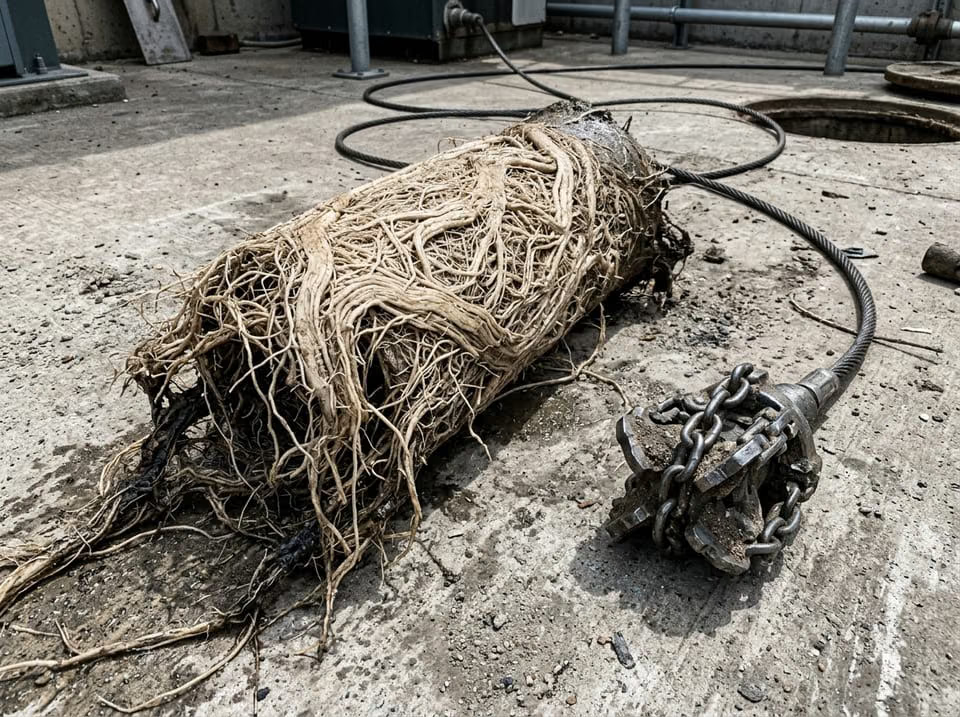
The camera step is where the value is. With the roots cleared, the opening they used becomes visible and locatable, and the repair can be scoped. The mass in the photograph above still holds the cylindrical shape of the four-inch pipe it was cut from, which is what a jet brings out of a line that a cable would only have bored a channel through.
In Broward the usual sources are ficus, live oak, black olive and palms, all with aggressive lateral roots, planted along property lines where the lateral tends to run. The pipe they find is usually original cast iron: roughly 35% of South Florida living units built in the 1960s and 1970s went in with it, per bioresponsecorp.com, and the Cast Iron Soil Pipe Institute rates the material at 50 to 75 years, with regional contractor reporting putting South Florida practice at 40 to 50. A joint that has been in damp sand since 1969 has had time to open.
Access is through an exterior cleanout where one exists, or a pulled toilet where it does not. On an older house without a cleanout, installing one on the first visit makes every future root job and camera run cheaper. The recording leaves with the homeowner, and it is the document any repair quote is written against.
What actually fixes tree roots in a sewer line for good?
Only repairing the opening they came through fixes tree roots in a sewer line for good. Jetting and cutting remove the mass and restore flow; lining the run or replacing the section removes the entry point. Clearing alone is a delay, because the crack or failed joint stays where it is and the roots find it again within a season or two. Which repair applies depends on what the camera finds after the mat is gone: roots at one joint in round, graded pipe is a sectional liner or a re-coupled joint, and roots plus an offset or a belly is a replacement of the affected run.
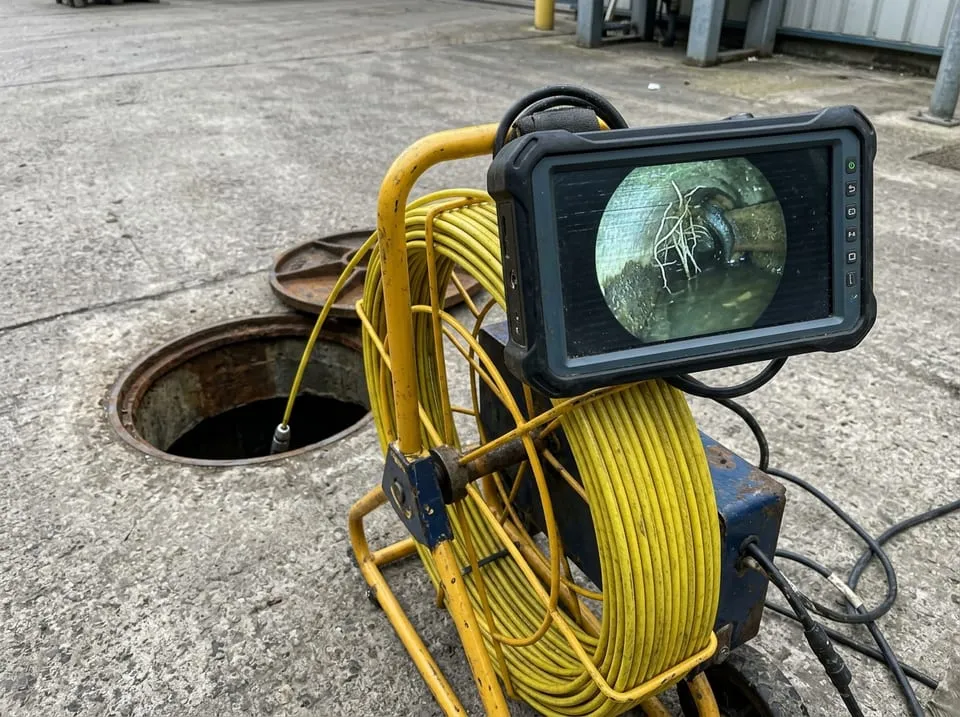
The monitor in the photograph shows the finding that decides the job: fine white root hairs pushing through a cast iron joint into standing water. That frame carries three facts. There is an opening at that joint. There is a low point holding water just past it. And whatever clears the roots will need repeating until the joint is sealed or the section replaced.
| Finding | Options |
|---|---|
| Roots at one joint, pipe round and graded | Sectional liner, or excavate and re-couple |
| Roots at several joints, pipe otherwise sound | Full-length lining |
| Roots plus an offset joint | Excavation or pipe bursting (a liner cannot cure across a step) |
| Roots plus a belly | Replacement of the affected run |
| Roots plus channeled cast iron | Replacement |
What each treatment does, and how long it holds:
| Treatment | What it removes | How long it holds |
|---|---|---|
| Cable or auger | Punches through the mat, pulls some root back | Months |
| Hydro jetting with a root nozzle | Scours the full bore back to the pipe wall | A season or two |
| Foaming root herbicide | Kills root tissue in contact with the foam | A year or so, if repeated |
| Lining the section | Seals the entry points along the lined run | Long-term, if the run covers the defect |
| Excavate and replace the section | Removes the defective pipe entirely | Permanent for that section |
The first three treat the symptom. The last two treat the cause. That is not a criticism of jetting: clearing the line is the necessary first step, because a camera cannot see through a root mat and no repair can be scoped until the line is clear.
The pattern to avoid is the annual clearing. A root clearing every spring on the same line is a defect being managed indefinitely at a few hundred dollars a year while the root wedged in the crack levers it steadily wider. The opening that admitted a root hair becomes an opening that admits soil, and in Broward’s sandy fill that turns a repairable joint into a section that has washed out beneath the slab or the lawn. The cost ladder runs the other way: repeat clearings at a reported $200 to $900 a visit against a sectional liner or a spot repair, reported at $1,500 to $4,000 for a shallow yard line, that removes the entry point once.
The eligibility rule for the lining option comes from a working plumber: “You can only do trenchless if your sewer line has correct pitch and is mechanically sound.” Root intrusion on a pipe that is otherwise round and correctly graded is a good lining candidate. Root intrusion on a pipe that has already been levered apart into an offset joint is not, because the liner cannot cure across the step. The camera settles which case a line is, and the recording is the homeowner’s.
Does relining actually stop tree roots, or will they come back?
A cured liner stops tree roots along the run it covers, because the liner is jointless and roots enter at joints and cracks, so along the lined section the entry points stop existing. Roots come back where coverage is partial: a liner covering thirty of fifty feet leaves twenty feet of original joints for roots to find, and a liner that stops short of the connection at the main leaves the most root-prone joint in the system untouched. Whether relining stops roots is a question about coverage and termination, not about the product.
The strongest objection to lining a root-damaged line comes from within the trade. A plumber on a trade forum put it directly: “Anyone here saying lining is not a seasoned plumber. If cast iron did not stop those roots what makes you think a liner will? Your decision to make is to have it dug up and replaced, or use root killer and have it snaked with chain knockers every couple years.” The objection deserves a straight answer, and it gets one.
The technical answer is that cast iron did not stop the roots because cast iron has joints, and after fifty years in damp sand those joints have opened. A cured-in-place liner is a single continuous tube from where it starts to where it ends. Roots follow moisture, and a jointless liner does not leak it. Along the lined run the objection does not hold.
Where the objection lands, and lands fairly, is everywhere the liner is not:
- Partial length. Thirty feet lined on a fifty-foot lateral leaves twenty feet of original joints, and roots will find whichever joint is left.
- The connection at the main. A liner that terminates short of it leaves the single most root-prone joint in the system in place.
- The house end. A liner that starts past the first joint under the slab leaves that joint open.
- Lateral connections. Each reopened branch is a cut edge, and the quality of that reinstatement matters.
So the questions that decide whether lining solves a root problem are about coverage:
- What is the total length of the lateral, and how much of it is being lined?
- Where does the liner start and where does it terminate?
- What happens at the connection to the main?
- Does the warranty cover the whole line or only the lined section?
If those answers are vague, so is the warranty. A homeowner reported 30 feet relined for $4,500 after a first quote of $14,000 for the same job, and the difference between those two quotes was almost certainly not the felt. Ask what length each bid covers.
The plumber’s alternative, dig it up and replace it, is the correct answer in a specific case: roots plus an offset joint, a belly, or channeled cast iron. A liner preserves the existing grade and cannot cure across a step, so a line the roots have already levered apart is a replacement, and the camera is what finds that. Reported South Florida figures for that class of work run $80 to $250 per linear foot.
The other alternative, chain knockers every couple of years, is the annual clearing under a different name, and the section above says what it costs over time.
If roots have been cleared from your line before, request a free quote for a clear-and-scope that finds the opening rather than clearing the mat again.
Why would my yard smell like sewage?
A yard smells like sewage when a sewer line below it is leaking wastewater into the soil, and on a Broward house the usual reason is a crack or failed joint that roots have been working at for years. The same forum reply that names the cause of root intrusion names the smell: “They can only get inside from a break in the pipe. The dirt around the break will smell like death.” The smell is the break announcing itself above ground. A wet spot that does not dry, a strip of greener grass along the line’s route, or a sinking patch in the same place are the other signs of the same leak.
The sinking sign is the one specific to here. When a line breaks below grade in Broward’s sandy fill, soil washes into the pipe and is carried away, leaving a void that settles at the surface. A widely upvoted landscaping-forum reply gave the right instruction for that case: “Get a plumber to run a camera through your line and see if it’s broken or sinking.” Florida’s Building Code, Plumbing Chapter 7, writes its material rules for exactly this ground: on filled or unstable ground the building sewer must conform to a standard for ABS, cast iron, copper or copper-alloy, PVC or PP pipe.
The Florida failure signature, since these houses are slab-on-grade and the basement guidance on national websites does not apply:
- A sinking or soft strip in the yard along the line’s route toward the street
- Sewer odor rising through slab joints, a floor drain, or an unused guest bathroom
- Drain flies indoors with no obvious source
- Repeat backups at the lowest fixture, or a shower pan that fills when the toilet is flushed
- A backup that arrives with heavy rain, because a high water table pushes groundwater into a cracked pipe
- A floor area that sounds hollow underfoot
Roots and the smell arrive together because they come from the same opening, and the sequence is the same in every case. A hairline crack, a joint that has shifted, or a corroded section releases moisture and nutrient vapor into the surrounding soil. Fine root hairs grow toward it and through it. Inside the pipe they thicken into a mat that catches paper and solids, and the root itself thickens inside the crack, levering it wider, so the opening that admitted a root hair becomes an opening that admits soil and releases sewage. The smell in the yard is that last stage.
What to do is a camera run with a surface locate, after the line is jetted if roots have closed it. The locate puts a paint mark and a depth on the lawn above the break, which is what a crew digs to and what a homeowner takes to the utilities desk if the mark is near the sidewalk. The City of Pembroke Pines Utilities FAQ states that lines from the meter to and within the dwelling are the property owner’s, and that the City maintains lines on City property only; Utilities Customer Service at 954-518-9000 answers where a specific address stands.
Ownership and insurance are separate questions. Standard policies generally treat root intrusion, corrosion and wear as maintenance rather than sudden accidental loss, which is one more reason to fix a root-cracked joint on a planned schedule rather than after it has washed out.
“Roots tell us where the break is. We jet it, scope it, and mark the depth and distance, so the homeowner knows what is actually being repaired.”
The guarantee covers that repair. We Fix It Right the First Time or It’s Free: if the section we repaired fails again from the same defect, we come back and redo the work at no charge. Roots finding a different opening forty feet further along an untouched run of old cast iron is a second defect in a different place, and the recording from the first visit is what shows the difference.
Frequently asked questions
What are the warning signs of a broken sewer line in a Florida home?
Florida homes are slab-on-grade, so the signs differ from basement guidance. Look for a sinking or soft strip in the yard along the line, sewer odor rising through slab joints, drain flies indoors, repeat backups, and a floor area that sounds hollow underfoot.
What does a sewer camera inspection actually show?
It names a defect and locates it. The vocabulary is specific: belly or sag, offset joint, crack, root intrusion, channeling, scale, collapse. A surface locator marks the position and depth on the ground. Rust and scale alone on old cast iron are expected, not a verdict.
Can a sinking spot in the yard mean a broken sewer line?
Yes, and it is one of the clearest signs. When a line breaks below grade, sandy fill washes into the pipe and is carried away, leaving a void that settles at the surface. A depression following the line's route toward the street warrants a camera inspection.
What actually fixes tree roots in a sewer line for good?
Only repairing the opening they came through. Roots cannot penetrate sound pipe, so finding roots means finding an existing crack or failed joint. Jetting and cutting remove the mass; lining the run or replacing the section removes the entry point. Clearing alone is a delay.
Related services
- Tree Roots in a Sewer Line: Why They Get In and What Stops ThemTree roots cannot penetrate sound sewer pipe. They enter through a crack, a failed joint…
- Hydro Jetting for Broward County Sewer LinesWe hydro jet main sewer lines for Broward County homes, scouring scaled cast iron, greas…
- CIPP Pipe Lining: How It Works, What It Costs, and When It Will Not WorkCIPP lining pulls a resin-saturated felt sleeve into an existing sewer pipe, inflates it…
- Broken Sewer Line: What the Signs Look Like in a Florida HomeA broken sewer line shows itself through repeat backups, a persistent sewer smell at flo…