Sewer Line Repair in Hallandale Beach
Sewer line repair in Hallandale Beach starts with a camera inspection and a surface locate, and the recorded footage is yours. We quote in writing, then clear, spot repair, line or replace what the camera named, on whichever side of the condo boundary it sits. The median year built here is 1975. We Fix It Right the First Time or It's Free.
- Golden Isles
- Three Islands
- Hallandale Beach Original Section
- Diplomat
- Layne Boulevard
- Foster Road
What does sewer line repair in Hallandale Beach involve?
Sewer line repair in Hallandale Beach involves establishing whose pipe the problem is in, clearing the line if it is blocked, scoping it on camera once it flows, locating any defect from the surface with a distance and depth marked on the ground, handing the recorded footage to the owner, and quoting in writing for the narrowest repair the footage supports: a cleaning, a spot repair, a full-length liner, or a replacement. The boundary question comes first because Hallandale Beach is one of Broward’s densest and most condo-heavy cities, and a backup in a unit is often caused in a pipe the unit owner does not control.
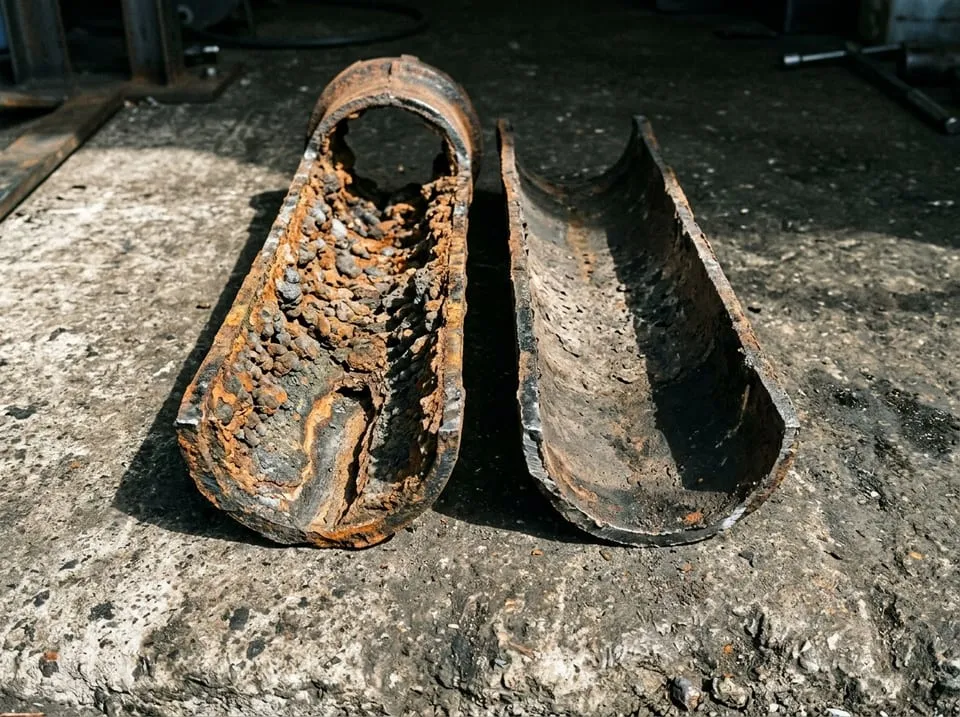
The U.S. Census Bureau’s American Community Survey 2023 5-Year Estimates, tables B25034 and B25035, give Hallandale Beach 29,019 housing units, a median year built of 1975, 68.4% built before 1980 and 30.6% before 1970. Almost a third of the housing predates 1970, which puts it in the cast iron era. PVC became standard in Florida residential construction in the late 1970s, and the Cast Iron Soil Pipe Institute rates cast iron at 50 to 75 years of service, with South Florida practice nearer 40 to 50 given the damp sandy ground. A 1960s house in the Original Section is inside that window on either figure.
The older sections near the beach add a specific factor: they sit low, close to sea level, on fill, with a high water table. That accelerates external corrosion along the whole length of a buried iron line, because the sand around it never dries out, and it means a cracked line takes on groundwater during heavy rain. A backup that arrives with a storm in Golden Isles or on Three Islands is good evidence of a break rather than a blockage. Florida’s Building Code speaks to this ground in its clause for filled or unstable ground, which sets the conforming materials for a building sewer as ABS, cast iron, copper or copper-alloy, PVC and PP.
| Vintage | Share of the city | Likely drain material |
|---|---|---|
| Pre-1970 | 30.6% | Cast iron, now 56+ years old |
| 1970–1979 | ~37.8% | Mixed (the changeover decade) |
| 1980 and later | 31.6% | PVC |
The number that shapes the work here is the housing type rather than any of those, though. In a single-family house on Layne Boulevard the chain is simple: fixtures, branch, main line, lateral, city main. In a condominium a unit’s drains join a shared vertical stack serving every unit above and below, and that stack joins a building lateral, so the visit starts with documents rather than with a cable:
- Read where the association documents place the boundary between unit and common element
- Ask whether other units in the same stack have reported problems, which localizes it immediately
- Clear the line if it is blocked, scope it once it flows, and mark any defect from the surface
- Hand over the footage, which shows which side of the boundary the defect sits on
- Quote against the named defect and its position, to whoever is responsible for that side
Rust and scale on a fifty-year-old line are the expected condition of the material and are not a verdict. A named, located defect is, and in a shared building it is also the document that settles who pays.
Who is responsible for a broken sewer pipe in a Hallandale Beach condo?
Responsibility for a broken sewer pipe in a Hallandale Beach condo is set by the association’s governing documents, which draw a boundary between the unit owner’s plumbing and the common element, and that boundary is not drawn consistently from building to building. A unit’s drains join a shared vertical stack, the stack joins a shared building lateral, and a backup in a third-floor bathroom is often caused by something in the stack that the unit owner does not control. The documents answer the question. Plumbing logic does not.
Hallandale Beach is dense and heavily multi-family, and that changes what a sewer problem is. In a single-family house the owner is responsible for the private side and the question is what the pipe is made of. In a building along the Diplomat corridor the first question is whose pipe it is, and a unit owner who pays for a repair on the association’s side of that boundary rarely gets the money back.
Before spending money:
- Read where the association documents place the boundary between unit and common element
- Ask whether other units in the same stack have reported problems, which localizes it immediately
- Find out whether the association has scoped the building lateral recently
- Confirm who is authorized to approve work on common plumbing
- Get the association’s plumber’s findings in writing if they have already attended
Camera footage does a second job in a shared building. A recorded pass with a surface locate shows where the defect sits, and a defect at a marked distance is either inside the unit’s boundary or outside it. That makes the footage the document that settles an argument about which side of the line the problem is on, which is why the recording should go to the unit owner rather than stay with whoever ran the camera.
| Setting | Who usually owns the pipe | What settles it |
|---|---|---|
| Single-family, defect under the lawn | The property owner | Camera locate on private property |
| Single-family, defect near the street | Establish before digging | Utility confirmation; Broward right-of-way rules may apply |
| Condo, defect in the unit’s own branch | The unit owner | Association documents |
| Condo, defect in the shared stack or building lateral | The association | Association documents |
On the public side, this page does not state where the utility’s responsibility for a sanitary lateral begins in Hallandale Beach, because that boundary is set by the utility and should be confirmed for a specific address before anyone digs. What can be stated is the process: locate the defect, mark it, and confirm responsibility for that position before a trench is priced. Work in public right-of-way in Broward County brings a Road Cut and Restoration Permit covering the paved area including signage and striping, and as-builts signed and sealed by a Professional Land Surveyor registered in Florida, with disturbed right-of-way restored at the owner’s or utility’s own expense. None of that applies to a joint under a private lawn on Foster Road, and a quote should say which side of that line the repair falls on.
The Sewer Line Repair Broward field team puts it this way: “In a condo we scope first and say plainly whether it is the unit’s problem or the building’s. That answer is worth more than the repair.” For a Hallandale Beach line scoped and put on the right side of the boundary, request a free quote.
What does a sewer camera inspection actually show in a Hallandale Beach home?
A sewer camera inspection in a Hallandale Beach home shows the pipe material and then the condition of the run from the cleanout to the connection: channeling in cast iron, a belly or sag holding standing water, an offset joint, a crack or fracture, root intrusion, or groundwater infiltration. The locator on the camera head gives each finding a distance and a depth, painted on the surface, and the recorded footage goes to the owner. In a shared building the footage also shows which side of the unit boundary the defect sits on.
| Defect | Consequence |
|---|---|
| Channeling in cast iron | Constant catching; cleaning does not correct it |
| Belly or sag | Standing water; solids drop out |
| Offset joint | A step that catches material |
| Root intrusion | Proves an existing opening |
| Crack or fracture | Groundwater in, soil in, sewage out |
Each of those has a name, and the name is what the owner should expect to hear. A homeowner on a public plumbing forum, reading his own footage, wrote: “Looks like a sag in the line between 15’ and 34’. Or it may be very flat and needs to be flushed and jetted. I didn’t see any cracks, offsets, or roots. Inside of cast iron pipes look like that and replacing due to rust isn’t a typical reason to replace them unless there’s a visible issue on the outside.” That is the right standard. Rust and scale on a fifty-year-old line in the Original Section are the expected condition of the material and are not a verdict. A named, located defect is.
The inspection has to happen on a flowing line. A camera pushed into a backed-up pipe sees brown water and nothing else, so the sequence is always clear first, scope second, and a quote based on footage from a flooded line should be questioned. A cable clearing also has a limit: it opens a hole through a root mass or a grease plug and leaves the rest on the wall, so a heavily fouled line is jetted before the camera pass if the footage is meant to show pipe rather than what is stuck to it.
The camera settles the method as well as the defect. A liner preserves the existing grade, including a wrong one, and cannot cure across a step, so a bellied or offset line has to be dug up while a corroded but round and correctly graded one can usually be lined. Where a trench is the right call, PVC DWV to SDR 35 is an approved residential sanitary spec in Florida. Where pipe bursting is, Florida’s Building Code requires the replacement pipe to be HDPE, SDR 17, ASTM F714, and requires the completed section to be inspected internally by video camera survey.
Two products come out of the visit. The footage is the document that lets a second plumber check the first, and in a condo it is the document that shows which side of the boundary the defect sits on. The surface mark turns a repair from “somewhere between the building and the street” into a spot with a depth beside it. On the low ground near the beach, depth decides how much water a trench will take on and how much ground has to be opened, and a quote written without a distance and a depth is a quote for unknown work.
What are the warning signs of a broken sewer line in a Hallandale Beach home?
The warning signs of a broken sewer line in a Hallandale Beach home are a backup that arrives with heavy rain, sewer odor at floor level that gets worse after a storm, a tub or shower that gurgles or fills when the toilet flushes or the washer drains, a line that has been cleared more than once in a year, drain flies that keep returning, and a sinking or soft strip in the yard along the pipe’s route. Homes here are slab-on-grade, so the first overflow arrives at the lowest fixture in a finished room rather than in a basement.
Rain is the Hallandale Beach signature because of the ground. The older sections near the beach sit low, close to sea level, on fill with a high water table, and a cracked line below that water table takes on groundwater during a storm. The pipe runs past capacity, gas is pushed up through slab joints and hairline cracks into a hallway rather than a bathroom, and the lowest fixture backs up. A backup that coincides with weather is strong evidence of a break rather than of grease, and it belongs on camera once the water has gone down.
The same crack works in the other direction in dry weather. Sewage leaves the pipe into the sand, the soil around the break saturates, drain flies breed in it, and the fill washes into the pipe, which is what a sunken strip of lawn over the line means. On the cast iron side of the city the pattern is different again: thinning along the whole run followed by loss of the pipe bottom where flow is heaviest, channeling, rather than a single clean break. A channeled pipe catches everything that passes, so the symptom is a line that clears, runs for a few months, and blocks again.
The two-fixture test locates the problem for free. When flushing a toilet makes a tub gurgle or rise, the restriction sits downstream of both fixtures, which places it in the main line rather than in either drain. In a condo the same test has a second reading: if the neighbor above or below reports the same thing, the restriction is in the shared stack, and the association documents decide who calls the contractor.
| What you observe | Where the problem is |
|---|---|
| One sink slow, nothing else affected | That fixture’s trap or branch |
| Flush the toilet, the tub gurgles or fills | Main line, downstream of both |
| Washer drains, the tub or shower backs up | Main line |
| Several units in one stack affected | The shared stack; common element |
| Backs up with heavy rain | A break admitting groundwater |
The frequency test is the second free diagnostic. A line cleared once and quiet for years was blocked. A line cleared twice in a year has a defect, and repeat clearings without a camera run are a standing appointment rather than a repair. The second clearing is the point at which a camera inspection with a surface locate earns its cost, because it converts a recurring symptom into a named fault at a known distance and depth, on a known side of the boundary.
Frequently asked questions
Should I replace my cast iron pipes now, or wait until they actually fail?
There is no universal answer, but the two paths are not equal. A planned replacement is scheduled, competitively quoted, and done with dry floors. An emergency one follows a backup and adds remediation. In Florida a third factor applies: carriers examine original plumbing at renewal.
What are the warning signs of a broken sewer line in a Florida home?
Florida homes are slab-on-grade, so the signs differ from basement guidance. Look for a sinking or soft strip in the yard along the line, sewer odor rising through slab joints, drain flies indoors, repeat backups, and a floor area that sounds hollow underfoot.
What does a sewer camera inspection actually show?
It names a defect and locates it. The vocabulary is specific: belly or sag, offset joint, crack, root intrusion, channeling, scale, collapse. A surface locator marks the position and depth on the ground. Rust and scale alone on old cast iron are expected, not a verdict.
Can my sewer line be repaired trenchless, or does it have to be dug up?
Eligibility is decided by the pipe, not the budget. As one plumber put it, you can only do trenchless if the line has correct pitch and is mechanically sound. A bellied, offset or collapsed line cannot be lined. Camera footage settles it before any quote is meaningful.
Should I get more than one quote for a sewer repair?
Yes, on any job over about $5,000. One plumber noted seeing sewer repairs cost $5,000 and $40,000, and one Florida lining job drew quotes of $4,500 and $14,000. Have every bidder quote against the same recorded camera footage so the bids are comparable.
Related services
- Who Is Responsible for the Sewer Line From the House to the Street?For the sewer line running from the house toward the street, the City of Pembroke Pines…
- Sewer Camera Inspection in Broward CountyWe camera-inspect sewer lines for Broward County homeowners: a recorded run from the cle…
- Main Sewer Line Clog: How to Tell It From a Single Blocked DrainA clog in the main sewer line affects more than one fixture and backs up at the lowest d…
- Cast Iron Pipe Replacement in Broward CountyWe replace original cast iron drain lines in Broward County homes with PVC to current Fl…
- Sewer Line Repair in Dania Beach, FLSewer line repair in Dania Beach starts with a camera inspection and a surface locate th…