Who Is Responsible for the Sewer Line From the House to the Street?
For the sewer line running from the house toward the street, the City of Pembroke Pines Utilities FAQ states that all water and sewer lines from the meter to and within the dwelling are the property owner's responsibility, and that the City maintains lines on City property only. For a specific address, City Utilities Customer Service is 954-518-9000.
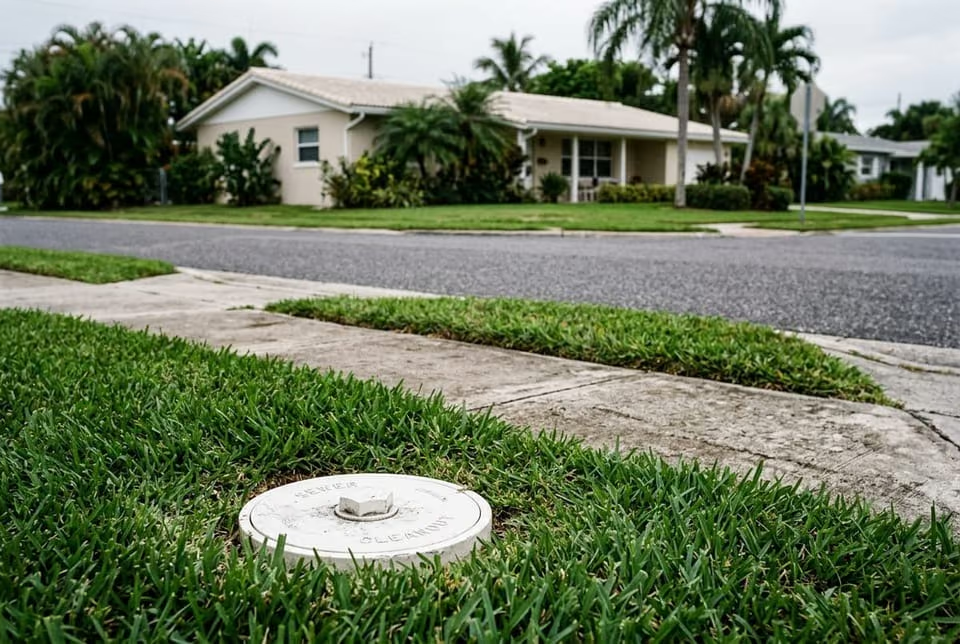
Who is responsible for the sewer line from the house to the street: the homeowner or the City of Pembroke Pines?
The property owner is responsible for all water and sewer lines from the meter to and within the dwelling in Pembroke Pines, and the City maintains water and sewer lines on City property only. That is the City’s own position, published in the City of Pembroke Pines Utilities FAQ on ppines.com, and it is the only local-authority statement on the question. This is the first question worth answering, because it decides whether a homeowner is facing a bill at all. It is also the question local plumbers answer vaguely and national websites answer for some other state.
The City’s wording, verbatim:
“All water and sewer lines from the meter to and within the dwelling are the responsibility of the property owner.”
The City maintains water and sewer lines on City property only.
Source: City of Pembroke Pines Utilities FAQ, ppines.com. Utilities Customer Service: 954-518-9000.
Three things follow from that statement in practice. Everything inside the house is the owner’s: the fixtures, the branch drains, the cast iron or PVC running under the slab, and the vent stack. The line leaving the building is the owner’s as far as the City’s statement reaches, which is the meter. And a defect in a line that sits on City property, such as under the street, is the City’s to maintain.
The FAQ says nothing about the sewer main in the street, because the main was never in question. It is City infrastructure and the City maintains it. The question every homeowner actually has, which is where on the run between the house and that main the responsibility changes hands, is taken up in the next section, and this page is careful about what the City has and has not said on it.
The wording matters for one more reason. The question the City was answering in that FAQ entry was about checking for a leak, and the answer places the meter as the reference point. Sewer laterals do not pass through a water meter, so the FAQ is best read as establishing the general principle, owner responsibility from the meter inward, rather than as a survey of the sanitary lateral. That is why this page reproduces the City’s sentence rather than paraphrasing it into something more specific than the City wrote.
For any other Broward municipality, the answer comes from that city’s own utilities department, and the same caution applies: a rule quoted for one city does not transfer to the next.
How much of the sewer line is the homeowner responsible for?
The City of Pembroke Pines establishes that the homeowner is responsible for the sewer line from the meter to and within the dwelling, and it does not publish a precise demarcation point for the sanitary lateral between the house and the main, so the honest answer for a specific address is the one City Utilities Customer Service gives on 954-518-9000. The FAQ settles the general division. Everything from the meter into and inside the house is the owner’s: the fixtures, the drains under the slab, and the line running out of the building. Lines on City property are the City’s.
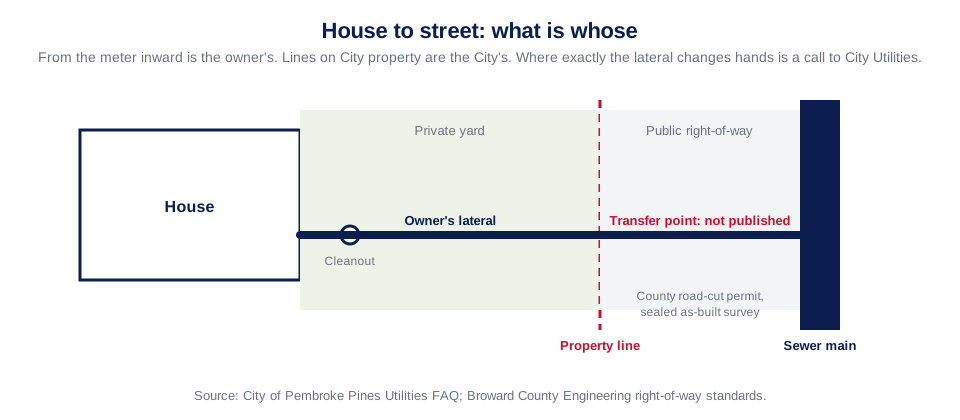
It does not publish a precise demarcation point for the sanitary lateral, and this page will not invent one. The FAQ above answers a leak-check question and establishes owner responsibility from the meter inward; it does not define where, exactly, on the run between a house and the main, responsibility transfers.
Many national sites will tell you the homeowner owns the lateral all the way to the main, or alternatively to the property line. Both rules exist somewhere in the United States. Neither is quoted here, because neither has been confirmed for this city.
For a specific address, call City Utilities Customer Service on 954-518-9000 and ask where responsibility ends for your lateral. That is a five-minute call and it is the only authoritative answer.
The two rules that exist elsewhere produce very different bills, which is why the call is worth making before any repair is quoted. Under a to-the-main rule, the homeowner owns the run under the sidewalk and the street, and a defect there is the homeowner’s to fix, with Broward County’s right-of-way requirements attached. Under a to-the-property-line rule, the homeowner’s responsibility stops at the lot boundary and a defect under the street belongs to the utility. A homeowner in a cost thread collected for this site described the second arrangement from another state: “In our area, the homeowner’s responsibility stops at the main,” with a house-to-curb replacement running $10,000 to $20,000 there. That account is quoted as an illustration of the spread, and it says nothing about Pembroke Pines.
What a homeowner can do while waiting on the City’s answer:
- Locate the exterior cleanout, usually a capped white PVC stub in the front lawn, and the water meter box near the sidewalk
- Locate the property line, from the survey in the closing documents or the county property appraiser’s parcel map
- Have the line camera-inspected with a surface locate, so the defect’s position is a paint mark on the ground rather than an estimate
- Note where that mark falls relative to the meter, the property line, and the sidewalk
- Put that location to City Utilities and ask, for that address, whether it falls in the City’s maintenance responsibility
The locate is what turns the ownership question into one the City can answer. “Somewhere near the street” is not a location a utility can act on, and a camera run with a locator produces “34 feet from the cleanout, five feet deep,” which is.
Does the city cover sewer line replacement?
The City of Pembroke Pines covers water and sewer lines on City property only, and a replacement of the line from the meter to and within the dwelling is the property owner’s responsibility under the City’s published FAQ, so a replacement that stays on private property is a matter between the owner and a contractor. Where a replacement extends into the public right-of-way, Broward County’s requirements attach, and they are substantial. Those requirements, rather than the pipe, are why a street-side job costs a multiple of an in-yard one.
| Requirement | What it means in practice |
|---|---|
| Road Cut and Restoration Permit | Required to open cut a roadway, drive aisle or alley; covers restoration of the paved area including signage and striping |
| Restoration at owner’s expense | County language: disturbed right-of-way “shall be restored by owner or utility at owner’s or utility’s own expense and Broward County will have no responsibility therefore” |
| Certified as-built drawings | Must be signed and sealed by a Professional Land Surveyor registered in Florida, showing house connection dimensions, lateral locations, and invert and rim elevations |
| Minimum Standards for Rights-of-Way | All work must follow “Minimum Standards Applicable to Rights-of-Way under Broward County” |
Sources: Broward County Engineering permit application and administrative code minimum standards, broward.org.
Those four rows are the honest answer to the most common complaint about sewer pricing, put by a homeowner in a thread titled “Why does getting sewer fixed cost so much?”: “how and why does it cost up to $20k?” A sealed survey, a permitted road cut, and full restoration including striping are real line items on a street-side job, and they do not appear at all on a repair that stops in the yard.
The reported ranges show the step. A spot repair in a shallow yard line is reported at $1,500 to $4,000 across South Florida work and homeowner accounts; a full lateral replacement to the main is reported at $10,000 to $30,000, with the top of that range reached when the run enters the right-of-way. Homeowner accounts land inside those bands: one Florida homeowner had 30 feet relined for $4,500 after a competing quote of $14,000, and another was quoted $14,300 for ten feet of under-slab replacement on a 1964 house. None of those are this site’s prices.
The material also shapes what “replacement” means in Broward. PVC became standard in Florida residential construction in the late 1970s, and roughly 35% of South Florida living units built in the 1960s and 1970s went in with cast iron, according to bioresponsecorp.com. The Cast Iron Soil Pipe Institute puts cast iron’s service life at 50 to 75 years, and South Florida practice runs nearer 40 to 50 years. Pembroke Pines itself is the exception in the county: median year built 1992 and only 23.1% of units pre-1980, per U.S. Census ACS 2024 five-year data, table B25034, so a replacement question here is more often about a belly or roots in a PVC line than about a channeled cast iron run.
Where the work does enter the right-of-way, the Florida Building Code, Plumbing Chapter 7 (2023), adds one more requirement on the trenchless route: replacement pipe on a pipe-bursting job must be HDPE SDR 17 to ASTM F714, and the completed section must be inspected internally by video camera survey and approved by the code official.
Who is responsible for a broken sewer pipe?
Responsibility for a broken sewer pipe follows its location: on private property, from the meter into and inside the dwelling, the City of Pembroke Pines places it with the property owner; on City property, the City maintains it; and for the run between those two, the City has not published a demarcation point, so the location of the break has to be established and then put to City Utilities on 954-518-9000. The sequence for working out which side of the line a problem is on is the same regardless of who ends up paying.
- Have the line camera-inspected with a surface locate, so the defect’s distance and depth are marked on the ground rather than estimated
- Note where the marked position sits relative to the property line, the meter, and the sidewalk
- Call City Utilities on 954-518-9000 with that location and ask whether it falls in their maintenance responsibility
- If it is on the private side, get the repair quoted with permits and restoration itemized separately
- If it crosses into right-of-way, confirm who is pulling the Road Cut and Restoration Permit and who is commissioning the sealed as-builts
The locate matters more than anything else here. “Somewhere near the street” is not a location that a utility can act on, and it is not a location that can be quoted accurately either.
The camera stage is reported at $150 to $400 for a standard residential lateral, and on a blocked line it follows a clearing, because a camera cannot see through standing water or a root mat. A self-leveling camera head on a push rod enters through the cleanout, a footage counter on the reel records distance, and the camera head carries a transmitter that a locator on the surface picks up. That is how a defect thirty-four feet down the line becomes a paint mark on the lawn with a depth written beside it.
The footage also settles what kind of break it is, which bears on the ownership conversation. A root mat proves an opening exists, since roots only enter through a break, as a comment with 305 upvotes on a root thread put it: “Definitely roots. They can only get inside from a break in the pipe.” A belly is a grade problem in the ground. An offset joint is a section that has moved. A channeled cast iron invert is corrosion. Each of those is a specific, locatable defect, and each is what the City needs described when asked whether the location falls on its side.
Two things the footage should always produce:
- A recorded video of the whole run, in the homeowner’s possession, so the City, a second contractor, or an insurer can look at the same evidence
- A written note of each defect with its distance from the cleanout and its depth, matching the marks on the ground
On a break that turns out to be on the private side, the same footage becomes the basis for competing bids. On one that turns out to be the City’s, it is the documentation that gets the call returned.
Will homeowners insurance cover a sewer line replacement?
Homeowners insurance and sewer line ownership are independent questions, and establishing that a line is the owner’s responsibility does not mean a homeowners policy pays for it; standard policies generally treat corrosion, wear and root intrusion as maintenance rather than sudden accidental loss, so the deteriorated line itself is typically not covered, while the sewer lateral under the yard is typically addressed only by an optional service line endorsement. Nothing on this page is a coverage determination. Policies differ by carrier, by form, and by endorsement, and only the policy documents and the carrier can say what a specific policy does.
If a line is genuinely the utility’s, no homeowners policy is involved. If it is the owner’s, the coverage question applies, and it is generally organized around one distinction.
| Situation | Typically |
|---|---|
| Repairing or replacing the deteriorated line itself | Not covered |
| Root intrusion damage to the pipe | Not covered (gradual) |
| Sewage backup into the home | Only with a backup endorsement, usually optional |
| The line under the yard | Only with a service line endorsement |
| Tearing out and rebuilding a floor to access the pipe | Sometimes covered even when the pipe is not |
In Florida the more consequential insurance issue is often renewal rather than a claim. A homeowner in a Florida discussion described the bind: a plumber advised “don’t fix what isn’t broken,” but “insurers in Florida will look for any reason to charge more or drop coverage.” That is a homeowner’s reported experience, not insurance advice, and it is the reason a documented camera inspection is worth having on file whatever the ownership answer turns out to be.
What ownership does change is who a homeowner should be talking to first. A break confirmed on the private side goes to a contractor and, where the policy has a service line endorsement, to the carrier with the footage attached. A break the City confirms as its own goes to City Utilities with the same footage. In both cases the report needs to state what was found, where, and how deep, because a vague report helps nobody in either conversation.
What a carrier and a utilities desk can each act on is the same package: the recording, the distance from the cleanout, the depth from the surface locate, and a written report that names the defect. Because policies are generally built around sudden events rather than gradual wear, the date the symptom first appeared and any backup that reached a floor belong in that report too, in the homeowner’s own words rather than the contractor’s. A report that arrives as “the pipe is old” reads as maintenance to everyone who receives it; a report that arrives as a named defect at a named point with a date attached gives each side something specific to answer.
The Sewer Line Repair Broward field team puts it this way: “We locate the defect and mark it on the ground with the depth. Where that mark falls decides who the homeowner should be talking to, and it is worth knowing before anyone digs.”
To have your line scoped and the defect located and marked, request a free quote.
Frequently asked questions
Who is responsible for the sewer line, the homeowner or the City of Pembroke Pines?
The City of Pembroke Pines Utilities FAQ states that all water and sewer lines from the meter to and within the dwelling are the responsibility of the property owner, and that the City maintains lines on City property only. For a specific address, call City Utilities on 954-518-9000.
Does the city cover sewer line replacement?
Generally not for the portion the property owner is responsible for. In Pembroke Pines the City maintains water and sewer lines on City property only, and states that lines from the meter to and within the dwelling are the property owner's responsibility. Confirm your address with City Utilities.
Related services
- Does Homeowners Insurance Cover Sewer Line Repair in Florida?A standard homeowners insurance policy generally does not cover repair of the sewer line…
- Sewer Line Replacement Cost in South Florida: What Drives the NumberSewer line replacement cost is set by the foot, by depth, and by what has to be restored…
- Broken Sewer Line: What the Signs Look Like in a Florida HomeA broken sewer line shows itself through repeat backups, a persistent sewer smell at flo…
- Sewer Line Repair in Pembroke PinesSewer line repair in Pembroke Pines starts with a camera inspection and a surface locate…
- About Sewer Line Repair BrowardWe diagnose sewer lines in Broward County by camera before quoting any repair, and the r…