Sewer Line Replacement Cost: What Actually Sets the Number
Sewer line replacement cost is set by the foot, by depth, and by what has to be restored afterward. Reported South Florida figures run about $80 to $250 per linear foot, with whole-home cast iron replacement averaging near $10,000. Depth, slab work, and public right-of-way restoration are what push a job past $20,000.
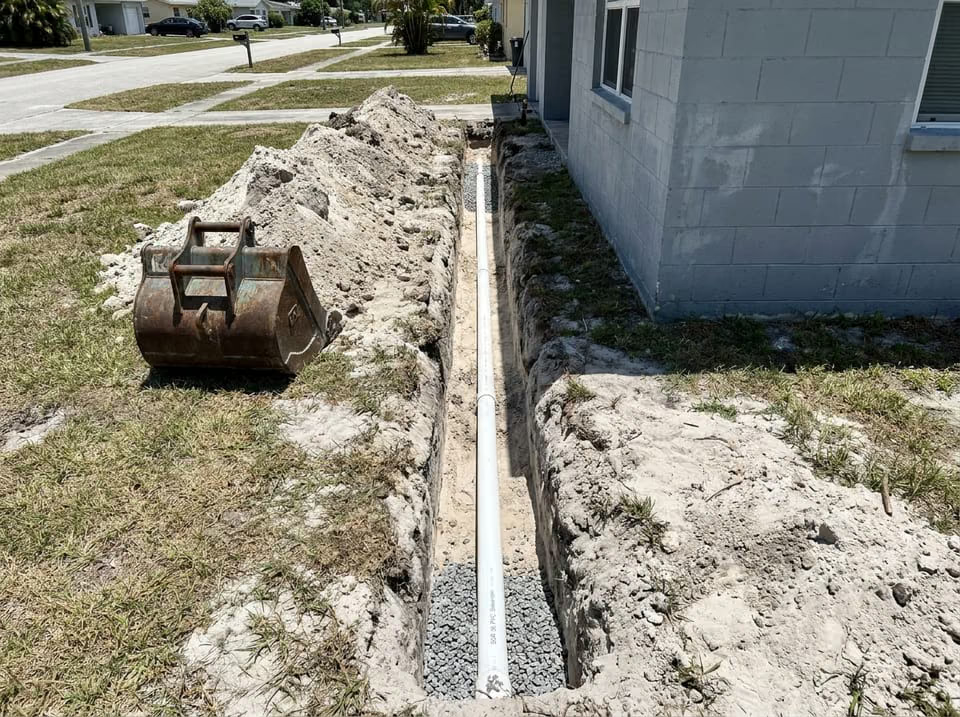
What does sewer line replacement cost in South Florida?
Sewer line replacement in South Florida is reported at $80 to $250 per linear foot, with whole-home cast iron replacement averaging near $10,000 and individual jobs observed anywhere from $5,000 to $40,000. The spread is that wide because almost none of the cost is pipe. Pipe is cheap. Everything around getting to the pipe and putting the site back is not, and the most common complaint about replacement pricing is that nobody explains that part. A homeowner on a public forum put it exactly: “I understand that you have to dig, possibly break through a bit of concrete if your luck isn’t with you. But how and why does it cost up to $20k?”
| Figure | Scope | Source |
|---|---|---|
| $80–$250 per linear foot | Cast iron replacement, South Florida | Regional contractor reporting |
| ~$10,000 | Average whole-home cast iron replacement | Regional contractor reporting |
| $14,300 | Quote for 10 feet of under-slab replacement, 1964 Florida house | Homeowner report |
| $4,500 vs $14,000 | Two quotes for the same 30-foot lining job | Homeowner report |
| $5,000 to $40,000 | Observed range across jobs | Plumber, public forum |
These are reported ranges from homeowners and contractors, and they are not our prices. They are on this page because the spread is the single most useful thing a homeowner can know before taking a bid. A company that quoted a flat per-foot figure over the phone for a line nobody has seen would be guessing, and the guess would be wrong in one direction or the other on most houses.
That $14,300 figure for ten feet is worth sitting with. It is a per-foot rate of over $1,400, far outside the reported band, and it is what happens when ten feet of pipe sits under a slab inside the footprint of the house. The price is concrete saw-cutting, dust containment, spoil carried out through the living room, backfill and compaction, new concrete and a finished floor, with a short length of PVC somewhere in the middle. The homeowner who reported it was under contract on a 1964 house and walked away.
The $10,000 average sits at the other end of the same logic. A whole-home number that low describes houses where most of the run is under the yard, reachable with a small excavator, and restored with sod. The two figures together explain why “replace the sewer line” and “replace the cast iron under the house” are different quotes for the same address, and why a camera run that separates the yard lateral from the under-slab drainage is the first step in pricing either one.
Broward’s housing stock makes the question common rather than rare. Roughly 35% of South Florida living units built in the 1960s and 1970s went in with cast iron, PVC did not become standard in Florida residential construction until the late 1970s, and per U.S. Census ACS 2024 five-year data the median year built is 1969 in Hollywood, 1972 in Fort Lauderdale and 1968 in Lighthouse Point. A house of that age is at or past the 40-to-50-year practical service life that regional reporting gives cast iron in South Florida conditions.
How hard is it to replace a sewer line?
Replacing a sewer line is hard in proportion to five things: how deep it runs, what sits on top of it, how long and wide the run is, whether it leaves the property line, and which method the pipe’s condition allows. The first two account for most of the difficulty and most of the price, because they decide whether the job is a small excavator in a yard or a shored trench with a crew standing in a confined space. None of the five can be read from the surface, which is why a replacement quote issued without camera footage is a quote for an unknown job.
Depth. Cost per foot climbs sharply with depth because the work changes character. A shallow yard run is a small excavator and hand tools. Past roughly ten feet the trench requires collapse protection, which means shoring or benching, a larger machine, and more crew standing in a hole that is now a confined-space risk. A forum commenter answering the “why $20k” question described it from the crew’s side: ten feet of depth is heavy equipment and requires trench collapse protection. In Broward’s sandy fill the shoring question arrives earlier than it would in clay, because sand will not hold a vertical wall.
What is on top of the pipe. A line under open St. Augustine grass is the cheapest case on the board. The same line under a driveway, a pool deck, a paver patio, or the slab of the house itself carries demolition and rebuild that can exceed the plumbing. On interior work the floor is cut, the trench is dug by hand inside the room, and terrazzo, tile and wood floors rarely survive it. Families frequently move out for part of the job.
Length and diameter of the run, which is the only part that behaves like a simple per-foot number, and the number of fixture connections that have to be reinstated along it.
Where the line goes. A run that stops at the property line is a private job. A run that continues into the public right-of-way brings Broward County into it, and the county’s own permit language is unambiguous: disturbed right-of-way “shall be restored by owner or utility at owner’s or utility’s own expense and Broward County will have no responsibility therefore.” A Road Cut and Restoration Permit covers the roadway, drive aisle or alley including signage and striping, and water and sewer work requires certified as-built drawings signed and sealed by a Professional Land Surveyor registered in Florida. Each of those is a line item.
Method. Open trench, pipe bursting, and lining price differently, and the line’s condition decides which are available rather than the budget. A bellied or collapsed line cannot be lined at any price.
The list is also the order in which a camera run answers the questions. A footage counter gives length, a locator gives depth at each defect, the picture gives material and condition, and the distance to the property line is measured on the lawn. A quote written against all five is a quote against known conditions.
Can you repair a sewer line without digging it up?
A sewer line can often be replaced or rebuilt without a full trench, using either cured-in-place lining, which cures a resin sleeve into a new pipe inside the old one through an existing cleanout, or pipe bursting, which pulls a bursting head through the old line and draws new HDPE pipe in behind it through two access pits. Both leave the driveway, pool deck and floors in place, which is where the savings come from. Both also require the line to be a candidate: a pipe that has bellied, offset or collapsed is not, and a trenchless quote issued before the line has been scoped is a quote for something nobody has confirmed is possible.
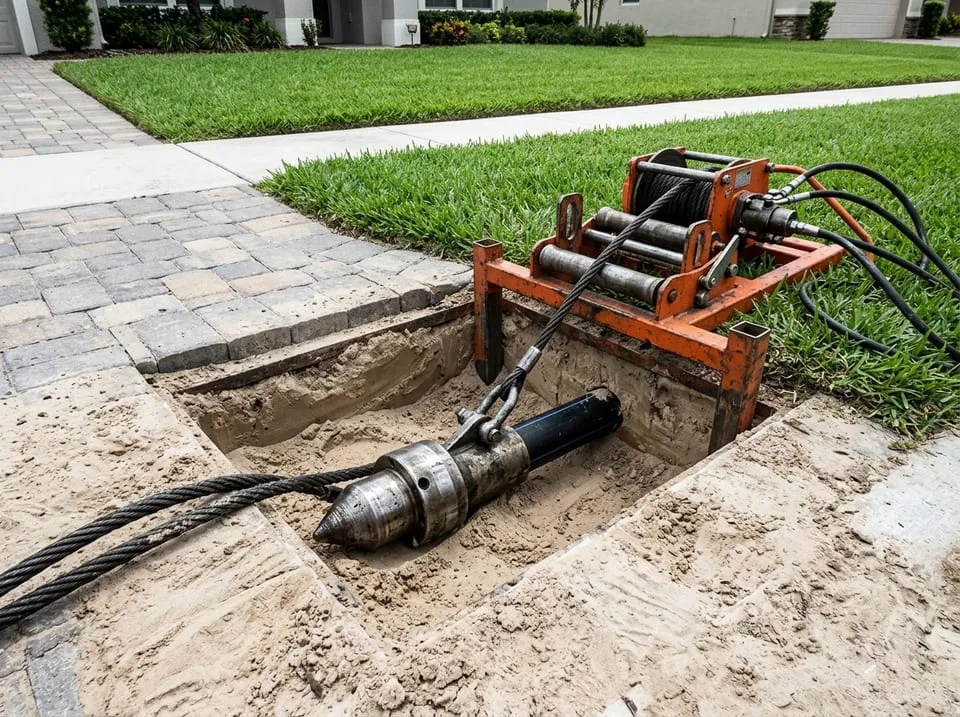
The savings are real and they are savings on restoration rather than on plumbing. A trenchless job on a residential lateral is priced against the excavation it avoids, so the more expensive the surface, the better trenchless compares. On an open yard run with easy access, a conventional trench is sometimes the cheaper job, because the restoration it saves is a strip of sod.
Eligibility is the gate, and a working plumber stated it in one sentence: “You can only do trenchless if your sewer line has correct pitch and is mechanically sound.” Lining preserves whatever grade the host pipe has, including a wrong one, so a lined belly is still a belly holding standing water. A liner also cannot cure across the step of an offset joint. Bursting tolerates some of what lining cannot, since it fractures the old pipe outward and replaces it, but it needs entry and exit pits and enough soil around the pipe to absorb the fragments, and it is rarely practical under a slab inside the house.
Florida’s Building Code, Plumbing Chapter 7, addresses bursting specifically. The replacement pipe shall be HDPE, SDR 17, conforming to ASTM F714, and the completed section shall be inspected internally by video camera survey and approved by the code official. The post-work camera run on a burst line is a code obligation, not a courtesy. We have not verified an equivalent residential CIPP approval path in the Florida Building Code, and this page does not assert one; where a permit is involved, that question belongs to a Broward plans examiner and the answer should be in writing.
Reported per-foot figures for trenchless work sit inside the same $80 to $250 band as replacement, because the method displaces the excavation cost rather than the pipe cost. The homeowner-reported spread on one lining job, $4,500 against $14,000 for the same 30 feet, shows that the per-foot figure is a starting point and not a quote. The variables that move it are whether a usable cleanout exists or pits must be dug, the length of the run and the number of lateral connections to reinstate, pre-cleaning of scale or root mass before any liner goes in, the cure method, and whether the run crosses the property line into County right-of-way.
How long does a sewer line replacement take?
A sewer line replacement takes from one day to more than a week depending on method and location: a trenchless lining on a residential lateral is usually one or two days, an open-trench yard replacement typically runs two to four days including restoration, and an under-slab replacement inside a house takes longer and often means moving out for part of it. Those are the durations reported by homeowners and in regional trade practice, not a schedule we promise for a line nobody has scoped. The camera run that sets the price also sets the calendar, because the same five factors drive both.
The account that best captures the under-slab case came from a homeowner whose 1961 house had a broken cast iron drain under the floor: “We thought it would be some advanced drilling equipment, but it was just 7 dudes digging under house for days. 1100 sq ft 1961 build.” That is the honest picture of interior replacement. The trench is dug by hand because no machine fits in a bedroom, spoil is carried out in buckets, and every day the floor is open is a day the house is partly unlivable. The plumbing itself is a small share of those days; cutting the slab, containing the dust, backfilling, compacting, pouring and finishing the floor are the rest.
A yard replacement runs on a different clock. Day one is excavation and the camera locate that keeps the trench on the pipe; day two is laying new SDR 35 PVC on bedding to the connection, backfill and compaction; the remaining days are restoration, which is sod on a lucky job and pavers or a driveway pour on an unlucky one. Where the run crosses into County right-of-way, the Road Cut and Restoration Permit and the surveyor’s sealed as-built add lead time before the crew arrives and paperwork after it leaves, so a street-side job is measured in weeks of process around a few days of digging.
Trenchless is the short calendar. A lining job on a lateral with a usable cleanout can be resin in the morning, cured by afternoon, laterals reinstated and re-scoped the same day or the next. Pipe bursting needs two pits, a pull, the code-required camera survey of the finished section, and backfill of the pits, which is also one to two days on most residential runs.
What lengthens any of the three:
- Discovering a second defect once the line is open, which is why a full-length camera run before the quote matters
- A line that has to be cleared of roots or scale before it can be scoped or lined
- Weather, since an open trench in sandy fill during a South Florida downpour is a trench that has to be re-dug
- Permit lead time on anything past the property line
- Floor finishes that have to cure before the room can be used again
Water service usually stays on during a sewer replacement. Drain use does not, and a house on a single lateral has no working drains while the connection is open. Ask each bidder how many days the house is affected and whether a temporary connection is part of the scope.
Should I get more than one quote for a sewer repair?
Yes, get at least three bids on any sewer replacement over about $5,000, and have every bidder quote against the same recorded camera run. A plumber summarized the estimating problem honestly: “No one can give you a price for this. I’ve seen sewer repairs cost $5000 and I’ve seen them cost $40,000. There are so many factors that go into the cost.” That is true before the line has been scoped and much less true after. A bid written against footage is a bid against known length, depth, material, grade and defect. A bid written without it prices the contractor’s uncertainty, and uncertainty is expensive.
The practical steps that narrow the spread:
- Have the line camera-inspected before requesting quotes, and get a copy of the footage
- Ask every bidder to quote against the same recorded run, not their own separate diagnosis
- Require the price broken into excavation, pipe and fittings, restoration, and permits
- Ask specifically what surface restoration is included: sod, pavers, driveway, striping
- Confirm whether the quote stops at the property line or continues into the right-of-way
- Get at least three bids on any job over about $5,000
Restoration is where most spread hides. A bid that excludes the driveway is not comparable to one that includes it, and neither is wrong; they describe different jobs. When each contractor puts sod, pavers, concrete and striping on separate lines, the comparison becomes honest and frequently shows that half the number is not plumbing. The property line is the other hidden variable, since a bid that continues into County right-of-way carries a permit, repaving with signage and striping, and a sealed as-built that a private-side bid does not.
Material is the one line that should not vary between bids, because it is set by code. Florida’s Building Code, Chapter 7, addresses this directly, and the clause that matters locally is the one written for filled or unstable ground: on that ground the building sewer must conform to a standard for ABS, cast iron, copper or copper-alloy, PVC, or PP pipe. PVC DWV is permitted in SDR26, SDR35, SDR41, PS50 or PS100, so SDR 35 PVC is an approved residential sanitary spec in Florida. A bid that names a lighter pipe than that, or does not name the pipe at all, is a bid to question.
Our position, stated on every replacement: “We quote the trench and the restoration as separate lines because they are separate jobs. A homeowner who can see that the sod and the driveway are half the number can decide where the line runs.” That is how Sewer Line Repair Broward writes a replacement bid, and it is why the reported ranges on this page are ranges rather than promises.
If you have a bid in hand and want a second one written against the same camera footage, request a free quote and attach the file.
Frequently asked questions
Can you repair a sewer line without digging it up?
Often, yes. Cured-in-place lining rebuilds the pipe from the inside through an existing cleanout, and pipe bursting replaces it through access pits. Both require the line to be a suitable candidate: lining preserves existing grade, so a belly or an offset rules it out.
How much does it cost to replace cast iron pipes under a Florida slab?
Under-slab work is the most expensive case because the price is concrete, containment and floor rebuild rather than pipe. One Florida homeowner was quoted $14,300 for ten feet under a 1964 house. Whole-home cast iron replacement in South Florida averages near $10,000.
Why does sewer line repair cost so much?
Almost none of the cost is pipe. It is depth, which past ten feet requires trench collapse protection; the surface above the pipe, whether sod, driveway or an interior floor; and restoration. Work in public right-of-way adds permits, repaving including striping, and a sealed surveyor's as-built.
How long does a sewer line replacement take?
A trenchless lining on a residential lateral is usually one or two days. An open-trench yard replacement typically runs two to four days including restoration. Under-slab replacement inside a house takes longer and often means moving out for part of it.
What happens if the repair doesn't hold?
We fix it right the first time or it's free. If the section we repaired fails again from the same defect, we come back and redo the work at no charge. The camera footage from the original visit is what settles whether a new problem is the same defect returning or a separate one.
Related services
- Sewer Line Repair Cost: What You Are Actually Paying ForSewer line repair cost is set by access rather than by pipe. A spot repair on an open ya…
- Cast Iron Pipe Replacement Cost in South FloridaReported South Florida cast iron replacement runs $80 to $250 per linear foot, with whol…
- Trenchless Sewer Repair Cost and Whether Your Line QualifiesTrenchless sewer repair cost prices against the excavation it avoids, since the method r…
- Who Owns the Sewer Line From the House to the Street?For the sewer line running from the house toward the street, the City of Pembroke Pines…
- Does Homeowners Insurance Cover Sewer Line Repair in Florida?A standard homeowners insurance policy generally does not cover repair of the sewer line…