Sewer Line Repair Cost: What You Are Actually Paying For
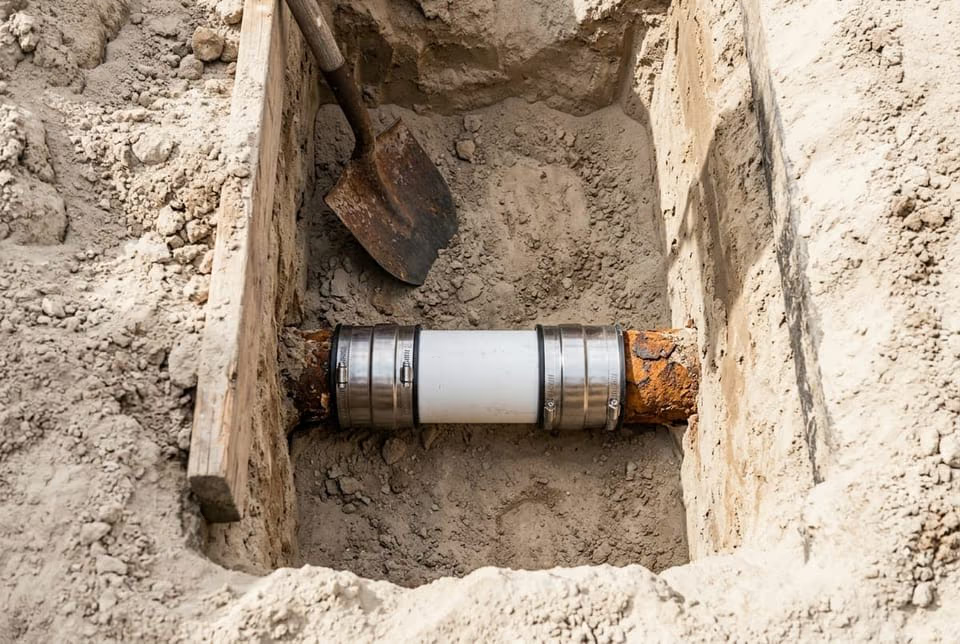
Sewer line repair cost is set by access rather than by pipe. A spot repair on an open yard line is the cheapest outcome; an under-slab repair inside the house is the most expensive. Reported South Florida figures run $80 to $250 per foot, and depth past ten feet, concrete, and right-of-way restoration push a job toward $20,000.
What does sewer line repair cost in South Florida?
Sewer line repair in South Florida runs from a few hundred dollars for clearing a blockage to $30,000 for a full lateral replacement that crosses into the public right-of-way, with most spot repairs landing between $1,500 and $9,000 depending on depth and what sits above the pipe. Reported regional figures for cast iron work run $80 to $250 per linear foot. The visible part of the job, a length of pipe, is the cheapest input in it. Two repairs of identical pipe, identical length and identical material can differ by a factor of ten, and every bit of that difference sits in access and reinstatement.
| Scenario | What it involves | Reported range |
|---|---|---|
| Cleaning or jetting a blockage | No excavation; cable or hydro jetting through a cleanout | $200–$900 |
| Camera inspection | Scoping the line, locating and depth-marking the defect | $150–$400 |
| Spot repair, shallow yard line | Small excavation, cut out and replace a section, backfill and sod | $1,500–$4,000 |
| Spot repair, deep or under hardscape | Shoring, larger machine, driveway or paver rebuild | $4,000–$9,000 |
| Under-slab repair inside the house | Floor demolition, containment, plumbing, concrete and floor rebuild | $6,000–$18,000 |
| Full lateral replacement to the main | Long trench, possible right-of-way work, permits and restoration | $10,000–$30,000 |
These are the ranges reported across South Florida work and homeowner accounts, and they are not our prices. The site carries no operator price list because the tenant has not published one, and a per-foot figure quoted over the phone would be a guess dressed up as a number. Where a specific job falls is settled by camera footage.
The table is ordered the way a job actually escalates. A blockage that clears with a cable and stays clear was a blockage. A blockage that comes back inside a year has a defect behind it, and the camera run is what turns the symptom into a scenario on the table. A homeowner who knows the defect is at 34 feet, five feet deep, under St. Augustine grass, is looking at the third row. The same defect under a paver driveway is the fourth row. The same defect under the kitchen floor is the fifth.
The reported per-foot band of $80 to $250 comes from regional contractor reporting on cast iron replacement in South Florida, where the same source puts whole-home replacement near $10,000 on average. The band is wide because the two ends describe different work: $80 a foot is a shallow, open yard run with a small machine; $250 a foot is deep, shored, or under something that has to be rebuilt afterward.
One more figure belongs at the top of a cost page because it is the one homeowners quote to each other. A plumber on a public forum, asked to estimate a repair sight unseen, refused: “No one can give you a price for this. I’ve seen sewer repairs cost $5000 and I’ve seen them cost $40,000. There are so many factors that go into the cost. Get some bids.” That is the honest range for the whole category, and the rest of this page is about what moves a job from one end of it to the other.
Why does sewer line repair cost so much?
Sewer line repair costs what it costs because almost none of the money is pipe. Four things set the price: how deep the line sits, what is on top of it, whether the defect is on the private side of the property line or in Broward County’s right-of-way, and what the existing pipe is made of. A homeowner on a public forum put the objection exactly: “I understand that you have to dig, possibly break through a bit of concrete if your luck isn’t with you. But how and why does it cost up to $20k?” Each of the four multipliers below is a step change, and a job that trips two or three of them is the $20,000 job.
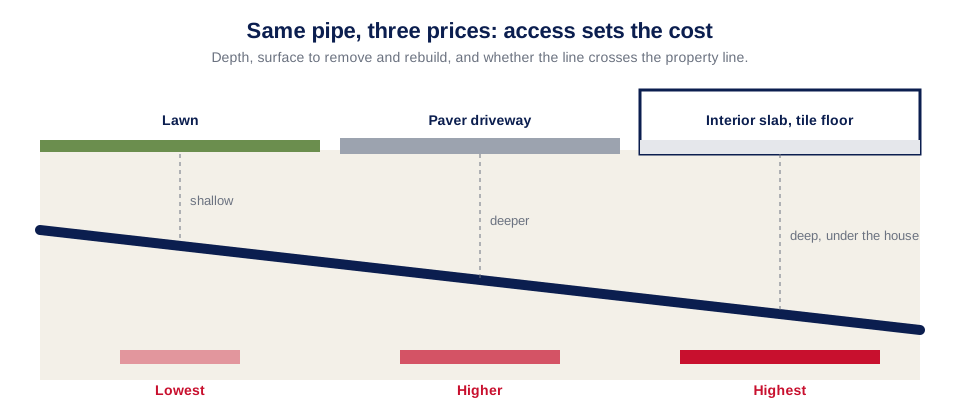
Depth. Below roughly ten feet a trench stops being an excavation and becomes a confined space with a collapse risk. A commenter in the same thread described it from the crew’s side: ten feet of depth is heavy equipment and requires trench collapse protection. Shoring, a larger machine, and the crew size that goes with them are step changes in price, not gradual ones. Broward’s sandy fill makes the shoring question arrive sooner than it would in clay, because sand does not hold a vertical wall.
Surface. Grass is free to put back. A paver driveway, a pool deck, a tiled interior floor, or a stamped-concrete patio each carry a demolition and a rebuild, and on interior work the rebuild frequently exceeds the plumbing. The homeowner-reported quote of $14,300 for ten feet of under-slab pipe on a 1964 Florida house is the clearest example on record: that number is concrete saw-cutting, dust containment, spoil carried out through the house, backfill and compaction, new concrete, and a finished floor, with a short length of pipe somewhere in the middle of it.
Position relative to the property line. Everything on the private side is between the homeowner and the contractor. Anything in the public right-of-way brings Broward County’s permit requirements: a Road Cut and Restoration Permit covering the paved area including signage and striping, and certified as-built drawings signed and sealed by a Professional Land Surveyor registered in Florida. The County’s own permit language states that disturbed right-of-way “shall be restored by owner or utility at owner’s or utility’s own expense and Broward County will have no responsibility therefore.” Those are real line items on a real invoice.
What the pipe is made of. A cracked section of PVC is a cut-and-couple. A failing cast iron line rarely has one defect; a fifty-year-old line that has lost its bottom in one section usually has thinned wall either side, which turns a spot repair into a conversation about the whole run. The Cast Iron Soil Pipe Institute rates cast iron at 50 to 75 years; in South Florida’s wet sandy fill, regional reporting puts the practical figure at 40 to 50. A Broward house built before about 1975 is inside that window.
Is it cheaper to repair or replace a sewer line?
Repairing a sewer line is cheaper than replacing it when the defect is isolated and the pipe on either side of it is sound; replacing is cheaper when the line has multiple defects, has lost its bottom along a run, or sits somewhere that costs more to reach than the pipe is worth. The deciding factor is access cost. When getting to the pipe is the expensive part of the job, doing one section now and re-opening the same floor or driveway in three years costs more than doing the run once.
The comparison is straightforward on a yard line. A spot repair on a shallow, open run is a small excavation, a cut-out section, two shielded couplings, backfill and sod, in the $1,500 to $4,000 band reported above. If the camera shows one crack and clean pipe either side, that repair is the whole job and replacement would be waste.
The comparison inverts under a slab. Opening a finished floor costs the same whether the crew replaces ten feet or forty, and cast iron does not fail in one place. It thins along its length and loses its bottom where flow is heaviest, a pattern the trade calls channeling. A camera that shows channeling across several sections is showing the next failure already forming, and a spot repair on that line buys a delay rather than a fix. That is how a ten-foot under-slab repair ends up quoted at $14,300 and a homeowner ends up asking whether the whole run should go instead.
Three findings tip the decision toward replacement regardless of price:
- Channeling across more than one section, because the wall loss is not local
- A belly or back-pitch, because grade is a layout defect that no repair to the wall corrects, and lining preserves the wrong grade along with the right one
- A collapse, because there is no host pipe left to repair
Three findings keep repair on the table:
- A single crack or fracture with sound wall either side
- Root intrusion at one joint on a pipe that is otherwise round, cleared and then sealed at the entry point
- An isolated offset in an accessible location, excavated and re-coupled
Between the two lists sits the case most Broward homeowners actually face: one defect under the slab and a yard lateral that looks serviceable. Those are separate decisions and should be quoted as separate lines, because a house may need the interior run replaced this year and the yard run left alone for a decade. What goes back in either case is set by code. Florida’s Building Code, Plumbing Chapter 7, permits PVC DWV in SDR26, SDR35, SDR41, PS50 or PS100, so SDR 35 PVC is an approved residential spec here, and the code’s clause for filled or unstable ground, written for exactly the sand Broward sits on, lists ABS, cast iron, copper or copper-alloy, PVC and PP as conforming materials.
Should I get more than one quote for a sewer repair?
Yes, on any sewer repair over about $5,000, and the bids are only useful if every contractor is pricing the same footage. The defining complaint in this trade is quote spread, and the numbers behind the complaint are real: one Florida homeowner had 30 feet relined for $4,500 after a first quote of $14,000; another was quoted $14,300 for ten feet of under-slab replacement on a 1964 house. This is counterintuitive advice from a company that would like the work, and it is still correct. A single quote in a market with a documented three-to-one spread on identical work is one company’s opinion, not a price.
A plumber described the estimating reality without flattering the trade: “No one can give you a price for this. I’ve seen sewer repairs cost $5000 and I’ve seen them cost $40,000.” The gap between those numbers is mostly unknown conditions, and a bid written before the line has been scoped is pricing the contractor’s uncertainty. Uncertainty is expensive. A bid written against a recorded camera run is pricing known depth, known distance, a named defect and a known surface, and two such bids should land close together.
What makes bids comparable:
- One camera inspection, recorded, shared with every bidder
- A written scope naming the defect, its distance from the cleanout, and its depth
- Price split into excavation, materials, restoration and permits
- An explicit statement of what surface is restored and to what standard
- Confirmation of whether the work stops at the property line
- The warranty term, and whether it covers the repaired section or the whole line
The restoration line is where most spread hides. A bid that excludes replacing the driveway is not comparable to a bid that includes it, and neither bid is wrong; they are quoting different jobs. Asking each contractor to put sod, pavers, concrete and striping on their own lines makes the comparison honest and frequently shows that half the number is not plumbing at all.
The property-line question is the other one. A bid that stops at the private side and a bid that continues into the County right-of-way differ by a Road Cut and Restoration Permit, repaving including signage and striping, and a surveyor’s sealed as-built. That difference can be thousands of dollars and it is invisible unless both contractors state where their scope ends.
If two bids differ by more than a factor of two against the same footage, one of them is pricing a different job. Asking which is usually enough to find out. For a bid written against footage you already hold, request a free quote and attach the file.
How do I know a plumber isn’t inventing a problem to sell me a big job?
The workable protection against a manufactured diagnosis is a copy of the recorded camera footage, because a recording can be shown to a second contractor and a diagnosis that survives a second opinion is one worth paying to fix. Every cost driver on this page, depth, position, surface and material, is unknown until someone has seen the line, which is why a reputable quote starts with a camera rather than a phone estimate. The camera is also the homeowner’s protection: a contractor who will not hand over the file is asking to be trusted on a five-figure decision without evidence.
A homeowner in a real-estate forum raised the worry in its bluntest form: “You need a contractor that ‘scopes’ only - and is NOT part of a plumbing company. That way you will know if it’s legit and not a ruse to get a huge job.” That is a reasonable position, and hiring a scope-only inspector is one workable answer. The simpler version is to insist on the file from whoever does the scoping. Recorded video can be sent to a second contractor for an independent read, which removes most of the asymmetry without a separate hire.
A fair report reads differently from a sales report, and the difference is specificity. A plumber reviewing footage of an old cast iron line in a trade forum wrote: “Looks like a sag in the line between 15’ and 34’. Or it may be very flat and needs to be flushed and jetted. I didn’t see any cracks, offsets, or roots.” That is a finding with a distance, a stated alternative explanation, and an explicit list of what was not found. “The line is bad” is not a finding. “It looks rusty” is not a finding either; surface scale is the expected condition of fifty-year-old cast iron, and a replacement quote justified by rust alone deserves a second read.
The Florida Building Code takes the same view of footage on one method. For trenchless pipe bursting, the completed section shall be inspected internally by video camera survey and approved by the code official, so on that job the post-work recording is a code obligation rather than a courtesy.
Our position, stated on every job: “Every inspection we run is recorded and the homeowner gets the file. A quote written off footage the customer holds is a quote that has to stand up to somebody else looking at it.” That is how Sewer Line Repair Broward scopes work, and it is the reason the price ranges on this page are reported ranges rather than promises. The camera decides which row of the table a house is in. The homeowner, holding the file, decides who fixes it.
Frequently asked questions
Why does sewer line repair cost so much?
Almost none of the cost is pipe. It is depth, which past ten feet requires trench collapse protection; the surface above the pipe, whether sod, driveway or an interior floor; and restoration. Work in public right-of-way adds permits, repaving including striping, and a sealed surveyor's as-built.
How do I know a plumber isn't inventing a problem to sell me a big job?
Require a copy of the recorded camera footage. A recording can be sent to a second contractor for an independent read, which removes most of the asymmetry. Some homeowners hire a scope-only inspector who is not part of a plumbing company, which also works.
What happens if the repair doesn't hold?
We fix it right the first time or it's free. If the section we repaired fails again from the same defect, we come back and redo the work at no charge. The camera footage from the original visit is what settles whether a new problem is the same defect returning or a separate one.
Should I get more than one quote for a sewer repair?
Yes, on any job over about $5,000. One plumber noted seeing sewer repairs cost $5,000 and $40,000, and one Florida lining job drew quotes of $4,500 and $14,000. Have every bidder quote against the same recorded camera footage so the bids are comparable.
Related services
- Sewer Line Replacement Cost: What Actually Sets the NumberSewer line replacement cost is set by the foot, by depth, and by what has to be restored…
- Cast Iron Pipe Replacement Cost: South Florida FiguresReported South Florida cast iron replacement runs $80 to $250 per linear foot, with whol…
- Broken Sewer Line: The Signs, and What They Look Like in FloridaA broken sewer line shows itself through repeat backups, a persistent sewer smell at flo…
- Sewer Camera Inspection Cost and What the Footage ShowsA residential sewer camera inspection typically costs $150 to $400. A camera on a push r…