Cast Iron Pipe Replacement Cost: South Florida Figures
Reported South Florida cast iron replacement runs $80 to $250 per linear foot, with whole-home replacement averaging near $10,000. The wide band is set by whether the pipe is under the yard or under the slab, since interior work carries floor demolition, containment and rebuild on top of the plumbing.
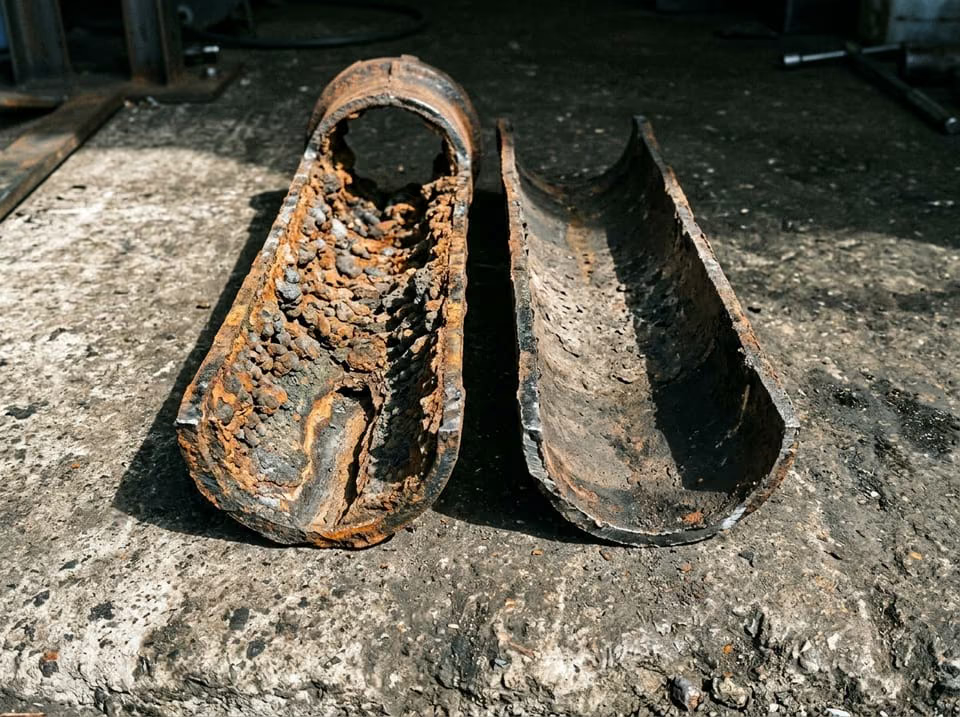
How much does it cost to replace cast iron pipes in South Florida?
Cast iron pipe replacement in South Florida is reported at $80 to $250 per linear foot, with whole-home replacement averaging near $10,000, and individual jobs observed anywhere from $5,000 to $40,000. It is the largest plumbing invoice most Broward homeowners will ever see, and the number depends far less on how much pipe there is than on where it runs. A yard lateral under St. Augustine grass sits at the bottom of the band. The same pipe under a terrazzo floor inside the house can cost more per foot than the whole yard run.
| Scope | Reported figure | Note |
|---|---|---|
| Per linear foot, South Florida | $80–$250 | Varies with depth and surface above |
| Whole-home replacement, average | ~$10,000 | Regional contractor reporting |
| 10 ft under-slab section, quoted | $14,300 | 1964 Florida house under contract |
| Observed job range | $5,000–$40,000 | Plumber, public forum |
These are reported figures from regional contractors and homeowners, not our prices. The tenant has not published a price list, and a per-foot figure quoted before a camera has been down the line would be a guess. The $14,300 quote for ten feet is the figure that explains the whole page. Ten feet of four-inch pipe is a trivial material cost. That quote is concrete saw-cutting, dust containment, spoil removal, the plumbing itself, backfill and compaction, new concrete, and a floor put back, inside an occupied house.
What moves the number:
- Linear feet of pipe being replaced, which is the only genuinely per-foot variable
- Depth, with a step change past roughly ten feet where trench collapse protection is required
- Surface above the pipe: sod, pavers, driveway, pool deck, or interior finished floor
- Number of fixture connections that have to be reinstated
- Whether the run leaves the property line into Broward County right-of-way, which adds a Road Cut and Restoration Permit covering signage and striping, plus as-builts signed and sealed by a Florida-registered Professional Land Surveyor
- Whether lining is possible instead, which removes most of the excavation cost
The reason cast iron is a Broward question and not a generic one is the housing stock. Regional reporting puts 35% of all of today’s South Florida living units as built during the 1960s and 1970s with cast iron, and PVC did not become standard in Florida residential construction until the late 1970s. Per U.S. Census ACS 2024 five-year data, table B25034, Hollywood’s median year built is 1969 with 52.8% of units built before 1970, Fort Lauderdale’s is 1972, Lighthouse Point’s is 1968 with 83.5% of units pre-1980, and Wilton Manors sits at 1971 with 73.7% pre-1980. The Cast Iron Soil Pipe Institute rates cast iron at 50 to 75 years; regional reporting puts the practical figure in South Florida’s wet sandy fill at 40 to 50. A large share of those houses is at or past it.
The distinction that matters most for price is the one the table hides: “replace the cast iron” and “replace the sewer line” are different quotes for the same address. A house may have a sound yard lateral and a failed under-slab drainage system, or the reverse, and only camera footage separates them. The next block is about the expensive half.
How much does it cost to replace cast iron pipes under a Florida slab?
Replacing cast iron under a Florida slab is the most expensive case in residential sewer work because the price is concrete, containment and floor rebuild rather than pipe: one Florida homeowner was quoted $14,300 for ten feet under a 1964 house, more than the $10,000 that regional contractors report as the average for an entire home. That homeowner was under contract, the seller would not negotiate, and the buyer walked. The number is not a per-foot rate gone wrong. It is what ten feet of pipe costs when the pipe is inside the footprint of an occupied house.
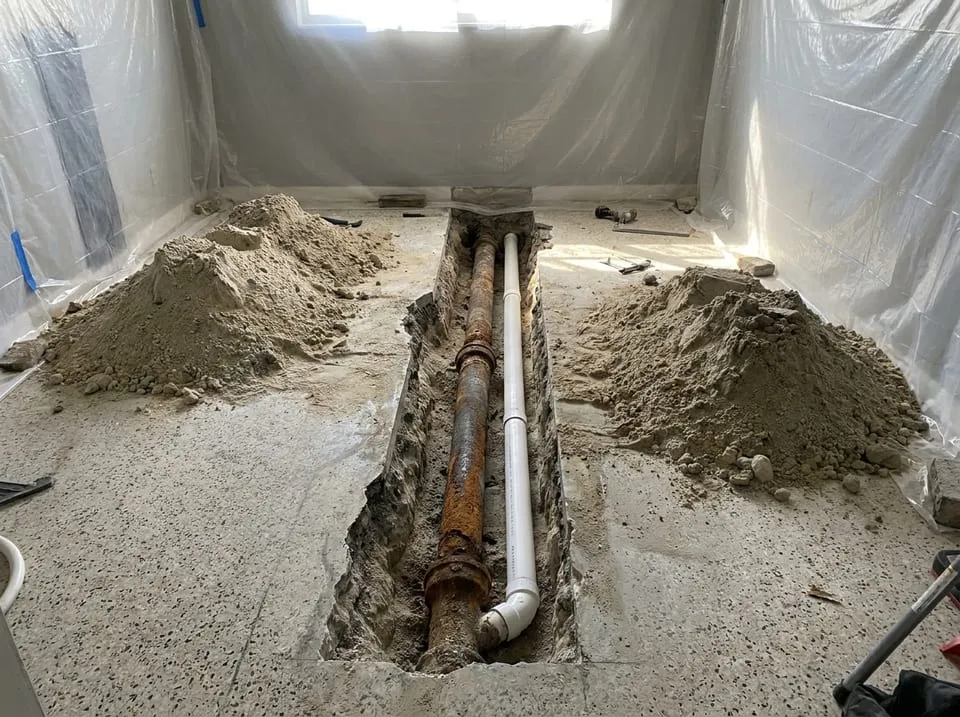
Yard runs are the cheaper half of the problem. An excavator, a trench, new pipe to spec, backfill, and sod. The house stays livable throughout and the restoration is landscaping. Depth is the one thing that changes the character of a yard job, since past roughly ten feet a trench needs collapse protection, a larger machine and more crew, and Broward’s sand does not hold a vertical wall the way clay does.
Under-slab runs change the job into a construction project. The floor is cut with a saw along the route the camera locator marked, the slab section is broken out and carried off, the trench is dug by hand inside the room because no machine fits, spoil is carried out through the house in buckets, the old iron is cut out and new PVC coupled in, and then everything is reversed: backfill, compaction, new concrete, cure time, and a finished floor. Tile, wood, and terrazzo floors rarely survive it, and matching fifty-year-old terrazzo is its own trade. Containment sheeting on every doorway is standard because slab dust goes everywhere. Families frequently move out for part of the work.
A homeowner whose 1961 house needed this described it without decoration: “We thought it would be some advanced drilling equipment, but it was just 7 dudes digging under house for days. 1100 sq ft 1961 build.” That is the honest picture, and it is why the reported durations for under-slab work run longer than the two to four days typical of a yard replacement.
The under-slab job also has a scope problem that the yard job does not. Cast iron under a house is not one pipe; it is a branched drainage system with a connection at every fixture. Each of those connections has to be reinstated, and the count of fixtures is a line item. A three-bath house has more of them than a one-bath house, and a bathroom on the far side of the slab from the main run adds floor to cut.
What goes back in is set by code, which removes one variable from the quote. Florida’s Building Code, Plumbing Chapter 7, permits PVC DWV in SDR26, SDR35, SDR41, PS50 or PS100 for sanitary drainage, so SDR 35 PVC is an approved residential spec here. The code’s clause for filled or unstable ground, written for exactly the sand and fill Broward is built on, lists ABS, cast iron, copper or copper-alloy, PVC and PP as conforming materials. A bid that does not name the pipe going in is a bid to question.
This is why we quote the yard and the slab as separate lines. They are separate decisions, and plenty of houses only need one of them done now.
Should cast iron drain pipes be replaced?
Cast iron drain pipes should be replaced when a camera names a defect that cannot be repaired in place, such as channeling along more than one section, a belly, an offset joint, or a collapse; they should not be replaced because they look rusty, since surface scale is the expected condition of fifty-year-old cast iron and is not by itself evidence of lost wall. The age of the house puts the pipe in the window. Only the footage says where in the window it sits, and two 1968 houses on the same street can be a decade apart in what the line actually looks like.
Cast iron fails from both sides at once. Inside, sewage produces hydrogen sulfide, which bacteria convert to sulfuric acid at the crown, and that acid eats the top of the pipe. Outside, damp soil corrodes the wall inward, and South Florida supplies that half generously: a high water table, sandy fill, and ground that never dries out for a season. The result is a failure pattern that surprises homeowners. The pipe does not spring one leak. It thins everywhere and then loses its bottom in the section that carries the most flow, which the trade calls channeling. On camera, a channeled pipe shows a trough instead of a round bore.
That pattern is what makes the repair-or-replace question harder for cast iron than for PVC, and it is what separates the findings below:
| Camera finding | Replace? | Why |
|---|---|---|
| Surface rust and scale, bore still round | No | Expected condition; not a wall defect |
| Single crack, sound wall either side | No | Cut out and couple, or line the section |
| Root intrusion at one joint, pipe round | No | Clear it, seal the entry point |
| Channeling across multiple sections | Yes | The next failure is already forming |
| Belly or back-pitch | Yes | Grade is a layout defect; lining preserves it |
| Offset joint or collapse | Yes | No repair or liner can bridge it |
A plumber reviewing footage of exactly this kind of line in a trade forum showed what a fair read sounds like: “Looks like a sag in the line between 15’ and 34’. Or it may be very flat and needs to be flushed and jetted. I didn’t see any cracks, offsets, or roots. Inside of cast iron pipes look like that and replacing due to rust isn’t a typical reason to replace them unless there’s a visible issue on the outside.” That is an old, ugly pipe reported as serviceable, with one specific concern at a specific distance.
The timing question follows from the same logic. A Florida homeowner asked it for the whole state: “I’m curious about how current owners of older Florida houses are dealing with the cast iron issues under their homes. Is everyone rushing to repair before the plumbing fails or are you adopting a wait and see what happens position.” Another in the thread answered for many: “I’m not spending $20K unless I have to. I’d wait until there’s an issue.” Wait and see is a legitimate posture when a camera shows no active defect. It is a gamble when the camera has never been down the line, because a planned replacement is scheduled, competitively bid and done with dry floors, and an emergency one follows sewage through the slab and adds remediation.
Can you repair a sewer line without digging it up?
A cast iron sewer line can often be rebuilt without digging by cured-in-place lining, which cures a resin sleeve into a new jointless pipe inside the old one from an existing cleanout, and that removes the excavation, which is where the money in cast iron replacement is. It requires a host pipe that still holds its shape and grade. A bellied, offset or collapsed line cannot be lined, and a line that has lost its bottom may or may not be a candidate depending on how much wall remains to support the cure.
One Florida homeowner reported 30 feet relined for $4,500 against a competing quote of $14,000 for the same job. That spread is the argument for getting the line scoped and then getting more than one bid, in that order. The per-foot band for lining sits inside the same $80 to $250 range reported for replacement, because the method displaces the excavation cost rather than the pipe cost, and the variables that move a lining quote are access, pre-cleaning, length and the number of connections, cure method, and whether the run crosses the property line.
The eligibility rule came from a working plumber in one sentence: “You can only do trenchless if your sewer line has correct pitch and is mechanically sound.” Lining preserves whatever grade the host has, including a wrong one, so a lined belly still holds water. A liner cannot cure across the step of an offset joint. And a channeled pipe, the Florida failure signature, is the case-by-case row: enough remaining wall and the liner has a form to cure against; too little and there is nothing to line.
Pipe bursting is the second trenchless route and it tolerates more, because it fractures the old pipe outward and pulls new pipe through rather than relying on the old one as a form. Florida’s Building Code sets an explicit path for it: the replacement pipe must be HDPE, SDR 17, conforming to ASTM F714, and the finished section must be inspected internally by video camera survey and approved by the code official. Under a slab inside the house, bursting is rarely practical because the pits would be indoors. We have not verified an equivalent residential CIPP approval path in the Florida Building Code, and this page does not assert one; where a permit is involved in a lining job, the answer belongs to a Broward plans examiner, in writing.
Under-slab cast iron is where lining changes the economics most, and where its limits matter most. If the interior run is corroded but still round and correctly graded, lining from a cleanout avoids the saw, the containment, the buckets of spoil and the terrazzo, and the $14,300-for-ten-feet case becomes a different job. If the interior run has channeled through, a liner has nothing to hold, and the floor comes up. The camera decides which house you are in.
The questions that keep a lining quote honest:
- What length is being lined, and where does the liner start and stop?
- What happens at the connection to the main?
- Has the full run been checked for a belly or offset?
- Is pre-cleaning a separate line?
- Does the warranty cover the whole line or only the lined section?
For a lining or replacement quote written against your own camera footage, request a free quote.
Will insurance cover cast iron pipe replacement?
A standard homeowners policy generally does not cover replacing cast iron pipe, because corrosion over fifty years is treated as wear rather than as sudden accidental loss, and in Florida the bigger insurance question about cast iron is often not a claim at all. It is renewal. Nothing on this page is a coverage determination; policies differ by carrier, by form and by endorsement, and only your policy documents and your carrier can say what yours does. What follows is the pattern Florida homeowners report and the questions that get a useful answer.
Carriers writing in this state examine original plumbing in older homes closely, and a homeowner in a Florida thread described the bind precisely. A plumber advised “don’t fix what isn’t broken,” having “seen some still going 100 years,” but “insurers in Florida will look for any reason to charge more or drop coverage.” That makes the decision partly a policy question rather than purely a plumbing one. The cost of leaving fifty-year-old cast iron in place may arrive as a surcharge, an inspection requirement, or a non-renewal rather than as a backup, and a non-renewal in this market is not a small inconvenience.
Two optional endorsements are commonly sold and are the ones to ask about. Service line coverage addresses underground lines on the property that serve the home, typically including the sewer lateral, often with a modest limit and its own deductible, and terms vary on whether wear and tear is included. Sewer and drain backup coverage addresses damage inside the house when sewage comes up through the drains, which base forms usually exclude. Neither is typically included by default. A third provision worth reading for is access or tear-out: some forms cover opening a floor to reach a pipe even when the pipe itself is excluded, and on an under-slab job that can be the larger number.
Questions worth putting to a carrier before deciding whether to replace:
- Does the policy currently ask about plumbing material or year of last repipe?
- Would documented replacement or lining change the premium or the renewal position?
- Is a camera inspection report accepted as evidence of condition?
- Is service line coverage available on this policy, and what does it exclude?
- Is backup coverage in force, and at what limit?
The answers occasionally shift the economics entirely. A homeowner who learns that a documented repipe changes a renewal decision is looking at a different calculation from one whose carrier does not ask, and the calculation should be made with the carrier’s answer in hand rather than guessed at.
Ownership is a separate question from coverage and it has its own honesty limit. In Pembroke Pines the City’s Utilities FAQ states that “all water and sewer lines from the meter to and within the dwelling are the responsibility of the property owner,” and the City maintains lines on City property only. The City does not publish a curb or property-line demarcation for the sanitary lateral, so this site does not invent one; Utilities Customer Service at 954-518-9000 is the authority for a specific address. If a line is the owner’s, and inside the house it always is, the policy questions above apply.
Our position, stated on every cast iron quote: “We quote yard and under-slab separately because they are separate decisions. Plenty of houses only need one of them done now.” That is how Sewer Line Repair Broward prices this work, and a report that states what was found, where, and how deep is the document a carrier can actually read.
Frequently asked questions
Will cast iron pipes affect my Florida homeowners insurance?
They can. Florida carriers examine original plumbing in older homes closely, and the cost of leaving cast iron in place sometimes arrives as a surcharge or a non-renewal rather than as a backup. Ask your carrier whether documented replacement or lining changes their position before deciding.
How much does it cost to replace cast iron pipes under a Florida slab?
Under-slab work is the most expensive case because the price is concrete, containment and floor rebuild rather than pipe. One Florida homeowner was quoted $14,300 for ten feet under a 1964 house. Whole-home cast iron replacement in South Florida averages near $10,000.
Should cast iron drain pipes be replaced?
Not automatically. Surface rust and scale are the expected condition of fifty-year-old cast iron and are not a verdict. Replacement is indicated by a named defect: channeling across multiple sections, a belly, an offset, or a collapse. A single crack in sound pipe is repairable.
How long does a sewer line replacement take?
A trenchless lining on a residential lateral is usually one or two days. An open-trench yard replacement typically runs two to four days including restoration. Under-slab replacement inside a house takes longer and often means moving out for part of it.
Related services
- How Long Do Cast Iron Pipes Last? Service Life in Florida HomesHow long cast iron pipes last depends on the ground. The Cast Iron Soil Pipe Institute p…
- Cast Iron Pipe Repair: When Repair Beats ReplacementCast iron can be spot-repaired when the defect is isolated and the surrounding pipe stil…
- CIPP Pipe Lining: How It Works, What It Costs, and When It Will Not WorkCIPP lining pulls a resin-saturated felt sleeve into an existing sewer pipe, inflates it…
- Sewer Line Replacement Cost in South Florida: What Drives the NumberSewer line replacement cost is set by the foot, by depth, and by what has to be restored…
- Does Homeowners Insurance Cover Sewer Line Repair in Florida?A standard homeowners insurance policy generally does not cover repair of the sewer line…