Does Homeowners Insurance Cover Sewer Line Repair on a Florida Home?
A standard homeowners insurance policy generally does not cover repair of the sewer line itself, because wear, corrosion and root intrusion are maintenance rather than sudden accidental loss. Resulting water damage is sometimes covered where the escape was sudden. Service line endorsements are sold separately. Read your own policy. Terms differ by carrier.
Does homeowners insurance cover sewer line repair in Florida?
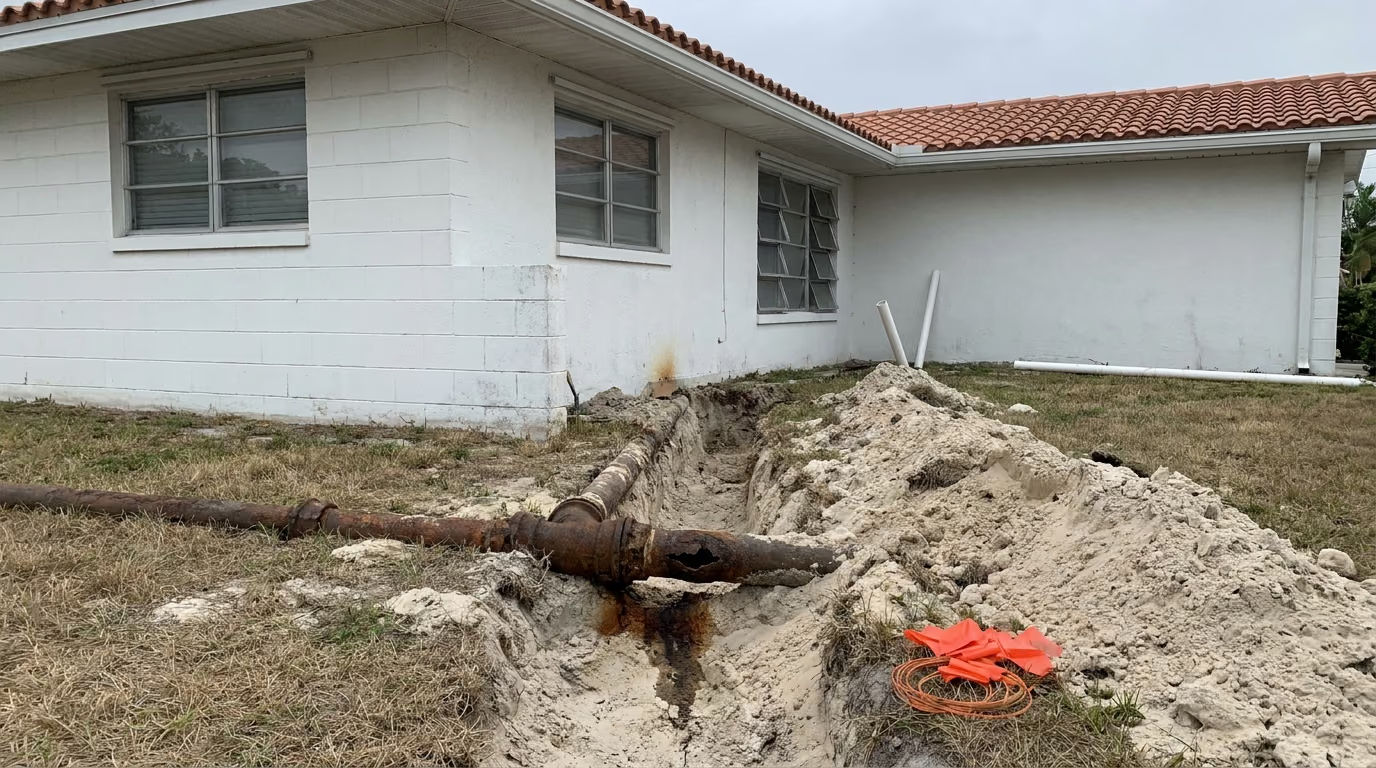
Homeowners insurance in Florida generally does not cover repairing or replacing the sewer line itself, because property policies are built around sudden and accidental loss and a pipe that has corroded over fifty years, developed a belly, or admitted tree roots is treated as deterioration, which is maintenance. Water damage inside the house from a sudden escape is often covered. Sewage backup is usually covered only by an optional endorsement. The line under the yard is usually covered only by a separate service line endorsement. This is the question homeowners ask immediately after a camera inspection, and the general answer disappoints.
Nothing on this page is a coverage determination. Policies differ by carrier, by form, and by endorsement, and only your policy documents and your carrier can tell you what yours does. What follows is how these policies are typically structured and which questions get a useful answer.
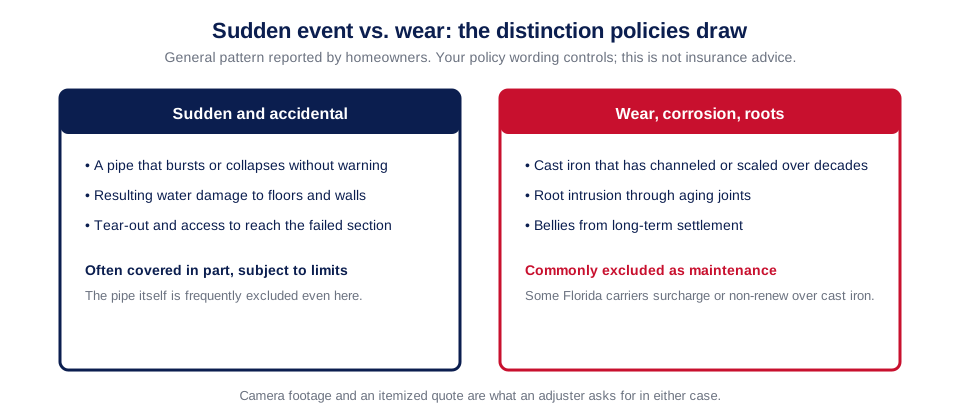
The single distinction that produces most of the outcomes is sudden versus gradual. A pipe that bursts without warning fits the idea of an accident. A pipe that thinned for five decades in South Florida’s wet sandy fill, lost its bottom where the flow was heaviest, and finally let sewage through the slab does not, even though the backup itself happened on one bad night. The failure was gradual; only the discovery was sudden.
| Situation | Typically |
|---|---|
| Repairing or replacing the deteriorated line itself | Not covered |
| Root intrusion damage to the pipe | Not covered (gradual) |
| Water damage inside the house from a sudden escape | Often covered, depending on form and cause |
| Sewage backup into the home | Only with a backup endorsement, usually optional |
| Tearing out and rebuilding a floor to access the pipe | Sometimes covered even when the pipe is not (“access” or “tear-out” provisions) |
| Damage caused by the repair work itself | Depends on the contractor’s insurance, not yours |
| The line under the yard | Only with a service line endorsement |
The access provision in row five is the one most homeowners do not know to ask about, and on an under-slab job it can be the larger number. The plumbing might be $4,000 and the concrete and flooring $9,000. A form that excludes the pipe but covers opening the floor to reach it changes the economics of an interior repair considerably, and it is worth reading for by name.
The reason the distinction bites harder in Broward than most places is the age of the pipe. The Cast Iron Soil Pipe Institute rates cast iron drain pipe at 50 to 75 years; regional reporting puts the practical figure in South Florida conditions at 40 to 50. Roughly 35% of South Florida living units built in the 1960s and 1970s went in with cast iron, and PVC did not become standard in Florida residential construction until the late 1970s. A failure on a line of that age is, by the policy’s logic, the expected end of a gradual process, and a claim framed as a sudden event on a fifty-year-old pipe is the claim most likely to be denied. The camera report that names the defect, its distance and its depth is also the document that says which side of the line a given failure falls on.
Will homeowners insurance cover a collapsed sewer line?
A collapsed sewer line is usually not covered by a standard homeowners policy, because collapse is the end state of corrosion, root damage or soil movement over years, and the policy treats the process rather than the moment as the cause; what is sometimes covered is the sudden damage inside the house that the collapse produced, and, under an access or tear-out provision, the cost of opening a floor to reach the pipe. The word “collapsed” describes an event, and a carrier will look at what led to it.
On South Florida cast iron the answer is almost always channeling. The pipe fails from the inside out and the outside in at once: hydrogen sulfide in the sewage becomes sulfuric acid at the crown, and the high water table and sandy fill corrode the wall from the soil side. The bottom goes first where flow is heaviest, the trough widens, sand washes in, and eventually the pipe no longer holds its shape. A camera that records that sequence is recording a gradual loss. A sinking spot in the yard along the line’s route, greener grass over it, and slab cracks are the surface signatures of the same process, and each of them is evidence of duration rather than suddenness.
The scenarios where a collapse might be read differently, and the questions that go with them:
- External force. A collapse caused by a vehicle, construction equipment, or a sudden ground movement is a different cause from corrosion, and some forms treat it differently. The question is whether the policy names the cause.
- A sudden escape inside. Sewage that came up through a shower pan or floor drain and ruined a floor is interior damage with a date, and that portion is often treated separately from the pipe. The question is whether the form has a backup endorsement in force, because base forms usually exclude backup.
- Access. The saw-cut slab, containment, and floor rebuild required to reach a collapsed section may fall under a tear-out provision even where the pipe does not. The question is whether the form has one and what it excludes.
- Service line. If a service line endorsement is in force, the collapsed lateral under the yard may be within its scope, subject to its limit, its deductible, and whether it excludes wear and tear.
What a claim of any of those kinds needs is documentation that states what was found, where, and how deep. A report that says “the line collapsed” gives a carrier nothing to work with. A report that says “collapse at 34 feet, five feet deep, under the driveway, with channeling from 15 feet onward” is a document a carrier can read, and it is also the honest one: it names the gradual process alongside the event, and a homeowner is better served by an accurate report than by one written to fit a claim.
The cost side of the same question is what makes it urgent. Reported South Florida figures put cast iron replacement at $80 to $250 per linear foot and whole-home replacement near $10,000; one homeowner was quoted $14,300 for ten feet under a 1964 Florida slab; a plumber on a public forum described the observed range as $5,000 to $40,000. A collapse that a policy will not pay for is a five-figure bill, and the time to learn what a policy does is before the camera finds the collapse rather than after.
What insurance covers sewer line replacement?
The insurance that covers sewer line replacement is usually an optional endorsement rather than the base policy: service line coverage addresses underground lines on the property that serve the home, typically including the sewer lateral, and sewer and drain backup coverage addresses damage inside the home when water or sewage backs up through the drains. Neither is typically included by default. Both are usually inexpensive relative to what they cover, and both are worth confirming at renewal rather than after a loss.
- Service line coverage: covers underground utility lines on the property that serve the home, typically including the sewer lateral, often with a modest limit and its own deductible. Terms vary on whether wear and tear is included, and on a fifty-year-old cast iron line that single term decides whether the endorsement responds at all.
- Sewer and drain backup coverage: covers damage inside the home when water or sewage backs up through drains. Backup is excluded from most base forms, so this is the endorsement that responds to the scenario homeowners most fear, and it is the one to check first in a slab house where the lowest fixture is a shower pan.
The two endorsements answer different halves of the same event. A lateral that channels through under the yard and backs sewage into the guest bathroom produces a pipe bill and a cleanup bill. Service line coverage is the endorsement that speaks to the first, within its limit and its wear-and-tear terms; backup coverage is the one that speaks to the second. A homeowner with one and not the other is covered for half the night.
What to read for on each, before a loss rather than after:
| Term | Why it matters |
|---|---|
| Limit | Service line limits are often modest; a run past the property line into Broward County right-of-way, with a Road Cut and Restoration Permit and a surveyor’s sealed as-built, can exceed a small limit on restoration alone |
| Deductible | Endorsements frequently carry their own, separate from the policy deductible |
| Wear and tear | The term that decides whether corrosion on old cast iron is inside or outside the endorsement |
| Where the line ends | Whether the endorsement stops at the foundation, the property line, or the connection |
| Backup limit | Interior sewage cleanup in a slab house involves flooring, drywall and remediation, and the limit should reflect that |
Ownership frames all of this. Coverage on a line only matters if the line is the owner’s to repair, and in Pembroke Pines the City’s Utilities FAQ states that “all water and sewer lines from the meter to and within the dwelling are the responsibility of the property owner.” The City maintains lines on City property only. The City does not publish a curb or property-line demarcation for the sanitary lateral, so this site does not invent one; Utilities Customer Service at 954-518-9000 is the authority for a specific address. Inside the house the line is always the owner’s, and the endorsements above are the instruments that apply to it.
A camera inspection report is the document every one of these terms is read against. It states the material, the defect, the distance and the depth, and it is reported at $150 to $400 for a residential lateral. Asked before renewal, “is a camera report accepted as evidence of condition” is a question that occasionally changes which endorsements are offered and at what price. For a documented inspection you can hand to a carrier, request a free quote.
Will cast iron pipes affect my Florida homeowners insurance?
Cast iron pipes can affect a Florida homeowners policy at renewal rather than at claim time, because carriers writing in this state look closely at original plumbing in older homes, and homeowners report the cost of leaving fifty-year-old cast iron in place arriving as a surcharge, an inspection requirement, or a non-renewal rather than as a backup. In Florida the more consequential insurance issue is often not a claim at all. It is whether the policy is still there next year.
A homeowner in a Florida discussion described the bind exactly. A plumber advised “don’t fix what isn’t broken,” having “seen some still going 100 years,” but “insurers in Florida will look for any reason to charge more or drop coverage.” That is a reported homeowner experience, stated here as one, and it is the angle most pages on this subject leave out. It changes the economics of waiting. A homeowner weighing a planned replacement against wait-and-see is usually comparing a five-figure bill against nothing, and in this market the second column is not nothing.
The houses in question are a large share of Broward’s stock. Roughly 35% of South Florida living units built in the 1960s and 1970s went in with cast iron, and PVC did not become standard here until the late 1970s, so a house built before about 1975 very likely has original iron under the slab. Per U.S. Census ACS 2024 five-year data, table B25034, the median year built is 1969 in Hollywood, 1968 in Lighthouse Point, 1971 in Wilton Manors and 1972 in Fort Lauderdale, and 83.5% of Lighthouse Point’s units predate 1980. A non-renewal in a market with that much pre-1975 housing is not a small inconvenience.
Questions worth putting to a carrier before deciding whether to replace:
- Does the policy currently ask about plumbing material or year of last repipe?
- Would documented replacement or lining change the premium or the renewal position?
- Is a camera inspection report accepted as evidence of condition?
- Is service line coverage available on this policy, and what does it exclude?
- Is backup coverage in force, and at what limit?
The answers occasionally shift the decision entirely. A homeowner who learns that a documented repipe or lining changes a renewal position is comparing the cost of the work against a premium difference or a policy that stays in force, which is a different calculation from the plumbing alone. A homeowner whose carrier does not ask about plumbing material is back to the plumbing question, which a camera answers. Either way the calculation should be made with the carrier’s answer in hand rather than guessed at, and the camera report is the document that makes the conversation specific.
The report matters because vagueness helps nobody. A carrier asked about “old cast iron” has a category; a carrier shown a recording that says “scale throughout, bore round, grade correct, no cracks, offsets or roots, re-scope in three years” has a condition. The second is a document that can support a renewal, a premium discussion, or a decision to line or replace on a schedule rather than in an emergency. Our position, stated on every inspection: “We write reports that state what was found, where, and how deep. Whether a carrier pays is between the homeowner and the carrier, and a vague report helps nobody in that conversation.” That is how Sewer Line Repair Broward writes an inspection, and it is the only kind of report a carrier can read.
Who is responsible for a broken sewer pipe?
The property owner is responsible for a broken sewer pipe from the meter inward, and in Pembroke Pines the City states it directly: “All water and sewer lines from the meter to and within the dwelling are the responsibility of the property owner.” The City maintains lines on City property only, and its Utilities Customer Service at 954-518-9000 is the authority for a specific address. Coverage and ownership are separate questions with separate answers. If a line is genuinely the utility’s, no homeowners policy is involved. If it is the owner’s, every policy question on this page applies.
There is an honesty limit on that citation and this site keeps to it. The City’s FAQ answers a leak-check question, and it establishes owner responsibility from the meter inward. It does not publish a curb or property-line demarcation for the sanitary lateral, and no sentence on this site claims one. Any page that tells a Broward homeowner exactly where their responsibility ends at the street, without citing a published boundary, is stating something the City has not stated. The right move for a specific address is the phone number, and the ownership question has its own page on this site with the City’s wording in full.
What the ownership answer settles in practice:
- Inside the house and under the slab, the drainage system is the owner’s without exception, which is why under-slab cast iron is the homeowner’s bill and the homeowner’s policy question.
- Under the yard, from the house toward the meter, the City’s wording puts the line on the owner’s side.
- In the public right-of-way, the question of who owns the pipe is separate from the question of who pays to restore the surface, and on the second one Broward County is explicit: disturbed right-of-way “shall be restored by owner or utility at owner’s or utility’s own expense and Broward County will have no responsibility therefore.” A Road Cut and Restoration Permit covers the roadway including signage and striping, and water and sewer work requires as-builts signed and sealed by a Professional Land Surveyor registered in Florida.
The last point is where ownership and cost meet. A repair that runs past the property line carries permit, repaving and survey line items that a private-side repair does not, and a homeowner asking whether insurance covers the work should also be asking whether the work is theirs to do at all. A camera run with a locator answers that on the lawn: the defect is at a distance from the cleanout and a depth from the surface, and the paint mark is either on the private side of the line or it is not.
Where a homeowner and a utility disagree about whose pipe has failed, the recording is again the useful document. It shows the defect, its distance, and the material, and a footage counter reading that places a collapse at 60 feet from a cleanout on a lot that is 50 feet deep is a fact both sides can look at. Reported figures put a residential camera inspection at $150 to $400, and a full lateral replacement to the main at $10,000 to $30,000, which is the range of the question the inspection settles.
The three documents a homeowner needs before a sewer conversation with a carrier or a utility are the same three: the policy with its endorsements, the City’s statement of ownership, and a camera report that names the defect, the distance and the depth. This page is about the first two. The third is the one we produce.
Frequently asked questions
Will cast iron pipes affect my Florida homeowners insurance?
They can. Florida carriers examine original plumbing in older homes closely, and the cost of leaving cast iron in place sometimes arrives as a surcharge or a non-renewal rather than as a backup. Ask your carrier whether documented replacement or lining changes their position before deciding.
Related services
- Who Owns the Sewer Line From the House to the Street?For the sewer line running from the house toward the street, the City of Pembroke Pines…
- How Long Do Cast Iron Pipes Last? Service Life in Florida HomesHow long cast iron pipes last depends on the ground. The Cast Iron Soil Pipe Institute p…
- Cast Iron Pipe Replacement Cost in South FloridaReported South Florida cast iron replacement runs $80 to $250 per linear foot, with whol…
- Broken Sewer Line: What the Signs Look Like in a Florida HomeA broken sewer line shows itself through repeat backups, a persistent sewer smell at flo…