How Long Do Cast Iron Pipes Last?
How long cast iron pipes last depends on the ground. The Cast Iron Soil Pipe Institute puts cast iron at 50 to 75 years. In South Florida's sandy fill, high water table and year-round moisture, the practical figure runs closer to 40 to 50 years. A Florida house built before about 1975 is at or past that window.
How long do cast iron pipes last in South Florida?
Cast iron pipes last 50 to 75 years by the Cast Iron Soil Pipe Institute’s figure and closer to 40 to 50 years in South Florida, where regional field reporting puts the practical service life below the national range because of the ground the pipe sits in. Cast iron does not fail on a schedule, and the honest answer to how long it lasts is a range wide enough to be frustrating. What narrows it is knowing which conditions accelerate corrosion, and South Florida has most of them.
| Material | Service life | Source |
|---|---|---|
| Cast iron | 50–75 years | Cast Iron Soil Pipe Institute (CISPI) |
| Vitrified clay | 50–60 years before joints separate and pipes crack | IAPMO |
| Orangeburg (bituminized fiber) | 30–50 years | IAPMO |
| Cast iron, South Florida conditions | 40–50 years in practice | Regional contractor reporting |
CISPI and IAPMO are standards bodies rather than contractors, which is why their figures are the ones worth quoting. The South Florida number is a field observation from regional work, and it sits below the national figure for reasons that are specific to the ground here.
Cast iron drain pipe fails from the inside out and the outside in at the same time. Inside, sewage produces hydrogen sulfide, which bacteria convert to sulfuric acid at the pipe crown. That is what eats the top of the pipe. Outside, moisture and dissolved minerals corrode the wall from the soil side.
South Florida supplies the outside half generously. The water table sits high, much of the residential fill is sand rather than clay, and the ground never dries out for a season the way it does further north. A pipe that spends fifty years in permanently damp, well-aerated sand corrodes faster than the same pipe in dry inland soil, and it does so along its whole length rather than at isolated wet spots. Florida’s Building Code acknowledges the ground in its own terms: Plumbing Chapter 7 carries a clause for building sewers on filled or unstable ground, which is what most of Broward is built on, and lists the materials that conform there.
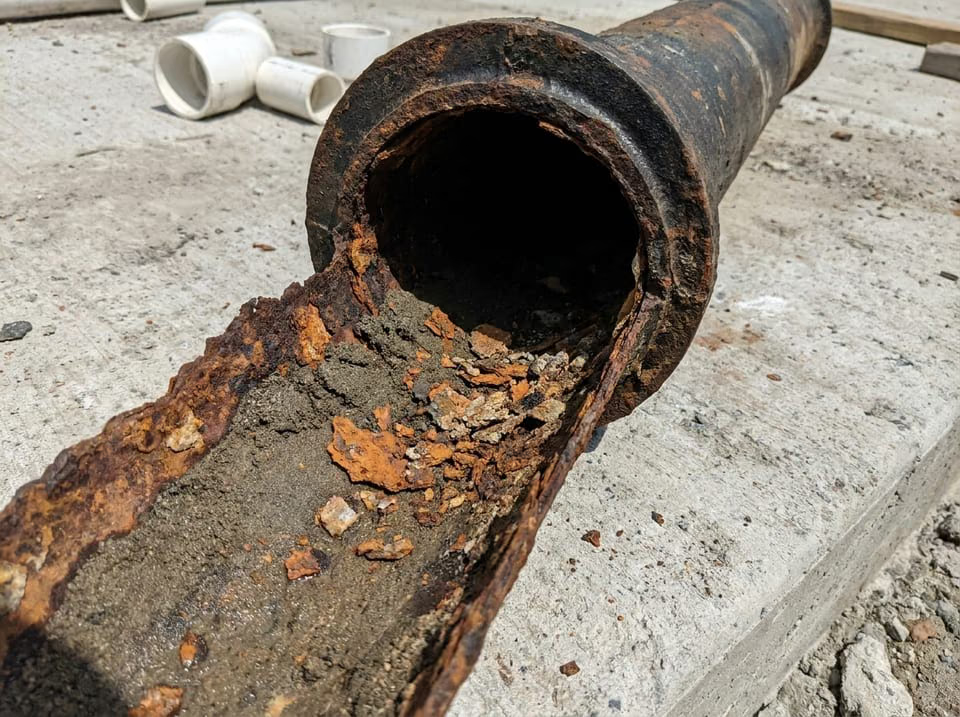
The result is a failure pattern that surprises homeowners: the pipe does not spring one leak, it thins everywhere and then loses its bottom in the section that carries the most flow. The trade calls it channeling, and the photograph at the top of this page shows it, a length of excavated drain pipe with its lower half corroded away until the pipe is an open trough. On camera, a channeled line shows a flat floor of sand and scale where a round bore should be.
The range on the table, then, is not a countdown. It is the span inside which a camera should be looking. A 45-year-old line in Broward can be channeled through or can be scaled, ugly and serviceable, and the difference is not visible from the year the house was built. It is visible on a monitor, with a distance counter, from a cleanout.
Should I buy a house with cast iron pipes?
A house with cast iron pipes is worth buying when a camera inspection before closing shows the line is serviceable, and the year that decides whether a Florida house is likely to have cast iron at all is about 1975. PVC became standard in Florida residential construction in the late 1970s. Before that, and particularly through the boom years, cast iron was the default: roughly 35% of all of today’s living units in South Florida were built during the 1960s and 1970s with cast iron drain lines, per regional reporting.
That gives a usable threshold. A Florida home built before about 1975 very likely has original cast iron under the slab, and that pipe is now 50 years old or more. A home built after about 1980 almost certainly has PVC and is not in this conversation at all.
Broward’s housing stock makes that threshold consequential rather than academic. Using U.S. Census ACS 2024 five-year data, table B25034:
- Hollywood: median year built 1969, with 52.8% of units built before 1970
- Lighthouse Point: median 1968, 83.5% pre-1980
- Fort Lauderdale: median 1972, 66.3% pre-1980, on 101,234 total units
- Oakland Park: median 1972, 45.6% pre-1970
- Wilton Manors: median 1971, 73.7% pre-1980
- Pembroke Pines: median 1992, only 23.1% pre-1980, and largely outside the cast iron era
A buyer looking at the median house in Hollywood or the Lighthouse Point equivalent is looking at cast iron at or past the South Florida practical range. A buyer in Pembroke Pines usually is not, and the camera there is more often checking PVC for a belly than iron for channeling.
A buyer in exactly this position asked the question for the whole state: “I want to buy a 1977 built home in Florida. These cast iron pipes are under the slab. Should I run? Candidate for lining?” The best answer in the thread was the plain one: get a video inspection to see the current state inside, rather than speculate its life off external appearance. A pre-purchase camera inspection with a written report is reported at $250 to $500, and on a pre-1975 house it can identify a five-figure liability while the contract is still negotiable.
The liability is not hypothetical. One buyer under contract on a 1964 Florida house reported: “The bid to replace 10 feet of pipe under the slab was $14.3k. Seller wouldn’t even negotiate so I wish the current buyer lots of luck.” That is the figure a camera inspection exists to surface before closing rather than after. Reported South Florida cast iron replacement runs $80 to $250 per linear foot and averages near $10,000 per home, and an inspection costing a small fraction of that is the only instrument that says which house a buyer is looking at.
What the buyer should ask the inspector for is the recording, the findings in defect-and-distance form, and the list of what was not found. On a serviceable line that report says the plumbing is fine and the year built is just a year. On a defective line it is the foundation of a repair estimate and a reason to reprice the house.
Do cast iron pipes need to be replaced?
Cast iron pipes need to be replaced when a camera names a defect that cannot be repaired in place, and a fifty-year-old line that shows only rust and scale does not need to be replaced on age alone; it is automatically worth looking at, and it is not automatically a replacement. The distinction matters because the industry’s incentive runs toward the first reading, and homeowners are right to be suspicious of it.
One plumber reviewing camera footage of an old line described what a real assessment sounds like: “Looks like a sag in the line between 15’ and 34’. Or it may be very flat and needs to be flushed and jetted. I didn’t see any cracks, offsets, or roots. Inside of cast iron pipes look like that and replacing due to rust isn’t a typical reason to replace them unless there’s a visible issue on the outside.” That is a fifty-year-old pipe being reported as serviceable, with a specific defect at a specific distance.
Rust and scale on the inside of an old cast iron pipe are expected and are not, on their own, a verdict. What changes the verdict is a defect the camera can name and locate:
- Channeling: the bottom of the pipe corroded away, leaving a trough instead of a round bore
- Cracks or fractures through the wall, as opposed to surface scale
- Offsets at joints where sections have shifted apart
- Bellies or sags holding standing water, which no amount of cleaning corrects
- Root intrusion, which proves an opening already exists
Each of those carries a number. The footage counter on the reel ties every observation to a distance from the cleanout, and a locator on the surface picks up the camera head’s sonde and marks the position and depth on the lawn or the floor. “Sag between 15 and 34 feet” is a finding that can be located, priced and bid against by three contractors. “It looks bad” is not a finding.
Which of those defects leads to which fix is the next question, and the answers are not all replacement. A single crack with sound wall either side is a spot repair. Root intrusion at one joint on a pipe that is otherwise round is a clearing and a sealed entry point. A corroded but round and correctly graded line is a lining candidate. Channeling across several sections, a belly, an offset or a collapse are the findings that point to replacing the run, and they point there because a repair to one section of a channeled line leaves thinned wall either side of the coupling, and the next failure is already forming.
The camera is also what stops a serviceable pipe from being sold as a replacement. A homeowner in a real-estate forum put the worry bluntly: “You need a contractor that ‘scopes’ only - and is NOT part of a plumbing company. That way you will know if it’s legit and not a ruse to get a huge job.” Hiring a scope-only inspector is one workable answer. The simpler one is to hold a copy of the recording, because a diagnosis that can be sent to a second contractor is a diagnosis that has to survive a second read. A replacement quote justified by rust alone does not usually survive one.
How expensive is it to replace cast iron pipes?
Replacing cast iron pipes in South Florida is reported at $80 to $250 per linear foot, with whole-home replacement averaging near $10,000, and the band is that wide because the price is set by where the pipe runs rather than by how much of it there is. A yard lateral under St. Augustine grass sits at the bottom of the range. The same pipe under a terrazzo floor inside the house can cost more for ten feet than the average for a whole home, and one Florida homeowner was quoted exactly that: $14,300 for ten feet under a 1964 slab.
The reported figures, with their sources:
| Scope | Reported figure | Source |
|---|---|---|
| Per linear foot, South Florida | $80–$250 | Regional contractor reporting |
| Whole-home replacement, average | ~$10,000 | Regional contractor reporting |
| 10 ft under-slab section, quoted | $14,300 | Homeowner report, 1964 Florida house |
| 30 ft relined, two quotes for the same job | $4,500 vs $14,000 | Homeowner report |
| Observed job range | $5,000–$40,000 | Plumber, public forum |
These are reported ranges from homeowners and regional contractors, not our prices. They are on this page because the spread is the single most useful thing a homeowner can know before taking a bid, and because the age of the house does not predict which end of it a job will land on.
What moves the number is access. Depth changes the character of a trench past roughly ten feet, where collapse protection, a larger machine and more crew come in, and Broward’s sand does not hold a vertical wall the way clay does. The surface above the pipe decides the restoration line, which on interior work frequently exceeds the plumbing: saw-cut slab, containment, spoil carried out in buckets, backfill, new concrete and a finished floor. A run that continues past the property line into Broward County right-of-way adds a Road Cut and Restoration Permit covering signage and striping and an as-built signed and sealed by a Florida-registered Professional Land Surveyor. The pipe itself is the cheapest input. Florida’s Building Code permits PVC DWV in SDR26, SDR35, SDR41, PS50 or PS100, so SDR 35 PVC is an approved residential spec, and a bid that does not name the pipe going in is a bid to question.
Lining is where the number changes most, because it removes the excavation. A cured-in-place liner installed from a cleanout leaves the floor alone, and the homeowner who reported paying $4,500 for 30 feet of relining was paying for resin, pre-cleaning and a day’s work rather than for concrete. The same homeowner reported a first quote of $14,000 for the same job, which is why a single bid is not a price. Lining requires a host pipe that still holds its shape and grade; a channeled line is case by case depending on how much wall remains, and a bellied or collapsed one cannot be lined at all.
A planned replacement is bid three times against the same footage and done with dry floors. An emergency replacement is bid once, after sewage has come up through the slab, with remediation on top. The reported range on this page is wide enough to hold both, and the camera run is what decides which one a house gets.
Should I replace my cast iron pipes now, or wait until they actually fail?
Waiting is a legitimate posture when a camera shows an old cast iron line with no active defect, and it is a gamble when the camera has never been down the line, because the two outcomes it is gambling between are not symmetric. A planned replacement is scheduled, quoted competitively, and done with the floors dry. An emergency replacement happens after sewage has come up through the slab, and it carries remediation on top of the plumbing. The real question is rarely “how long does cast iron last.” It is whether to act now or wait for a failure.
A Florida homeowner asked it directly: “I’m curious about how current owners of older Florida houses are dealing with the cast iron issues under their homes. Is everyone rushing to repair before the plumbing fails or are you adopting a wait and see what happens position.” Another in the thread answered for many: “I’m not spending $20K unless I have to. I’d wait until there’s an issue.”
There is no universally right answer, and both positions are defensible on a scoped line. On an unscoped one, wait-and-see is a bet placed without looking at the cards. The camera run that costs $150 to $400 tells the waiting homeowner that waiting is safe for now, and tells the acting homeowner exactly what to bid on, and either way the next scope in a few years is measured against a recording rather than a memory.
The Florida wrinkle is insurance. Carriers here look closely at old plumbing at renewal, and a homeowner in the same thread described the bind exactly: a plumber advised “don’t fix what isn’t broken,” having seen some pipe still going after 100 years, but “insurers in Florida will look for any reason to charge more or drop coverage.” The cost of doing nothing sometimes arrives as a surcharge or a non-renewal rather than as a backup. That is a reported homeowner experience, not insurance advice, and the useful step is to ask a carrier, before deciding, whether a camera report or a documented replacement changes their position. Nothing on this page is a coverage determination; only a policy and a carrier can say what a policy does.
The decision, laid out the way it actually presents:
| Camera finding | Reasonable posture |
|---|---|
| Rust and scale only, bore round, grade correct | Wait, and re-scope in a few years |
| Single crack or one rooted joint | Repair that section now; it is cheap while it is small |
| Corroded but round along the run | Get lining bids now, while it is still linable |
| Channeling in more than one section | Plan the replacement; the next failure is forming |
| Belly, offset or collapse | Replace that section before it backs up |
The third row is the one with a clock on it: a line that is linable today may channel through in a few years and stop being linable, at which point the floor comes up.
Our position, stated on every inspection: “A camera run tells you which decade the pipe is in, not just how old the house is. Two 1968 houses on the same street can be ten years apart in what the line actually looks like.” That is how Sewer Line Repair Broward reads a cast iron line, and the homeowner keeps the file either way.
To find out where your line sits in that range, request a free quote and we will confirm what the inspection covers before scheduling.
Frequently asked questions
Should I replace my cast iron pipes now, or wait until they actually fail?
There is no universal answer, but the two paths are not equal. A planned replacement is scheduled, competitively quoted, and done with dry floors. An emergency one follows a backup and adds remediation. In Florida a third factor applies: carriers examine original plumbing at renewal.
Should cast iron drain pipes be replaced?
Not automatically. Surface rust and scale are the expected condition of fifty-year-old cast iron and are not a verdict. Replacement is indicated by a named defect: channeling across multiple sections, a belly, an offset, or a collapse. A single crack in sound pipe is repairable.
Should I buy a Florida house that still has cast iron pipes under the slab?
Not without scoping it first. A camera inspection before closing costs $150 to $400 and produces recorded footage naming any defect and its distance. On a pre-1975 Florida house that can identify a five-figure liability while the contract is still negotiable.
Related services
- Cast Iron Pipe Repair: When a Section Can Be SavedCast iron can be spot-repaired when the defect is isolated and the surrounding pipe stil…
- Cast Iron Pipe Replacement Cost: South Florida FiguresReported South Florida cast iron replacement runs $80 to $250 per linear foot, with whol…
- CIPP Pipe Lining: How Cured-in-Place Lining Works and When It Does NotCIPP lining pulls a resin-saturated felt sleeve into an existing sewer pipe, inflates it…
- Sewer Camera Inspection Cost and What the Footage ShowsA residential sewer camera inspection typically costs $150 to $400. A camera on a push r…
- Does Homeowners Insurance Cover Sewer Line Repair on a Florida Home?A standard homeowners insurance policy generally does not cover repair of the sewer line…