CIPP Pipe Lining: How It Works, What It Costs, and When It Will Not Work
CIPP lining pulls a resin-saturated felt sleeve into an existing sewer pipe, inflates it against the pipe wall, and cures it into a hard, jointless pipe inside the old one. It avoids digging, but it requires a host pipe that still holds its shape and grade. A collapsed, offset, or back-pitched line cannot be lined.
How does CIPP pipe lining work?
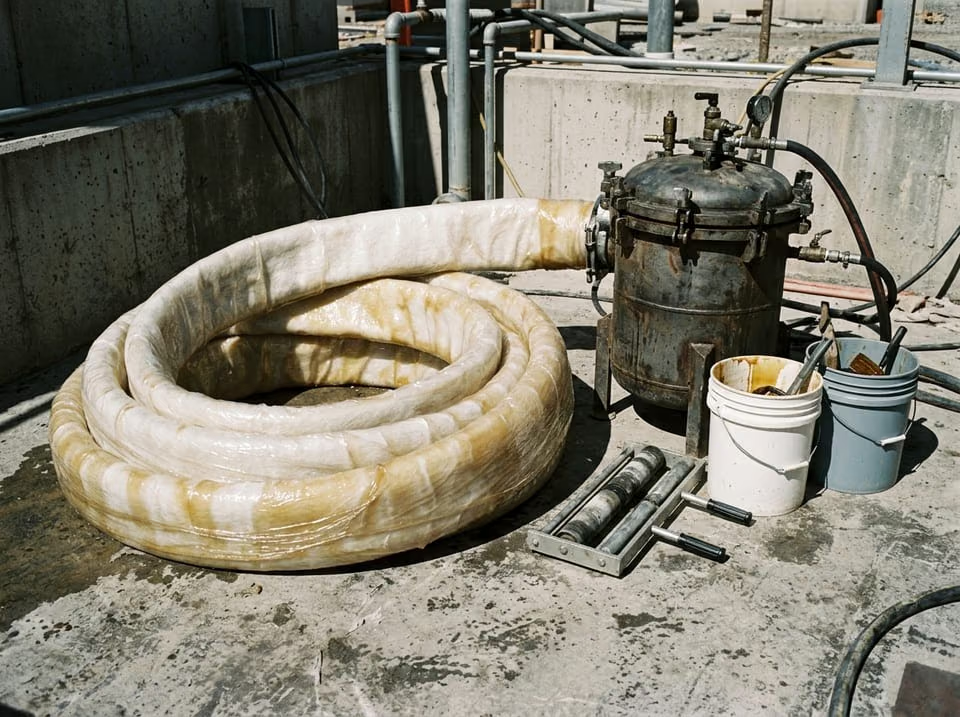
CIPP pipe lining, cured-in-place pipe lining, works by saturating a felt or fiberglass sleeve with a thermosetting resin, pulling or inverting it into the host pipe through an existing cleanout, inflating it with air or water so it presses tight against the pipe wall, and curing it with ambient heat, hot water, steam or ultraviolet light into a continuous pipe with no joints. The old pipe stays in the ground as the form. For a Broward house with original cast iron under a slab, it is the difference between a crew working from two access points and a crew opening the floor of the house.
The sequence on a residential lateral runs in a fixed order, and each step exists for a reason:
- Camera run first. The line is scoped end to end, with the footage counter giving length and a locator giving depth at each defect. This is where eligibility is decided, before any resin is ordered.
- Pre-cleaning. Scale is descaled and any root mass is jetted and cut out, because the liner cures against whatever surface it meets. On a fifty-year-old cast iron line this can be a day on its own.
- Measurement and wet-out. The liner is cut to length for the run and saturated with resin, either on site or in a controlled facility, then kept cool until installation.
- Installation. The sleeve is inverted or pulled into place from the cleanout, then inflated so it takes the shape of the host pipe along its full length.
- Cure. The resin hardens by the method the system uses. Ambient cure is slowest and cheapest; hot water, steam and UV are faster and cost more to mobilize.
- Reinstatement. Lateral connections that the liner covered are reopened from inside with a robotic cutter.
- Post-cure camera. The finished bore is scoped again to confirm the liner is fully cured, the laterals are open, and no fins or wrinkles remain.
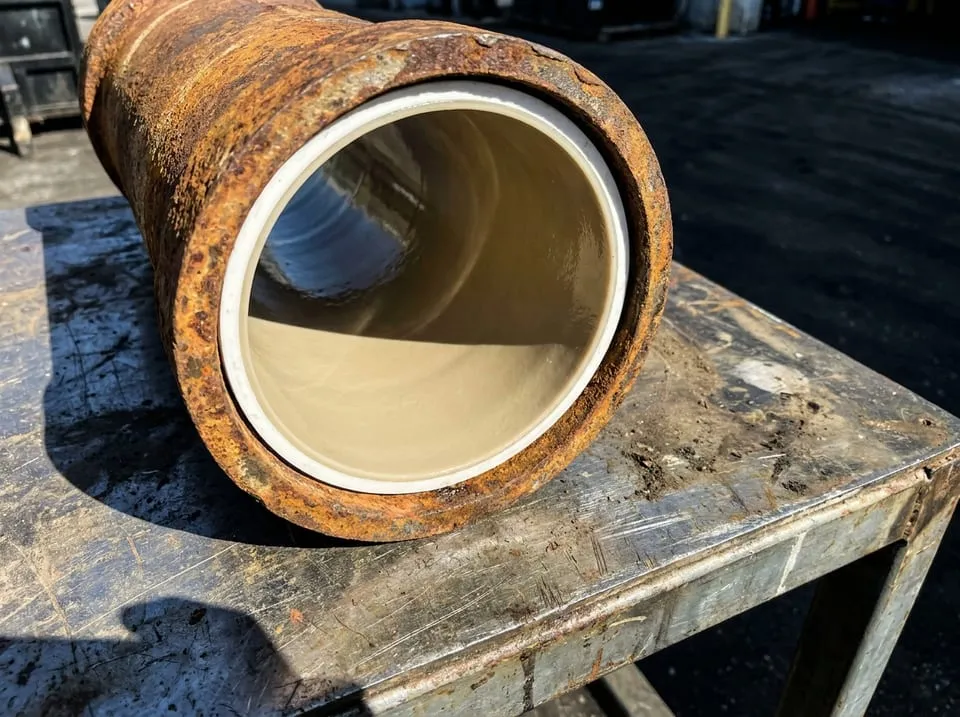
The finished liner is typically 3 to 6 millimeters thick, so a lined 4-inch line loses a small amount of internal diameter. That reduction is usually offset by the fact that the new surface is smooth, where the cast iron it replaced was scaled and rough. Flow capacity in practice tends to be equal or better. The photograph above shows the result in section: a glossy cured liner sitting inside a pitted, tuberculated host, the two walls visibly distinct.
The whole operation on a residential lateral is normally a one- or two-day job, and the excavation is limited to access pits if no usable cleanout exists. Older Broward houses frequently have no exterior cleanout, in which case installing one is often the first line on the quote and makes every future service call cheaper.
The method is also oversold, and the limits are structural rather than commercial. A liner takes the shape of the pipe it cures inside, including the wrong shape. The rest of this page is about when that matters.
Can my sewer line be repaired trenchless, or does it have to be dug up?
A sewer line can be lined when the host pipe still holds its shape and its grade, and it has to be dug up when it has bellied, offset at a joint, or collapsed, because the liner needs a continuous form to cure against and it reproduces whatever form it finds. A working plumber in a trade forum wrote the eligibility rule plainly: “You can only do trenchless if your sewer line has correct pitch and is mechanically sound.” That sentence is the whole gate. A quote for lining issued without a camera run is a quote for something nobody has confirmed is possible.
| Host pipe condition | Can it be lined? | Why |
|---|---|---|
| Corroded, scaled, hairline-cracked, still round | Yes | The liner needs a shape to cure against, not a sound pipe |
| Root intrusion at joints, pipe otherwise intact | Usually | Roots are cut and jetted out first, then the joints are sealed by the liner |
| Bellied or back-pitched section | No | Lining preserves the existing grade, including the wrong grade |
| Offset joint or significant misalignment | No | The liner cannot bridge a step it has to cure across |
| Collapsed or crushed section | No | There is no host pipe left to line |
| Missing pipe bottom from long-term corrosion | Case by case | Depends how much wall remains to support the cure |
The first row is the one that surprises homeowners in the right direction. A liner does not need a sound pipe. It needs a round one. Fifty-year-old cast iron that is dark, scaled and pitted along its whole length, the expected condition of Broward pipe from the 1960s and 1970s, is a good candidate as long as the bore is still a bore and the grade still falls toward the main.
The belly row is the one that surprises them in the wrong direction. A sag between 15 and 34 feet holds standing water and settles solids, and a liner cured through it holds exactly the same water in exactly the same place. The lined pipe is permanent, and so is the belly. A second commenter in the same thread named the other disqualifiers in one line: if the pipe is collapsing or offset you will not be able to do trenchless. An offset leaves a step the sleeve bridges with a void behind it; a collapse leaves nothing to inflate against.
The last row is the Florida case. Cast iron under a South Florida slab fails by channeling, losing its bottom to corrosion until the pipe is a trough, and whether a trough can be lined depends on how much wall is left to support the cure. Enough and the liner has a form; too little and there is nothing to line, and the floor comes up.
Every row is read from footage. The camera gives shape, the footage counter gives length, the locator gives depth, and the picture of standing water gives grade. A homeowner holding that recording can ask any bidder which row their line is in and expect a specific answer with a distance attached. A bidder who quotes lining without having seen the run is guessing about the third and fourth rows, and those are the ones that turn a lining job into a replacement after the resin has been paid for.
Does relining actually stop tree roots, or will they come back?
Relining stops tree roots along the length it covers, because a cured liner is jointless and roots enter through joints and cracks, so a correctly installed full-length liner removes the entry points on the lined run; roots come back when the liner is partial, when it stops short of the connection to the main, or when the pipe beyond the lined section still has its original joints. The most useful criticism of lining comes from plumbers rather than customers, and it deserves to be heard in full.
On the question of roots, one plumber in a trade forum wrote: “Anyone here saying lining is not a seasoned plumber. If cast iron did not stop those roots what makes you think a liner will? Your decision to make is to have it dug up and replaced, or use root killer and have it snaked with chain knockers every couple years.”
The objection has force, and the honest answer is conditional. Roots cannot penetrate sound pipe. They follow moisture, and a sewer line only leaks moisture where it is already open, at a joint that has shifted, a crack, or a corroded section. A liner cured through the full run closes every one of those openings with a continuous wall, and along that run the entry points stop existing. What the liner does not do is remove the tree, change the soil, or protect any pipe it does not cover.
That last clause is where the criticism lands, and it lands fairly. A liner that covers thirty feet of a fifty-foot lateral leaves twenty feet of original joints for roots to find, and roots will find whichever joint is left. A liner that stops short of the connection at the main leaves the most root-prone joint in the system untouched, because that connection is the one joint the homeowner’s contractor did not make and the one most likely to have moved. Lining a section and calling the root problem solved is the failure mode.
The practical version is three questions, and vague answers to any of them mean a vague warranty:
- What is the total length of the lateral, and how much of it is being lined?
- Where does the liner start and where does it terminate?
- What happens at the connection to the main?
The plumber’s alternative is also real and also has a cost. Repeat clearing with a cable or chain knocker and a root herbicide is reported at a few hundred dollars a visit, and it manages the defect indefinitely rather than fixing it. Each clearing pulls the root back; the root that stayed in the crack keeps levering it wider, which eventually admits soil as well as roots and turns a repairable joint into a section washed out beneath the slab. The choice is between a liner that covers the whole run, an excavation that replaces the defective section, and a standing annual appointment.
In Broward the roots in question are usually ficus, live oak, black olive and palm, all with aggressive lateral root systems and all commonly planted along the property line where the lateral runs. A camera after jetting shows the opening the roots came through and how many joints they have reached, which is what decides whether a liner covering the full run is a fix or a partial one.
How much does sewer pipe lining cost, and why do quotes vary so much?
Sewer pipe lining in South Florida is reported at around $80 to $250 per linear foot, the same band regional contractors report for cast iron work generally, because lining displaces the excavation cost rather than the pipe cost; quotes vary as much as three to one because access, pre-cleaning, cure method and length are priced differently by every company, and some of them are pricing a line they have not scoped. One Florida homeowner on a public forum said it exactly: “Pipe relining! No digging and I got 30’ relined for $4.5 grand. Get different quotes first company quoted $14 grand.”
That is not a small variance and it is not usually explained by materials. The resin and felt for 30 feet of 4-inch liner cost roughly the same for every installer. What differs is everything around them, and the variables that genuinely move the price are these:
- Access: whether a usable cleanout exists or access pits have to be dug, and whether a cleanout has to be installed first
- Length and diameter of the run, and how many lateral connections need reinstating with the robotic cutter
- Pre-cleaning: heavy scale or root mass means jetting and cutting before any liner goes in, sometimes a full day
- Cure method: ambient, hot water, steam and UV in ascending order of mobilization cost
- Whether the run leaves the property line, which brings Broward County right-of-way restoration, a Road Cut and Restoration Permit including signage and striping, and a surveyor’s sealed as-built into scope
Whole-home cast iron replacement in South Florida is reported at an average near $10,000, and a lining job on a residential lateral generally lands in the same territory per foot. Where lining changes the economics is under a slab. The homeowner-reported quote of $14,300 for ten feet of under-slab replacement on a 1964 Florida house is almost entirely concrete, containment and floor, and a liner from the cleanout, if the line qualifies, removes nearly all of that. On an open yard run under sod, the excavation a liner avoids was cheap, and a conventional trench is sometimes the cheaper job.
Get more than one quote. In a market where the same 30 feet drew $4,500 and $14,000, a single bid is not a price. It is one company’s opinion of what the job is worth. What makes two lining bids comparable is that both are written against the same recorded camera run, both name where the liner starts and terminates, both put pre-cleaning on its own line, and both state whether the price stops at the property line.
The Sewer Line Repair Broward field team puts it this way on every lining quote: “We scope the line, show the homeowner the footage, and say whether it can be lined or not. If there is a belly in it, lining preserves the belly. So we say replace, and we lose the easier job.” That is how Sewer Line Repair Broward decides between lining and replacement, and a lining bid from us is only ever written against footage the homeowner holds.
To find out whether your line is a lining candidate, request a free quote and we will confirm what the camera inspection covers first.
What are the disadvantages of CIPP lining?
The disadvantages of CIPP lining are that it reproduces every layout defect in the host pipe, including a belly or back-pitch, so it cannot fix grade; that it reduces the internal diameter by the thickness of the cured liner; that a partial liner leaves the unlined joints as root-prone as they were; that pre-cleaning a scaled cast iron line can add a day and a line item; and that a residential CIPP approval path in the Florida Building Code has not been verified by this site. None of these is a reason to avoid lining. Each is a reason to ask a specific question before the resin is mixed.
The grade limitation is the one that cannot be engineered around. A liner takes the shape of the pipe it cures inside, so a sag is a lined sag and the standing water stays where it was. Pipe bursting, the other trenchless method, occasionally allows re-grading because it destroys the old pipe rather than using it as a form; lining never does. A footage counter and a locator show a belly before any resin is ordered, which is why the camera run comes first and why a belly on the footage turns a lining quote into a replacement quote.
Diameter loss is real and usually minor. A cured liner is a few millimeters thick, so a lined 4-inch line is slightly smaller in bore. The scaled, rough cast iron it covers was already restricting flow, and the smooth liner tends to carry equal or better flow in practice. On a line that was undersized to begin with, the reduction matters more, and bursting, which can upsize, is the better answer.
The code question is the one this site answers by stating what it has not confirmed. Florida’s Building Code, Plumbing Chapter 7, sets out an explicit path for trenchless pipe bursting: the replacement pipe must be HDPE, SDR 17, conforming to ASTM F714, and the finished section must be inspected internally by video camera survey and approved by the code official. That requirement is written into the code. We have not verified an equivalent residential CIPP approval path in the Florida Building Code, so this page does not tell you there is one. If a permit is involved in your job, the question belongs to a Broward plans examiner, and the answer should be in writing before the resin is mixed.
The comparison against open trench, for the decisions that matter:
| Decision | CIPP lining | Open trench replacement |
|---|---|---|
| Surface disturbance | None with a cleanout; pits without one | Full trench, plus whatever is above it |
| Fixes a belly or offset | No | Yes |
| Diameter | Slightly reduced | As specified, SDR 35 PVC approved in Florida |
| Joints | None along the lined run | New joints, new pipe |
| Pre-cleaning required | Yes, on scaled or rooted pipe | No, the old pipe is removed |
| Florida code path | Not verified on this site | Explicit in Chapter 7 |
| Typical duration on a lateral | One or two days | Two to four days including restoration |
What goes back in an open trench is fixed by the same code chapter: PVC DWV is permitted in SDR26, SDR35, SDR41, PS50 or PS100, and on filled or unstable ground, the clause written for the sand Broward is built on, conforming materials are ABS, cast iron, copper or copper-alloy, PVC and PP. A lining bid and a trench bid put side by side on those rows usually decide themselves, and the camera decides which rows apply.
Frequently asked questions
Can you repair a sewer line without digging it up?
Often, yes. Cured-in-place lining rebuilds the pipe from the inside through an existing cleanout, and pipe bursting replaces it through access pits. Both require the line to be a suitable candidate: lining preserves existing grade, so a belly or an offset rules it out.
Does relining actually stop tree roots, or will they come back?
A cured liner is jointless, and roots enter at joints and cracks, so along the lined run the entry points stop existing. The failure mode is partial coverage: a liner covering thirty of fifty feet leaves twenty feet of original joints for roots to find.
How much does sewer pipe lining cost, and why do quotes vary so much?
South Florida figures run about $80 to $250 per linear foot. Variance is driven by access, pre-cleaning, cure method, and length. One Florida homeowner had 30 feet relined for $4,500 after a first quote of $14,000 for the same job, so get more than one bid.
Can my sewer line be repaired trenchless, or does it have to be dug up?
Eligibility is decided by the pipe, not the budget. As one plumber put it, you can only do trenchless if the line has correct pitch and is mechanically sound. A bellied, offset or collapsed line cannot be lined. Camera footage settles it before any quote is meaningful.
What happens if the repair doesn't hold?
We fix it right the first time or it's free. If the section we repaired fails again from the same defect, we come back and redo the work at no charge. The camera footage from the original visit is what settles whether a new problem is the same defect returning or a separate one.
Related services
- Sewer Pipe Lining for Broward County HomesWe line sewer pipes for Broward County homeowners by curing a resin sleeve inside the ex…
- Cast Iron Pipe Repair: When a Section Can Be SavedCast iron can be spot-repaired when the defect is isolated and the surrounding pipe stil…
- Trenchless Sewer Repair: Cost, Methods, and Which Lines QualifyTrenchless sewer repair cost prices against the excavation it avoids, since the method r…
- Sewer Camera Inspection Cost and What the Footage ShowsA residential sewer camera inspection typically costs $150 to $400. A camera on a push r…