Tree Roots in a Sewer Line: What Gets Them Out and Keeps Them Out
Tree roots cannot penetrate sound sewer pipe. They enter through a crack, a failed joint, or a corroded section that already exists, drawn by moisture and nutrients. That means finding roots in a line is also finding a defect, and clearing the roots without repairing the opening guarantees they return.
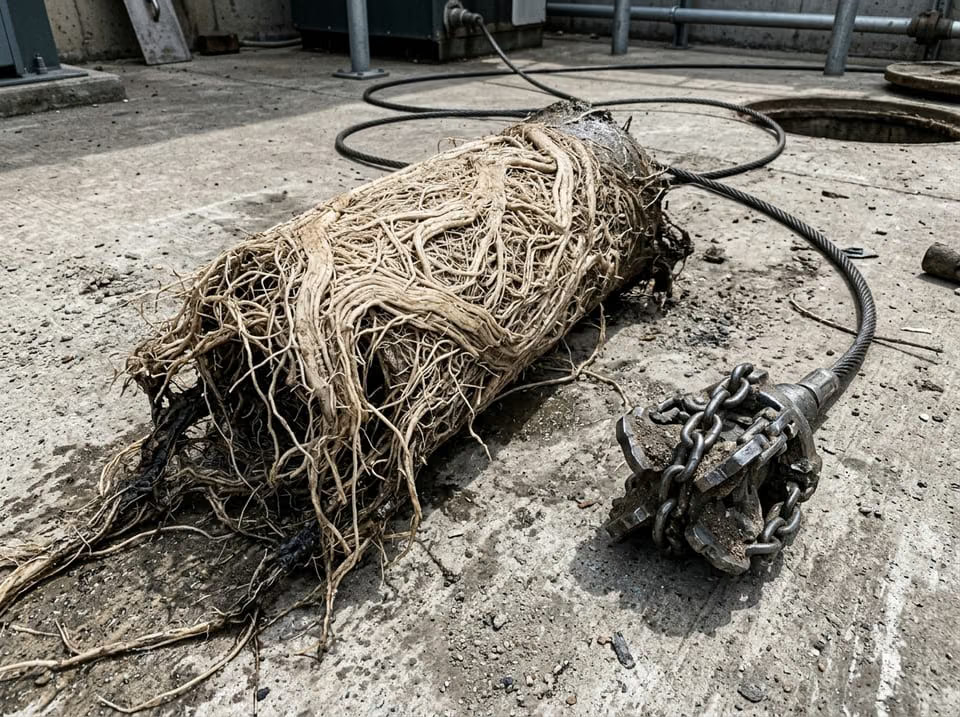
What actually fixes tree roots in a sewer line for good?
The only thing that fixes tree roots in a sewer line for good is repairing the opening they came through, because roots do not bore through cast iron or PVC; they follow moisture, and a sewer line only leaks moisture where it is already open. A commenter on a home-maintenance thread, in a reply that drew 305 upvotes, said it in one line: “Definitely roots. They can only get inside from a break in the pipe.” So a root mass on camera footage is simultaneously a blockage and a diagnosis. Cutting the roots restores flow; sealing or replacing the section they entered through is what stops them coming back.
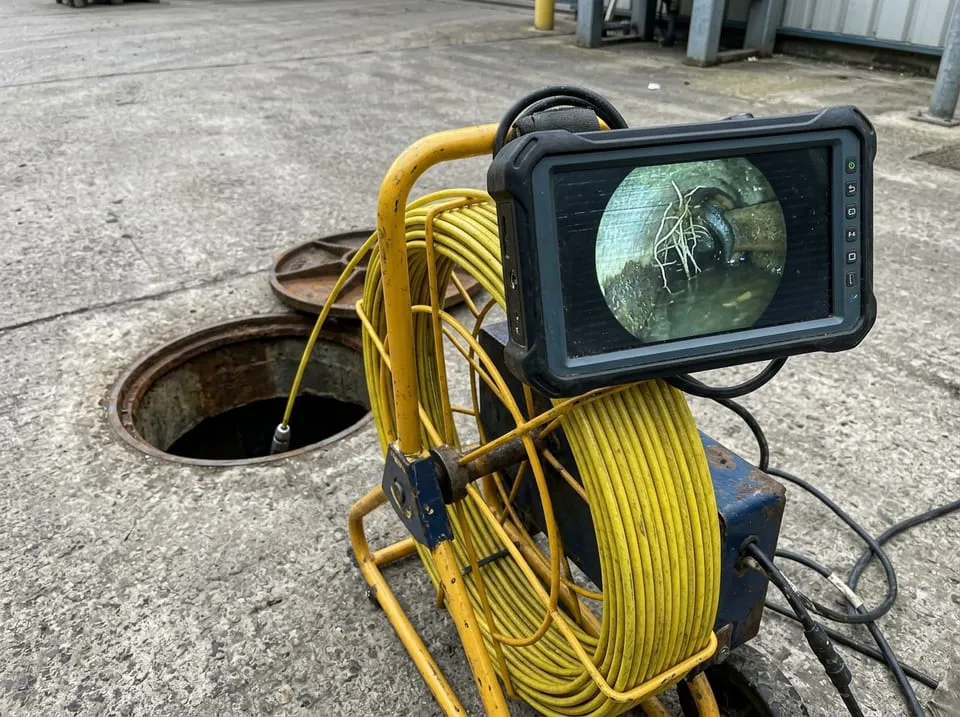
The intrusion develops in a fixed sequence. A hairline crack, a joint that has shifted, or a corroded section releases a small amount of moisture and warm nutrient vapor into surrounding soil. Fine root hairs grow toward it and through the opening. Inside the pipe they meet a continuous supply of water and nutrients, and they thicken into a mat that catches paper and solids.
Two things then happen at once. Flow reduces, producing the slow drains and backups that bring a homeowner to the phone. And the root itself thickens inside the crack, levering it wider. So the opening that admitted a root hair becomes an opening that admits soil, and in South Florida’s sandy fill that is how a root problem turns into a sinking strip of lawn along the line.
In Broward the usual culprits are ficus, live oak, black olive, and palms, all with aggressive lateral root systems, planted along property lines where the lateral tends to run. The pipe they find is very often original cast iron. The Cast Iron Soil Pipe Institute puts cast iron’s service life at 50 to 75 years, and South Florida practice runs nearer 40 to 50 years according to bioresponsecorp.com; a joint that has been corroding in wet sand since the median Hollywood house was built in 1969 (U.S. Census ACS 2024 five-year data, table B25034) is exactly the opening a ficus root is looking for.
“Tree roots” is the most frequent single term in the homeowner discussion collected for this site, at 161 mentions across 474 blocks of text, ahead of “backing up” at 136 and “collapsed line” at 119. That frequency reflects the repeat nature of the problem more than its prevalence: the same homeowner posts every spring because the same joint refills every spring.
The permanent fix therefore has three parts, in order:
- Clear the mat so the line drains and a camera can see the pipe wall
- Scope the line and locate every entry point with a distance and a depth
- Repair the entry points, by spot repair, lining, or replacement, depending on what the footage shows
Everything below this heading is about those three steps and about the honest limits of each.
Can you repair a sewer line without digging it up?
A root-damaged sewer line can be repaired without digging it up when the pipe is still round, correctly graded, and mechanically sound, in which case a cured-in-place liner seals the joints roots entered through along the lined run; when the pipe has been levered apart into an offset, collapsed, or settled into a belly, the section has to be excavated and replaced. Clearing the roots, by cable, jet, or foaming herbicide, never involves digging and never repairs anything. The table separates the treatments that remove the symptom from the two that remove the cause.
| Treatment | What it removes | How long it holds |
|---|---|---|
| Cable or auger | Punches through the mat, pulls some root back | Months |
| Hydro jetting with a root nozzle | Scours the full bore back to the pipe wall | A season or two |
| Foaming root herbicide | Kills root tissue in contact with the foam | A year or so, if repeated |
| Lining the section | Seals the entry points along the lined run | Long-term, if the run covers the defect |
| Excavate and replace the section | Removes the defective pipe entirely | Permanent for that section |
The first three treat the symptom. The last two treat the cause. Neither of those statements is a criticism of jetting: clearing the line is the necessary first step, because a camera cannot see through a root mat and no repair can be scoped until the line is clear.
Cabling is the cheapest option and the least complete. A rotating cutter head on a drum machine punches through the mat and pulls some of it back, restoring flow in an hour. What it leaves is the root stock in the joint and most of the mat pressed against the wall, and a cabled root line typically slows again within months. Hydro jetting with a root-cutting nozzle scours the bore back to the pipe wall and holds for a season or two, and it is the right way to clear a line before scoping it, because the camera then sees the wall rather than the mat. Foaming herbicide kills root tissue it touches and slows regrowth, and it does nothing to the opening.
The two trenchless repair methods split by what the footage shows. Lining suits a run with roots at several joints but correct grade and a round bore: a resin-saturated liner is cured inside the old pipe and the joints stop existing along the lined length. Pipe bursting suits a run that is too far gone to line but still has a path: a bursting head breaks the old pipe outward and pulls new pipe in behind it. The Florida Building Code, Plumbing Chapter 7 (2023), requires the replacement pipe on a pipe-bursting job to be HDPE SDR 17 to ASTM F714 and requires the completed section to be inspected internally by video camera survey and approved by the code official, so on that job the post-work camera run is an obligation rather than an upsell. The research behind this site did not confirm a residential approval path for CIPP lining in the Florida Building Code, so this site describes lining as a method and not as a code-approved one.
Excavation is the answer when the pipe has moved. An offset joint, a collapsed section, or a belly cannot be lined across, because a liner cures to the shape of whatever it is inside, and a belly is a grade problem in the ground rather than in the pipe.
Does relining actually stop tree roots, or will they come back?
Relining stops tree roots along the length that is lined, because a cured liner is jointless and continuous and roots enter at joints and cracks, and roots come back wherever original pipe is left in place, which is why the questions that decide a lining job are about coverage rather than about the product. Lining is the usual recommendation for root-damaged pipe, and it deserves the sharpest objection raised against it, which a plumber in a trade forum wrote: “Anyone here saying lining is not a seasoned plumber. If cast iron did not stop those roots what makes you think a liner will?”
The technical answer is that along the lined section, the entry points stop existing. But the objection identifies a real failure mode. A liner that covers thirty feet of a fifty-foot lateral leaves twenty feet of original pipe, and roots will find whichever joint is left. A liner that stops short of the connection to the main leaves the single most root-prone joint in the system in place. A homeowner who paid for a liner and had roots back in two years usually did not get a bad liner; they got a short one.
So the questions that decide whether lining solves a root problem are about coverage, not about the product:
- What is the total length of the lateral, and how much of it is being lined?
- Where does the liner start and where does it terminate?
- What happens at the connection to the main?
- Does the warranty cover the whole line or only the lined section?
- Are the branch connections inside the house being reinstated, and how?
The price spread on lining is the other reason to ask. A Florida homeowner reported having 30 feet relined for $4,500 after a first quote of $14,000 on the same job, a threefold difference for the same footage of pipe. Some of that spread is the difference between a liner that stops at the property line and one that runs to the main; some of it is one bidder pricing a different job. Two bids written against the same camera footage, each stating the start and end point of the liner in feet from the cleanout, make the difference visible.
Lining has a second honest limit that has nothing to do with roots. A liner reduces the inside diameter of the pipe slightly and cures to the shape of the host, so a channeled cast iron pipe whose bottom is gone produces a liner with a flat bottom, and a pipe with heavy scale needs that scale jetted off before the liner goes in. On a run that is round, graded and merely cracked at the joints, those are non-issues. On a run that is fifty years into South Florida’s wet sand, the footage decides.
What lining does well, when the coverage is right, is take a repeat-clearing line out of the subscription. The in-corpus cost ladder from the homeowner threads puts repeat clearings at roughly $200 to $600 a visit against a liner in the $5,000 to $10,000 range, and a line that has been cabled every spring for five years has already paid for a good part of the liner it did not get.
Can my sewer line be repaired trenchless, or does it have to be dug up?
A root-damaged sewer line can be repaired trenchless only if the pipe is still round, holds its grade, and has not been pushed apart at the joints, because a liner cannot cure across a step and a bursting head cannot pull new pipe through a collapse. As one plumber on a trade forum put it: “You can only do trenchless if your sewer line has correct pitch and is mechanically sound.” Root intrusion on a pipe that is otherwise round and correctly graded is a good lining candidate. Root intrusion on a pipe that has already been levered apart into an offset joint is not.
That determination comes from camera footage, which is also where the extent of the damage becomes visible. A single joint with fine roots is a different job from forty feet of pipe with a mat at every joint. The camera stage is reported at $150 to $400 for a standard residential lateral, and it produces the three things a trenchless decision rests on:
| What the footage has to show | Trenchless | Excavation |
|---|---|---|
| Bore shape | Round, or lightly scaled | Channeled, crushed, or collapsed |
| Grade | Continuous fall toward the street | A belly holding standing water |
| Joints | Cracked or root-entered but aligned | Offset, separated, or dropped |
| Access | A cleanout or pit at each end of the run | Any run where those cannot be made |
The eligibility question is the one almost no sales pitch leads with, and it is the one that matters. Trenchless is sold on avoiding the driveway, and avoiding the driveway is a real saving: on hardscape or interior work, restoration is frequently half the total, and a spot repair under a paver drive is reported at $4,000 to $9,000 against $1,500 to $4,000 in open lawn. But a liner cured across an offset produces a liner with a step in it, which catches roots’ successors, and the driveway gets dug anyway two years later. A contractor who camera-inspects, names the offset at 34 feet, and says the run has to be opened at that point is giving the cheaper answer.
Several conditions push a root job toward excavation in Broward specifically. Sandy fill settles, so bellies are common under driveways and pool decks where the ground was disturbed. Cast iron corrodes from the invert up in wet ground, so channeling is the usual end state rather than a clean crack. And ficus roots, once inside, thicken fast enough to lever a joint apart in a few seasons. The Florida Building Code’s clause on filled or unstable ground, which requires the building sewer on such ground to meet a listed standard for ABS, cast iron, copper, PVC or PP pipe, is written for exactly this soil.
Where a run is eligible, the two trenchless methods split by condition. A round, graded pipe with cracked joints is lined. A pipe that is beyond lining but still continuous is burst, with HDPE SDR 17 pulled in behind the bursting head and a code-required camera survey afterward. Where a run has one bad section and the rest is sound, a spot excavation at the marked point, with new PVC coupled to the old pipe either side, is often the cheapest honest answer of all.
What is the average cost to repair a sewer line with roots in it?
The cost to deal with roots in a sewer line runs in the order the work happens: clearing the line is reported at $200 to $450 by cable or $400 to $900 by hydro jetting, the camera inspection once the line is clear is reported at $150 to $400, and the repair that follows is a spot repair reported at $1,500 to $4,000 in open lawn, a liner in the $5,000 to $10,000 range from homeowner accounts, or a replacement reported at $10,000 to $30,000 for a full lateral. Those are ranges reported across South Florida work and homeowner accounts, not a price list, and the repair figure is unknowable until the footage exists.
- Clear the line: cable $200–$450, hydro jetting $400–$900
- Camera inspection once clear: $150–$400, and insist on a copy of the footage
- Then a repair quote, which will be a spot repair, a liner, or a replacement depending on what the footage shows
Repeating step one every year without ever reaching step two is the pattern this trade is criticized for, and it is avoidable by asking for the video.
The spread inside each row is real and it is set by access rather than by pipe. Depth is the first multiplier: below roughly ten feet a trench stops being an excavation and becomes a confined space with a collapse risk, and shoring and a larger machine are step changes in price. Surface is the second: grass is free to put back, and a paver driveway, a pool deck, or a tiled interior floor each carry a demolition and a rebuild. Position relative to the property line is the third: anything in the public right-of-way brings Broward County’s Road Cut and Restoration Permit, covering the paved area including signage and striping, and certified as-builts signed and sealed by a Professional Land Surveyor registered in Florida.
Homeowner accounts show how wide the spread gets. One Florida homeowner had 30 feet relined for $4,500 after a competing quote of $14,000; another was quoted $14,300 for ten feet of under-slab replacement on a 1964 Florida house. A plumber on a public forum put it this way, without flattering the trade: “No one can give you a price for this. I’ve seen sewer repairs cost $5000 and I’ve seen them cost $40,000.”
What makes root-repair bids comparable:
- One camera inspection, recorded, shared with every bidder
- A written scope naming each entry point, its distance from the cleanout, and its depth
- For a liner, the start and end point in feet and what happens at the main
- Price split into clearing, excavation, materials, restoration and permits
- The warranty term, and whether it covers the repaired section or the whole line
The Sewer Line Repair Broward field team puts it this way: “Roots tell us where the break is, which is useful. We jet it, scope it, and mark the depth and distance so the homeowner knows exactly what is being repaired and where.”
If your line has had roots cleared before, request a free quote and we will scope it properly once it is clear.
Frequently asked questions
Does relining actually stop tree roots, or will they come back?
A cured liner is jointless, and roots enter at joints and cracks, so along the lined run the entry points stop existing. The failure mode is partial coverage: a liner covering thirty of fifty feet leaves twenty feet of original joints for roots to find.
What actually fixes tree roots in a sewer line for good?
Only repairing the opening they came through. Roots cannot penetrate sound pipe, so finding roots means finding an existing crack or failed joint. Jetting and cutting remove the mass; lining the run or replacing the section removes the entry point. Clearing alone is a delay.
Related services
- Main Sewer Line Clog: How to Confirm It and What to DoA clog in the main sewer line affects more than one fixture and backs up at the lowest d…
- Broken Sewer Line: What the Signs Look Like in a Florida HomeA broken sewer line shows itself through repeat backups, a persistent sewer smell at flo…
- CIPP Pipe Lining: How It Works, What It Costs, and When It Will Not WorkCIPP lining pulls a resin-saturated felt sleeve into an existing sewer pipe, inflates it…
- Sewer Camera Inspection: Cost, Process, and What the Footage ShowsA residential sewer camera inspection typically costs $150 to $400. A camera on a push r…
- Sewer Line Root Removal in Broward CountyWe remove tree roots from sewer lines in Broward County homes by hydro jetting with a ro…