Sewer Camera Inspection: Cost, Process, and What the Footage Shows
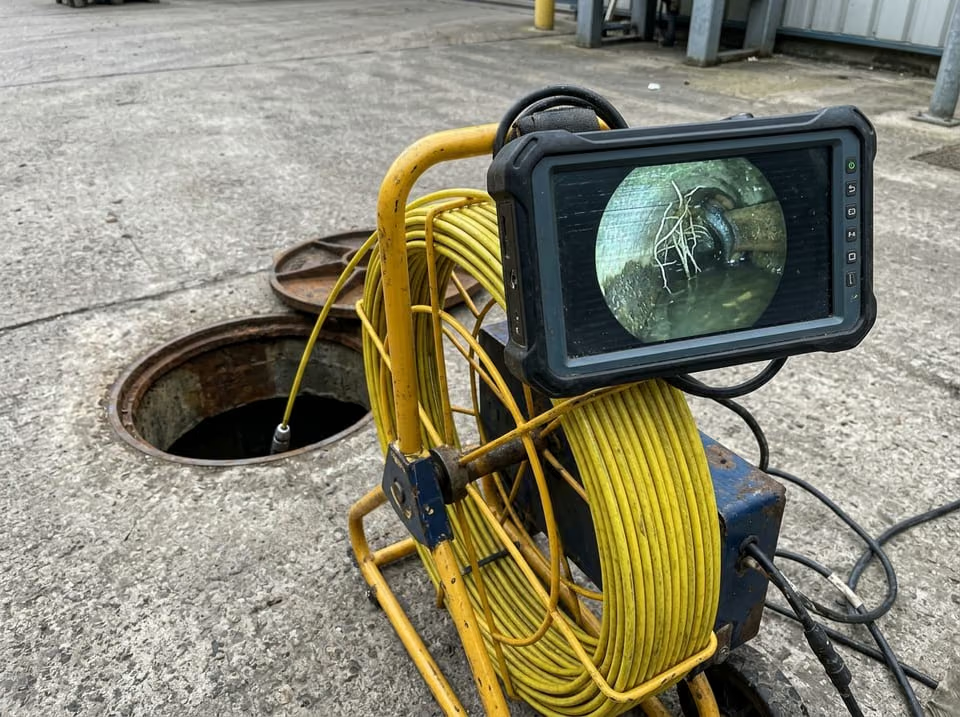
A residential sewer camera inspection typically costs $150 to $400. A camera on a push rod travels the line from a cleanout while a locator marks the position and depth of any defect from the surface. The output should be recorded footage naming the defect and its distance.
How much does a sewer camera inspection cost in South Florida?
A sewer camera inspection in South Florida typically costs $150 to $400 for a standard residential lateral, rising to $250 to $500 for a pre-purchase inspection with a written report, and it is the cheapest step in sewer work and the one that determines every number after it. It converts a symptom into a defect at a distance and a depth, which is what a repair can be quoted against. A camera cannot see through standing water, a root mat, or accumulated solids, so a blocked line is cleared first and scoped second, and a quote for scoping a backed-up main will normally include the clearing.
| Scope | Typical range |
|---|---|
| Standard residential lateral inspection | $150–$400 |
| Inspection bundled with a clearing or jetting call | Often reduced or included |
| Pre-purchase inspection with a written report | $250–$500 |
| Inspection of a line that must be cleared first | Add the clearing cost |
These are typical ranges reported across the trade, not our prices. The clearing cost on the last row is the one that surprises homeowners: cable clearing is reported around $200 to $450 and hydro jetting around $400 to $900, so on a fully blocked line the camera is the smaller half of the visit. On a line that drains, the camera goes straight in.
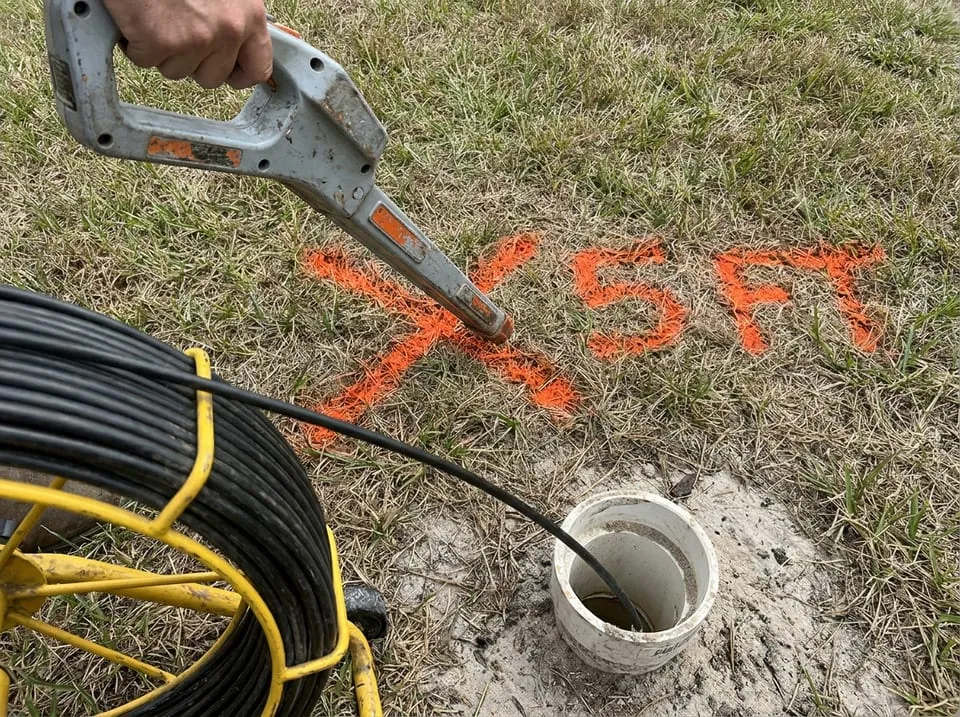
How the inspection runs. A self-leveling camera head on a semi-rigid push rod enters through an existing cleanout and is fed down the line while the operator watches a monitor. A footage counter on the reel records distance traveled, so every observation is tied to a number. The camera head carries a sonde, a small transmitter, and a locator on the surface picks it up. That is how a defect thirty-four feet down the line becomes a spray-painted mark on the lawn with a depth written beside it. Without the locate, a repair crew is digging on an estimate, and on Broward’s sand an estimate can be a wide hole.
If no cleanout exists, access is through a pulled toilet or a roof vent, both of which have limits: a toilet gives good access to the main run, and a vent entry is awkward and sometimes impossible past traps and fittings. On older Broward houses with no exterior cleanout, installing one is often recommended and is genuinely useful, since it makes every future service call cheaper and turns the next inspection into the top row of the table rather than the bottom.
The price is worth putting against what it protects. Reported South Florida figures for cast iron replacement run $80 to $250 per linear foot and average near $10,000 per home; one Florida homeowner was quoted $14,300 for ten feet of under-slab work. A $150 to $400 recording that says the line is serviceable, or that names one defect at one distance, is the difference between quoting that job and guessing at it. For a homeowner holding the file, it is also the document every competing bidder prices against.
What does a sewer camera inspection actually show?
A sewer camera inspection shows the inside of the pipe in real time with a distance counter, and a useful report names the defect, its distance from the access point, its depth from the locator, and the pipe material rather than saying “the line is bad.” Five things are visible on the monitor that decide everything after: whether the bore is round or has lost its bottom, whether water is standing in a sag, whether joints are aligned or stepped, whether roots are present and where they entered, and how much scale is narrowing the bore. Each of those is a word in a specific vocabulary.
The vocabulary a fair report uses:
- Belly or sag: a low section holding standing water; solids settle there and it cannot be cleaned out
- Offset: sections shifted apart at a joint, leaving a step that catches material
- Crack or fracture: a through-wall break, distinct from surface scale
- Root intrusion: roots entering through an existing opening, which proves the opening exists
- Channeling: the bottom of a cast iron pipe corroded away into a trough
- Scale: mineral and corrosion buildup narrowing the bore
- Collapse: the pipe no longer holding its shape
A plumber reading footage of an old line in a trade forum demonstrated what a fair report sounds like: “Looks like a sag in the line between 15’ and 34’. Or it may be very flat and needs to be flushed and jetted. I didn’t see any cracks, offsets, or roots.” That is a specific finding, a stated alternative explanation, and an explicit list of what was not found. The distances are the part that makes it actionable; a sag between 15 and 34 feet can be located on the lawn, depth-marked, and priced by the foot.
The locate is what turns the picture into a map. With the sonde at the defect, the operator walks the surface with the locator until it peaks, paints an X, and reads the depth. On a yard line that mark tells the excavator where to open one hole instead of a trench. Under a slab it tells the saw where to cut, which is the difference between opening one strip of terrazzo and opening the room. On a run that continues toward the street, the mark also shows whether the defect is on the private side or in Broward County right-of-way, where a Road Cut and Restoration Permit and a surveyor’s sealed as-built come into the price.
The footage also shows what the line is made of, which on a Broward house built before about 1975 is usually cast iron. The Cast Iron Soil Pipe Institute rates it at 50 to 75 years and regional reporting puts the practical figure in South Florida’s wet sandy fill at 40 to 50, so the camera is frequently looking at pipe near the end of its range. What it should report is which of the seven findings above are present, at what distance, and which are absent. The absence list matters as much as the presence list, because it is what stops a rusty but serviceable pipe from being sold as a replacement.
Do cast iron pipes need to be replaced?
Cast iron pipes need to be replaced when a camera names a defect that cannot be repaired in place, and they do not need to be replaced because they look rusty, since fifty-year-old cast iron is dark, rough and scaled on every monitor in the trade and that appearance is the expected condition rather than a verdict. A homeowner seeing the inside of an old line for the first time reasonably concludes the pipe is finished. It often is not. The question is whether the wall has been lost, not whether the surface is rough.
What changes the assessment is a defect the camera can locate: channeling, a crack, an offset, a belly, roots. Those are visible and specific, and they carry a distance. “It looks rusty” is not a finding, and a quote justified by rust alone deserves a second opinion. The plumber quoted above put the principle plainly in the same thread: inside of cast iron pipes look like that, and replacing due to rust is not a typical reason to replace them unless there is a visible issue.
The findings and what each one means for the decision:
| Finding on camera | What it means | Usual next step |
|---|---|---|
| Rust and scale, bore round, grade correct | Expected aging | Leave it, re-scope in a few years |
| Single crack, sound wall either side | Local defect | Spot repair or sectional liner |
| Roots at one joint, pipe round | An opening exists at that joint | Clear, then seal the entry point |
| Channeling across several sections | Wall loss along the run | Replace or line the run, if it qualifies |
| Belly or back-pitch | Layout defect | Excavate and re-grade; lining preserves it |
| Offset or collapse | Structural failure | Replace that section |
Cast iron fails from both sides at once, which is why the pattern matters more than the appearance. Inside, sewage produces hydrogen sulfide that bacteria convert to sulfuric acid at the crown; outside, South Florida’s high water table and sandy fill corrode the wall inward. The pipe thins along its length and then loses its bottom where flow is heaviest. So a camera that finds channeling in one section is usually looking at thinned wall either side of it, and a spot repair there buys a delay. A camera that finds scale everywhere and channeling nowhere is looking at an old pipe doing its job.
The tell on the monitor is the shape of the bore rather than its color. A scaled line still reads as a circle with a rough wall; a channeled line shows a flat or missing bottom where the invert has gone, often with water standing where it should be running. Ask the operator to pause on any section where the bottom disappears and to call out the footage marker, because that number is what any repair gets quoted against and what a second contractor can check.
Broward’s housing stock puts a lot of pipe in that second category. Roughly 35% of South Florida living units built in the 1960s and 1970s went in with cast iron, PVC did not become standard until the late 1970s, and per U.S. Census ACS 2024 five-year data the median year built is 1969 in Hollywood and 1972 in Fort Lauderdale. Two 1968 houses on the same street can be ten years apart in what the line actually looks like, and the only way to know which one you own is the recording.
How do I know a plumber isn’t inventing a problem to sell me a big job?
The workable protection against a manufactured diagnosis is a copy of the recorded camera footage from whoever runs the inspection, because a recording can be sent to a second contractor for an independent read, and that removes most of the asymmetry without a separate hire. The recurring complaint in this trade is the suspicion that a diagnosis is a sales tool, and it is a fair suspicion when the company that finds the defect is the company that quotes the repair. The file is the answer. A contractor who will not hand it over is asking to be trusted on a five-figure decision without evidence.
A homeowner in a real-estate forum said it directly: “You need a contractor that ‘scopes’ only - and is NOT part of a plumbing company. That way you will know if it’s legit and not a ruse to get a huge job.” Hiring a scope-only inspector is one workable answer, and on a pre-purchase inspection it is a common one. The simpler answer for a homeowner already in the house is to require the recording, watch the monitor during the run, and ask for the findings in the vocabulary above with distances attached. A report that says “sag between 15 and 34 feet, no cracks, no offsets, no roots” can be checked. A report that says “the line is bad” cannot.
What a fair report should contain, and what it should not:
- Should: the defect named, the distance from the access point, the depth from the locate, the pipe material, and a list of what was not found
- Should: the recording itself, in a format a second contractor can open
- Should not: a replacement recommendation justified by appearance alone
- Should not: a quote issued before the line has been seen end to end
- Should not: a refusal to release the footage until a contract is signed
The Florida Building Code takes a similar view for one method. On trenchless pipe bursting the completed section shall be inspected internally by video camera survey and approved by the code official, so on that job the post-work camera run is required, not optional, and the recording is a document the code official reads. The same standard applied to the pre-work inspection is what a homeowner should expect.
The reason this matters more in Broward than most places is the size of the decision the footage feeds. Reported South Florida cast iron replacement averages near $10,000 per home and runs $80 to $250 per linear foot, and the observed range across jobs, in one plumber’s words, is $5,000 to $40,000. A $150 to $400 recording is the cheapest insurance against paying the top of that range for a line that belonged at the bottom, and a second read of the same file is cheaper still.
Our position, stated on every inspection: “The homeowner watches the monitor with us and keeps the file. If the line is fine we say the line is fine. That is a result too.” That is how Sewer Line Repair Broward runs a camera, and a quote from us is only ever written against footage the homeowner already holds. To have your line scoped and recorded, request a free quote.
Should I buy a Florida house that still has cast iron pipes under the slab?
A Florida house with cast iron under the slab is worth buying when a camera inspection before closing shows the line is serviceable, and it is worth walking from or renegotiating when the footage names a defect, because on a pre-1975 house that inspection costs $150 to $500 and can identify a five-figure liability while the contract is still negotiable. A buyer in exactly this position asked the question for the whole state: “I want to buy a 1977 built home in Florida. These cast iron pipes are under the slab. Should I run? Candidate for lining?” The best answer in the thread was the plain one: get a video inspection to see the current state inside, rather than speculate its life off external appearance.
The two figures that frame the decision are on this page already. A pre-purchase inspection with a written report is reported at $250 to $500. A ten-foot under-slab replacement on a 1964 Florida house was quoted at $14,300, the seller would not negotiate, and the buyer walked. The inspection is the only instrument that tells a buyer which of those two houses they are looking at, and it is the one contingency in a Florida purchase that pays for itself on the first defect it finds.
When a camera inspection is worth doing, beyond a purchase:
- Before buying any Florida house built before about 1975
- After a second backup in the same year
- Before accepting any repair or replacement quote
- When a sewer smell has outlasted the free fixes
- When a spot in the yard is sinking along the line’s route
- After a root clearing, to see the opening the roots came through
The pre-1975 threshold comes from the housing record rather than from a rule of thumb. PVC became standard in Florida residential construction in the late 1970s, and regional reporting puts 35% of all of today’s South Florida living units as built during the 1960s and 1970s with cast iron. The Cast Iron Soil Pipe Institute rates that pipe at 50 to 75 years; South Florida practice puts it nearer 40 to 50. A house at the median year built for Hollywood (1969), Lighthouse Point (1968), Wilton Manors (1971) or Fort Lauderdale (1972), per U.S. Census ACS 2024 five-year data, is inside that window. Pembroke Pines, at a median of 1992 with 23.1% of units pre-1980, is largely outside it, and a buyer there is more often scoping a PVC line for a belly than cast iron for channeling.
What the buyer should ask for is the same thing any homeowner should: the recording, the findings in defect-and-distance form, and the list of what was not found. On a serviceable line that report is a negotiating document that says the plumbing is fine. On a defective line it is a repair estimate’s foundation and a reason to reprice the house. Either way, the inspection is done from a cleanout or a pulled toilet with the seller’s permission, takes far less time than the rest of the inspection period, and produces a file the buyer keeps whether or not the sale closes.
The insurance angle belongs in the same conversation. Florida carriers examine original plumbing in older homes at renewal, and a homeowner in a Florida thread reported that insurers here “will look for any reason to charge more.” A buyer who asks a carrier before closing whether a camera report is accepted as evidence of condition is asking the right question at the only time it is cheap to ask.
Frequently asked questions
What does a sewer camera inspection actually show?
It names a defect and locates it. The vocabulary is specific: belly or sag, offset joint, crack, root intrusion, channeling, scale, collapse. A surface locator marks the position and depth on the ground. Rust and scale alone on old cast iron are expected, not a verdict.
Should I buy a Florida house that still has cast iron pipes under the slab?
Not without scoping it first. A camera inspection before closing costs $150 to $400 and produces recorded footage naming any defect and its distance. On a pre-1975 Florida house that can identify a five-figure liability while the contract is still negotiable.
How do I know a plumber isn't inventing a problem to sell me a big job?
Require a copy of the recorded camera footage. A recording can be sent to a second contractor for an independent read, which removes most of the asymmetry. Some homeowners hire a scope-only inspector who is not part of a plumbing company, which also works.
Related services
- Broken Sewer Line: The Signs, and What They Look Like in FloridaA broken sewer line shows itself through repeat backups, a persistent sewer smell at flo…
- Main Sewer Line Clog: How to Tell It From a Single Blocked DrainA clog in the main sewer line affects more than one fixture and backs up at the lowest d…
- Cast Iron Pipe Repair: When a Section Can Be SavedCast iron can be spot-repaired when the defect is isolated and the surrounding pipe stil…
- Sewer Line Repair Cost: What You Pay For and Why Quotes DifferSewer line repair cost is set by access rather than by pipe. A spot repair on an open ya…