Main Sewer Line Cleaning in Broward County
We clear main sewer lines for Broward County homes where two fixtures back up together, by cable or hydro jetting through a cleanout, then camera-inspect the clean line and hand you the recording so the cause gets named. If the footage shows a defect, the repair is quoted against it. We Fix It Right the First Time or It's Free.
What does main sewer line cleaning in Broward County include?
Main sewer line cleaning in Broward County includes confirming the blockage is in the main rather than a single fixture, opening the line through an exterior cleanout or a pulled toilet with a drum cable machine or a hydro jetter, restoring flow at every fixture, and then a recorded camera inspection of the clear line with a surface locate for whatever caused the blockage. The main is the pipe every fixture drains into, which is why a main line problem makes two fixtures affect each other. Clearing it restores flow. The camera run afterward is what says whether the blockage was a clog or a defect.
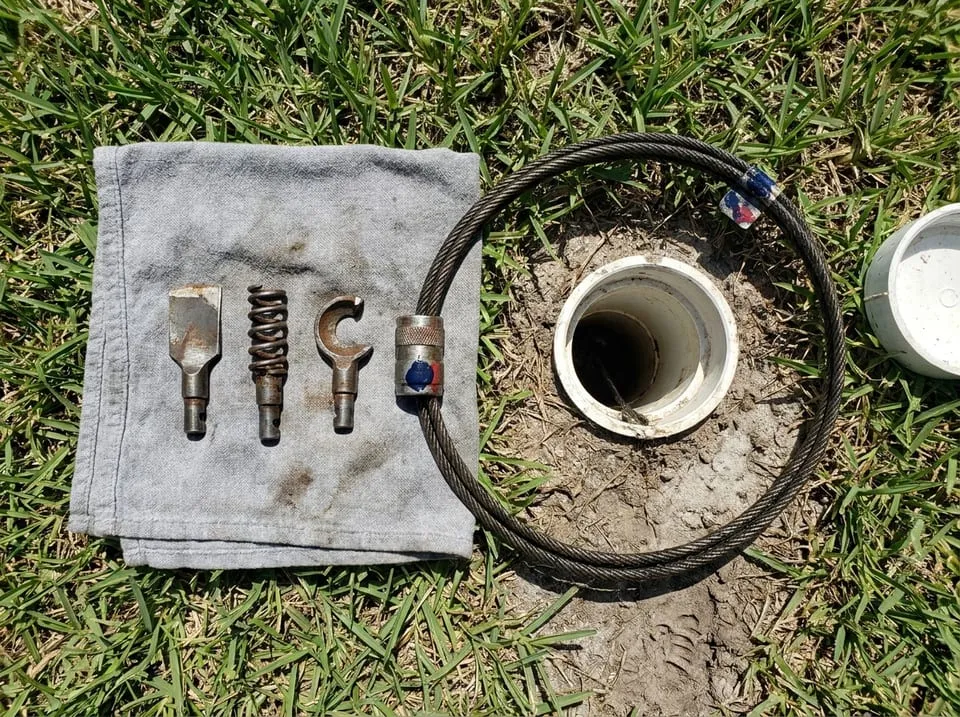
A main line blockage is distinguished from a fixture blockage by one observation: whether two fixtures interact. A blocked sink drains slowly and nothing else changes. When flushing a toilet makes a tub gurgle or fill, the restriction sits downstream of both, and the only pipe they share is the main.
How the line is cleared:
- Cable or auger, a reported $200 to $450: fast, bores through the obstruction, leaves the pipe wall as it was
- Hydro jetting, a reported $400 to $900: scours the bore back to the pipe wall, and the right choice on scale, grease and roots
- Camera inspection once clear, a reported $150 to $400: names the cause and locates it
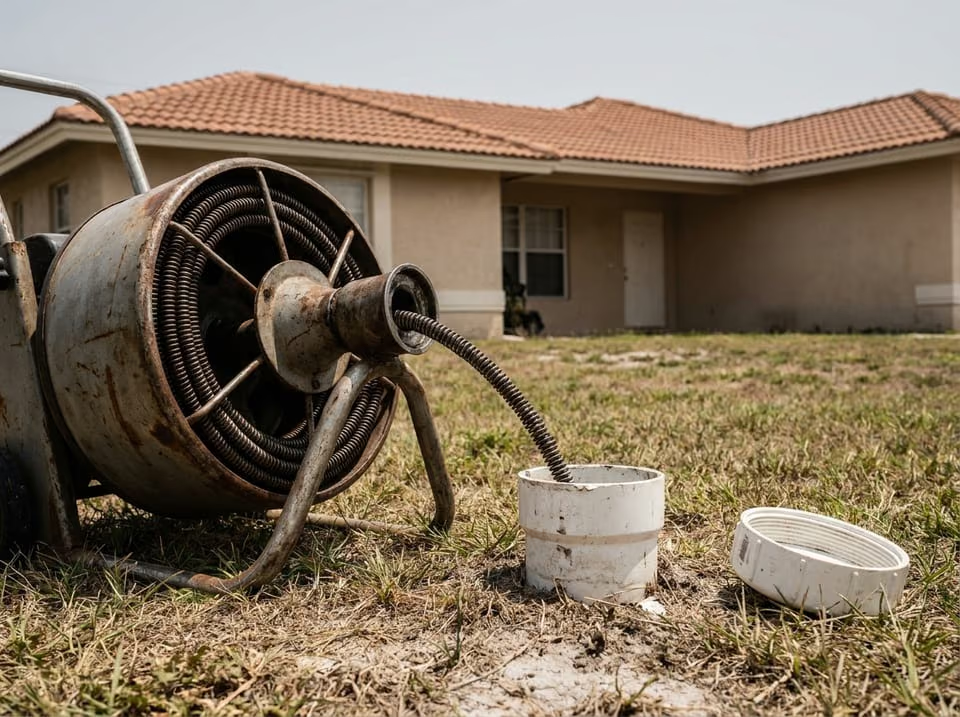
The photograph above is the first of those: a drum machine feeding cable into an open yard cleanout. Access is through an existing cleanout where one exists. Many pre-1975 Broward houses were built without one, and on those the cable goes in through a pulled toilet. Installing a cleanout on such a house is a small job that makes every future service call cheaper, and it is usually worth adding to the first visit.
Waste backs out at the lowest opening below the blockage. In a Florida slab home that means a shower pan, a tub, or a laundry floor drain, and there is no basement drain here to absorb it, which is why a main line blockage arrives as water on a finished floor. That is the argument for clearing at the gurgle stage, when the line is still draining and the work is a scheduled visit.
The camera run is included because the clearing alone leaves an open question. A line cleared once and quiet for years was blocked. A line cleared twice in a year has a defect, and on Broward’s original cast iron, rated at 50 to 75 years by the Cast Iron Soil Pipe Institute and nearer 40 to 50 in South Florida practice per regional contractor reporting, the defect is often the pipe itself. The recording is the homeowner’s to keep, and it is what a second contractor reads if a repair is quoted.
We clear it, scope it, and say whether it will come back. A homeowner is entitled to know whether they are buying a fix or a delay.
Why are multiple drains in my house draining slowly?
Multiple drains in the house are draining slowly because the pipe they all share has narrowed, and the cause is one of six things: wipes and non-flushables, grease along the pipe wall, scale and channeling in old cast iron, tree roots at a joint, a belly holding standing water, or an offset joint or partial collapse. The first two are clogs. The other four are pipe defects that produce clogs, and clearing them addresses the symptom while the cause stays in the ground. Which one a house has is found by the camera after the line is clear, and it decides whether the cleaning holds.
| Cause | Recurrence without repair |
|---|---|
| Wipes and non-flushables | Low, if habits change |
| Grease buildup | Moderate, and gradual |
| Cast iron scale and channeling | High (the bore itself is rough) |
| Tree roots | High (the opening they entered through remains) |
| Belly or sag | Certain (standing water cannot be cleaned out) |
| Offset or partial collapse | Certain |
The bottom four rows are pipe defects producing blockages. That is not an argument against clearing the line, since a blocked line has to be opened before anything else can happen, but it is the reason the camera run afterward matters.
Cast iron scale is the Broward default. A fifty-year-old cast iron line has a rough, tuberculated interior; lint, grease and paper catch on that roughness continuously, so the line does not so much block as gradually close. Roughly 35% of South Florida living units built in the 1960s and 1970s went in with cast iron, per bioresponsecorp.com, and PVC did not become standard in Florida residential construction until the late 1970s. U.S. Census ACS 2024 five-year data, table B25034, puts the median year built at 1969 in Hollywood and 1972 in Fort Lauderdale, with 74.7% and 66.3% of units pre-1980. In those cities the slow-drain call and the cast iron call are usually the same call.
Roots are the other big cause in older neighborhoods, and they deserve a specific note. Roots cannot penetrate sound pipe. As one widely upvoted comment put it: “Definitely roots. They can only get inside from a break in the pipe.” In Broward the usual sources are ficus, live oak, black olive and palms, all with aggressive lateral roots, planted along property lines where the lateral tends to run. Finding roots during a cleaning is finding an opening, which is why a root job comes with a repair conversation rather than just an invoice.
A belly is the cause that fools people. The line clears, drains normally for a while, then slows again with nothing new in it. Solids settle at the low point no matter how clean the bore is, and no cleaning removes standing water from a sag. Lining cannot fix it either, because a liner preserves the existing grade. A belly is a replacement of the affected run, and the camera is the only thing that finds it.
Why does my bathtub back up when I wash clothes?
The bathtub backs up when the washing machine drains because the washer pumps 15 to 30 gallons into the drain system in under a minute, faster than any other fixture delivers water, and a main line that is partly restricted cannot pass that volume. The water comes back up at the lowest opening below the restriction, and in a Florida slab home that is the tub, a shower pan, or a laundry floor drain. Because the tub and the washer only share pipe downstream, water appearing in the tub places the blockage in the main line, not in either fixture.
That makes the washing machine the best diagnostic appliance in the house. A sink runs at a trickle by comparison and a toilet flush is a gallon or two. A line that handles both without complaint and fails on the washer has its capacity reduced, and the reduction is in the shared pipe downstream of the laundry. Because the washer discharges through a pump rather than by gravity, it finds a restriction earlier than any other fixture will, which is why this is so often the first sign of a main line problem on an older house.
What to do when it happens:
- Stop the machine and stop using every other fixture; every flush adds volume to a line that cannot take it
- Keep people and pets out of the standing water, and do not pour drain chemicals into it
- Note which openings the water appeared at and in what order; that sequence tells the crew where the restriction sits
- Have the main line cleared: cable at a reported $200 to $450, hydro jetting at $400 to $900
- Have it camera-inspected once clear, at a reported $150 to $400, and keep the footage
The camera is the step that makes the difference on the next wash day. What it usually finds behind a washer-triggered backup on an older Broward house: scale and channeling in cast iron narrowing the bore, a root mat at a joint the roots entered through, grease cooled along the pipe wall, or a belly holding solids at a low point. Wipes and non-flushables snag on any of those. Clearing restores flow. The recording says whether the cause is still there.
The washer does not damage the line, and the reading “the washing machine broke the pipe” has it backwards. The machine found a restriction that was already there and would have shown up at the next heavy use anyway. Reducing load sizes buys a little time. It does not change what is in the pipe.
Reading where the water appears is useful on its own. If the tub fills but the toilet beside it is fine, the restriction is downstream of the tub and the toilet is simply a higher opening. If a floor drain in the garage laundry rises first, the restriction is close to the laundry branch’s connection to the main. The crew uses that sequence to choose the access point, and the camera confirms it.
If your line has blocked more than once, or the tub has started reacting to the washer, request a free quote for a clear-and-scope while the line is still draining.
Why is my drain slow but not clogged?
A drain that is slow but not clogged is a pipe whose bore has narrowed without closing, and on a Broward house built before about 1975 the usual reason is the inside of the original cast iron: scale and tuberculation on the wall, a channel corroded along the bottom, or a belly where solids settle at a low point. Nothing is stuck in the line, so a cable finds nothing to bore through. The pipe itself has less capacity than it was built with. Jetting restores the bore to whatever wall is left, and the camera afterward says how much that is.
The material sets the pattern. Cast iron drain pipe fails from the inside out and the outside in at the same time. Inside, sewage produces hydrogen sulfide, which bacteria convert to sulfuric acid at the pipe crown. Outside, moisture and dissolved minerals corrode the wall from the soil side, and South Florida’s damp sandy fill and high water table supply that generously. The Cast Iron Soil Pipe Institute rates the material at 50 to 75 years; regional contractor reporting puts South Florida practice at 40 to 50. A pipe installed in 1969 is now at 57 years, and a bore lined with five decades of rust nodules drains slowly with nothing in it.
The frequency test is the tool for this case. A line cleared once and quiet for years was blocked. A line cleared twice in a year has a defect. If a house has been on an annual clearing schedule, the useful next step is a camera inspection, and the recording usually shows one of these:
| What the camera finds | What it means | Next step |
|---|---|---|
| Scale and rust, pipe round and graded, no cracks, offsets or roots | Expected condition of old cast iron | Jet, then leave alone; re-scope at the next symptom |
| Belly between two points, holding water | Grade problem; solids settle there | Replacement of the bellied run |
| Channel worn along the invert in one section | Lost wall | Spot repair or sectional liner |
| Channeling across multiple sections | Lost wall along the run | Replacement |
| Roots at a joint | An opening already exists | Jet, then seal the joint by lining or replace the section |
Rust alone is not a diagnosis. A plumber reading footage of exactly this kind of line reported “a sag in the line between 15’ and 34’” and “no cracks, offsets, or roots,” and added that the inside of cast iron pipes looks like that and replacing due to rust is not a typical reason to replace them. That is an old pipe reported as serviceable, with one specific concern at a specific distance and an explicit list of what was ruled out. It is what a fair reading of a slow-but-not-clogged line sounds like.
The Pembroke Pines exception is worth stating because the site is based there. The city’s median year built is 1992 and only 23.1% of units are pre-1980, per the same Census table, so a slow drain in a 1990s Pines house is on PVC and is far more often a belly, a root at a joint, or a partial obstruction than scale. The camera settles it either way, and the footage is the homeowner’s.
“We clear it, scope it, and say whether it will come back. Homeowners are entitled to know if they are buying a fix or a delay.”
Why does my toilet gurgle when the washing machine drains?
A toilet gurgles when the washing machine drains because the washer’s 15 to 30 gallons, pumped into the line in under a minute, pushes air ahead of it through a restricted main, and the toilet’s trap is the nearest opening that air can escape through. The gurgle is that air bubbling up through the bowl. It only happens when the pipe the two fixtures share is partly blocked, and the only pipe they share is the main line. It is the warning stage: the line is still draining, and the backup that follows is usually weeks away.
If only the toilet gurgles when it is flushed, with nothing else in the house reacting, the problem is local and small: that toilet’s trap, or a vent. If the toilet reacts to the washer, or a shower or tub reacts to the toilet, two fixtures are interacting and the restriction is in the main. That case is worth clearing before it backs up, because the difference between the two stages is the difference between a service call and a remediation job.
What the gurgle stage buys:
- Time. The line is draining, so the visit is scheduled rather than an emergency.
- A dry floor. At the backup stage the same plumbing work is joined by a contaminated shower pan or laundry floor, a drying-out, and often a flooring replacement.
- A clean inspection. A camera cannot see through a backed-up line. A line that is slow but flowing can be jetted and scoped in one visit, and the recording names the cause.
- A choice. If the footage shows a defect, the repair is planned and competitively quoted rather than improvised on the day sewage came up.
What the gurgle usually means on an older Broward house is the same list as every other main line symptom: scale on cast iron closing the bore, a root mat at a joint, grease along the wall, or a belly. Which one it is decides whether the cleaning holds. Scale and grease respond to jetting and stay quiet for a season or more. Roots respond and come back, because the opening they entered through remains, and the cost ladder in that case is the useful thing to know: repeat clearings at a reported $200 to $900 a visit against a liner or a spot repair that removes the entry point once. A belly responds for a while and then refills, and only replacement of the run fixes it.
Reducing washer load sizes will quiet the gurgle for a while. It does not change what is in the pipe, and a homeowner who reads the quiet as a fix is usually back at the backup stage within the season. The useful action at the gurgle stage is a clear-and-scope while the floor is still dry.
The guarantee covers the repair the footage leads to. We Fix It Right the First Time or It’s Free: if the section we repaired fails again from the same defect, we come back and redo the work at no charge, and the recording from the first visit is what settles whether it is the same defect or a new one somewhere else on the line.
Frequently asked questions
Should I call a plumber for a gurgling toilet?
If only that toilet gurgles when flushed, the problem is local and small. If a shower, tub or floor drain reacts when the toilet is flushed, two fixtures are interacting and the restriction is in the main line. That case is worth clearing before it backs up.
How do I know if my main drain line is clogged?
Run one fixture and watch a different, lower one. If flushing a toilet makes a tub or shower gurgle or rise, or the washing machine sends water up a floor drain, the restriction sits in the pipe both fixtures share, which is the main line. A single slow sink with nothing else affected is that fixture's own trap or branch.
What actually fixes tree roots in a sewer line for good?
Only repairing the opening they came through. Roots cannot penetrate sound pipe, so finding roots means finding an existing crack or failed joint. Jetting and cutting remove the mass; lining the run or replacing the section removes the entry point. Clearing alone is a delay.
Related services
- Main Sewer Line Clog: How to Confirm It and What to DoA clog in the main sewer line affects more than one fixture and backs up at the lowest d…
- Hydro Jetting for Broward County Sewer LinesWe hydro jet main sewer lines for Broward County homes, scouring scaled cast iron, greas…
- Washing Machine Drain Backup: Why the Tub Backs Up on Wash DayA washing machine drain backup happens because the washer pumps out a large volume fast,…
- Is a Gurgling Toilet Dangerous? What the Sound Actually MeansA gurgling toilet is not dangerous in itself. The sound is air being pulled through the…
- Sewer Line Root Removal in Broward CountyWe remove tree roots from sewer lines in Broward County homes by hydro jetting with a ro…