Washing Machine Drain Backup: Why the Tub Backs Up on Wash Day
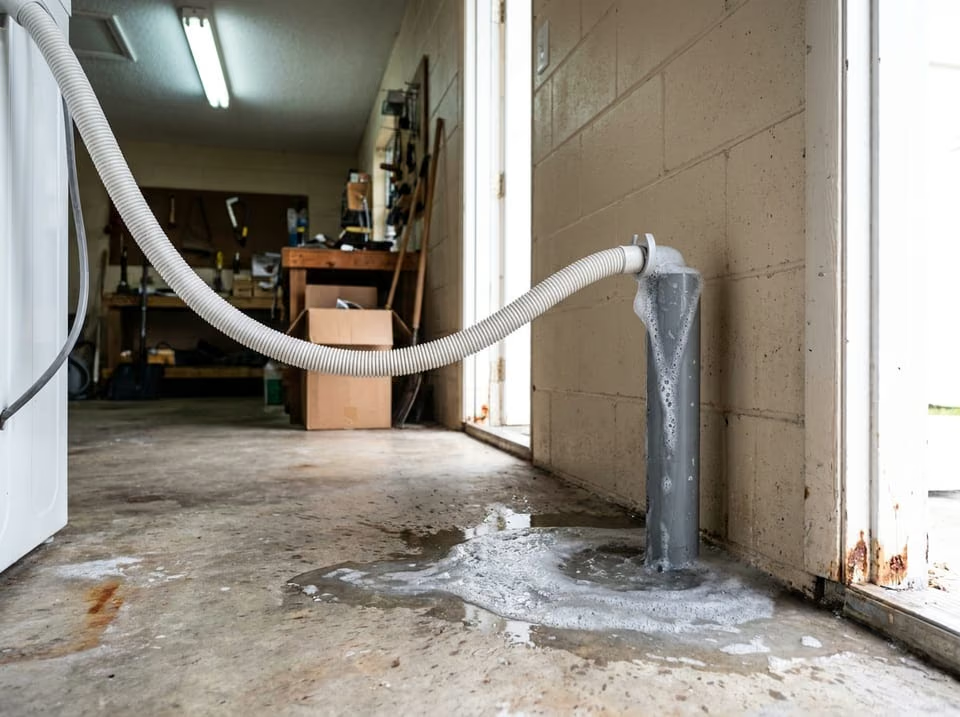
A washing machine drain backup happens because the washer pumps out a large volume fast, overwhelming a partially blocked line before any other fixture does. If the tub or a floor drain backs up when the washer drains, the blockage sits downstream of both, which places it in the main line.
Why does my bathtub fill up with water when my washing machine drains?
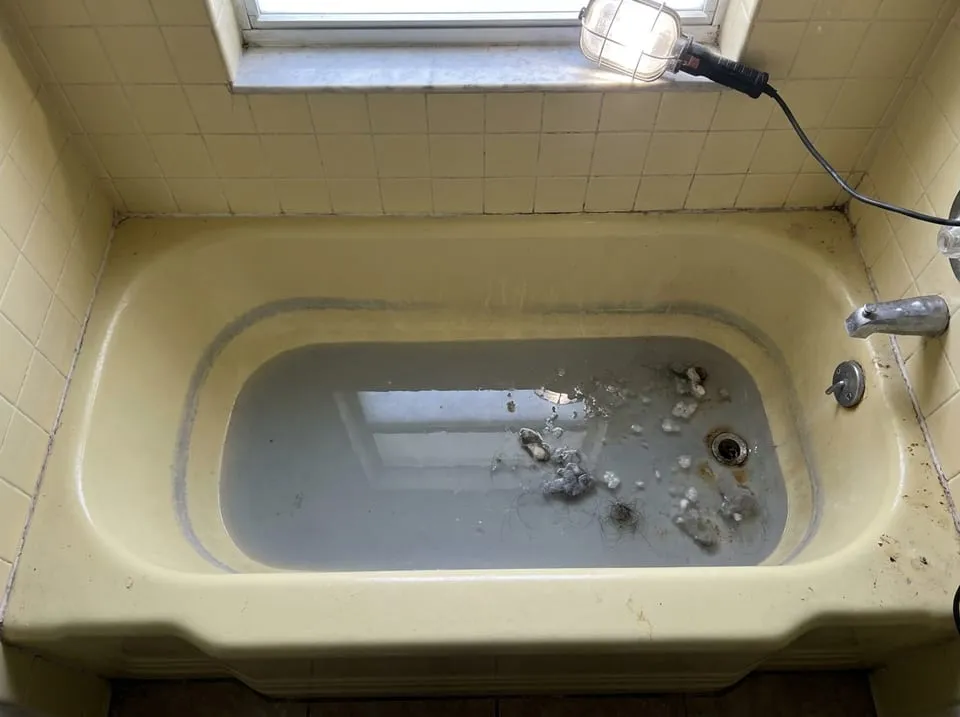
A bathtub fills with water when the washing machine drains because the washer pumps roughly 15 to 30 gallons into the drain line in under a minute, a partially blocked main line cannot pass that volume, and the excess comes back up at the lowest opening below the blockage, which in a Florida slab home is a tub, a shower pan, or a laundry floor drain. A washing machine is the best diagnostic appliance in a house, and homeowners rarely realize it. It discharges far faster than a sink, a shower, or a toilet delivers water into the same pipe, so a line with a partial restriction that handles a shower fails on a washer. The washer is usually the first fixture to expose a main line problem, and the backup shows up somewhere else entirely.
| Symptom | What it means |
|---|---|
| Washer drains, tub or shower fills | Blockage downstream of both (main line) |
| Washer drains, laundry floor drain overflows | Main line, or the laundry branch |
| Washer standpipe overflows and nothing else reacts | The washer’s own branch or standpipe |
| Toilet gurgles while the washer drains | Air displaced past a restriction (main line) |
| Only happens on a full load, never a small one | Partial blockage; volume is the trigger |
That last row is the most commonly misread. A blockage that only shows on heavy loads is not intermittent and is not going away. It is a restriction that has not yet reached the point where lighter use finds it, and every wash day pushes more lint and detergent residue against it.
Waste backs out at the lowest opening below the blockage. There is no basement floor drain in a Florida house to absorb it, which is why this symptom tends to arrive as gray water on a finished floor. In many Broward houses the laundry sits in the garage or a utility closet with a floor drain, and a floor drain overflowing there is the good version of this problem; the bad version is the tub in a bedroom bathroom, which is the lowest fixture in a lot of 1960s and 1970s floor plans.
The homeowner threads collected for this site rank this signature among the most discussed: an r/Plumbing post titled “Water coming out from under my toilet bowl while my washing machine is draining” ran to 106 comments, and an r/askaplumber post that opened “every time we do laundry our bathtub backs up” ran to 56. The advice in both threads converges on the same point. The washer is not broken and the tub is not clogged. The pipe they share is.
What to note before calling anyone:
- Which fixture the water appears in, and how far it is from the laundry
- Whether it happens on every load or only full ones
- Whether the toilet gurgles or the bowl level moves while the washer pumps
- Whether it started after heavy rain, which points at groundwater entering a broken line
- The year the house was built; before about 1975 in Florida means original cast iron is likely
Can a washing machine and bathtub share the same drain?
A washing machine and a bathtub share the same drain once their branches join the main line, and that shared section is where a backup on wash day lives. The washer’s own drain path is short: standpipe, trap, branch, into the main. A blockage confined to that path affects only the washer, and the overflow is at the standpipe. The moment a different fixture reacts, the shared section is implicated. A tub and a washing machine have almost nothing in common until their drains join, so water arriving in the tub because the washer is pumping proves the restriction is past that junction, in the main line running out of the house.
This is the same two-fixture logic that makes a shower gurgling on a toilet flush diagnostic. Two fixtures interacting is proof of a shared downstream problem, and it is the single most reliable test in household plumbing. It also tells a homeowner what kind of job to expect. A standpipe overflow with no other fixture reacting is a branch clog, often lint packed into the trap, and it is a short call. A tub backing up on a washer cycle is a main line job, which starts at the yard cleanout rather than in the laundry.
Every house has one lateral leaving the building, so the two always share a drain from the junction outward. The laundry side has its own failure modes that never reach the tub: a standpipe that is too short, or a drain hose pushed too far down it, produces a different symptom, where the washer siphons its own water back out or suds climb the standpipe and spill. Those are laundry-room problems.
Three questions settle which case a house is in:
- Does anything other than the washer react? If yes, main line.
- Does the standpipe overflow with a small load? If yes, the washer branch is packed, regardless of the main.
- Does the toilet gurgle while the washer pumps? If yes, air is being pushed past a restriction in the main, and the tub is next.
The toilet gurgle deserves a word because it is often the first sign, weeks before the tub fills. The washer’s pump pushes water and air down the line together; when the water piles up behind a restriction, the air escapes through the nearest trap, and a toilet’s trap is the largest and loudest in the house. A gurgle on wash day and nothing else is a main line telling a homeowner it is running out of room.
In pre-1980 Broward housing the shared section is very often original cast iron. The Cast Iron Soil Pipe Institute rates cast iron at 50 to 75 years of service, and South Florida practice runs nearer 40 to 50 years according to bioresponsecorp.com. Hollywood’s median year built is 1969 and Oakland Park’s is 1972, per U.S. Census ACS 2024 five-year data, table B25034, so the pipe a washer and a tub share in those cities is usually at the end of its life, with a rough bore that catches lint on every cycle.
What would cause my bathtub to back up?
A bathtub backs up on wash day because something in the main line is narrowing the bore, and in Broward County that is usually lint and detergent residue bound to grease along the pipe wall, scale and channeling inside original cast iron, tree roots at a cracked joint, or a belly holding standing water, with an offset joint or a partial collapse at the severe end. Lint is the washer’s own contribution. The rest are conditions of the pipe, and they are why the same tub backs up again a year after the line is cleared.
- Lint and detergent residue binding with grease along the pipe wall, gradually narrowing the bore
- Scale and channeling in cast iron, where a rough, corroded interior catches everything that passes
- Tree roots entering at cracked joints and forming a mat that lets water through slowly
- A belly or sag holding standing water, so solids drop out at the low point
- Grease from kitchen waste sharing the same main
- An offset joint or partial collapse where the pipe has physically moved
In pre-1980 Broward housing the first three usually appear together. A cast iron line at fifty years has a rough bore that catches lint and a set of joints that has admitted roots. Roots are the item that changes the framing, because of what they prove. A comment with 305 upvotes on a root-intrusion thread put it in one line: “Definitely roots. They can only get inside from a break in the pipe.” Finding roots is finding an opening, and lint packs against a root mat faster than against anything else in the list.
Channeling is the cast-iron failure specific to this ground. Sewer gas condenses into sulfuric acid at the crown of the pipe and eats downward, while wet sand attacks the outside of the invert, and the end state is a pipe whose bottom is gone. Waste runs along a trough in the fill, and the ragged edge of the remaining wall catches lint, paper and hair on every pass. A channeled line still drains, slowly, and it backs up on the washer long before it backs up on anything else.
A belly is the case cleaning cannot touch. A section of pipe that has settled below grade holds water permanently, solids and lint drop out at the low point, and no amount of jetting changes the grade of the ground. A plumber reading footage of a line like that described the fair report: “Looks like a sag in the line between 15’ and 34’. Or it may be very flat and needs to be flushed and jetted. I didn’t see any cracks, offsets, or root intrusion.” That report names a distance and lists what was ruled out, which is what a homeowner should expect from a camera run.
The distinction between a clog and a defect is the whole question on this page. Grease, lint and wipes are clogs: clear them and a sound pipe stays clear. Roots, scale, channeling, bellies and offsets are defects: clear them and the tub backs up again when the defect has caught enough. The year the house was built sets the odds, and a house built before about 1975 in Florida is on the defect side of that line more often than not.
How do I fix a slow draining drain?
A drain that backs up when the washing machine runs is fixed by clearing the main line through the cleanout, camera-inspecting it once it is clear, and then repairing whatever the footage names, in that order; pouring anything down the tub does nothing, because the restriction sits far downstream of it. The sequence matters because a camera cannot see through a blockage, so the inspection has to follow the clearing, and because the inspection is the only thing that tells a homeowner whether this was a clog or a defect.
- Stop running the washer. Each cycle pushes more water into a line that cannot take it.
- Note exactly which fixtures react and in what order, and how full a load has to be to trigger it.
- Have the main line cleared: cabling is reported at $200 to $450, hydro jetting at $400 to $900.
- Have it camera-inspected once clear, reported at $150 to $400, and keep the footage.
- Decide on a repair from what the footage names, not from the clearing.
Those are ranges reported across South Florida work and homeowner accounts, not a price list.
Cabling punches a hole through the obstruction with a rotating auger and pulls some of it back. It is fast and cheap, and on lint packed against roots it restores flow without touching the roots. Hydro jetting scours the full bore with high-pressure water and is the method that actually cleans a scaled cast iron line rather than perforating what is in it. On a washer-triggered backup, jetting is usually the right call, because lint and detergent residue coat the whole wall of the pipe rather than sitting in one place.
Step four is the one that gets skipped, and it is the one that determines whether this recurs. A line that backs up on laundry day, is cleared, and backs up again within a year has a defect rather than a blockage. Roots prove an opening already exists; a belly cannot be cleaned out because standing water is a grade problem; channeled cast iron will keep catching lint because the bore itself is rough. Skipping the scope entirely means paying to clear the same line again next year, and the second backup is as likely to reach the bedroom tub as the garage floor drain.
What the camera run should produce:
- A recorded video of the whole run, handed to the homeowner
- Any defect named in specific terms (belly, offset, crack, roots, channeling) with its distance from the cleanout and its depth
- A mark on the ground where a repair would be made
- A statement of what was not found
The repair then follows the defect. A single cracked joint with roots is a spot repair. A run with roots at several joints but correct grade and a round bore is a lining candidate. A channeled cast iron run is a replacement. A belly has to be dug and re-bedded. A plumber in a trade forum stated the eligibility rule for the trenchless options in one line: “You can only do trenchless if your sewer line has correct pitch and is mechanically sound.”
“A washer finding a problem is good news in one narrow sense: it finds it in a laundry room with a floor drain, not at two in the morning in a bedroom.”
If your tub backs up when the washer drains, request a free quote and we will clear the line and scope it.
Frequently asked questions
Why does my bathtub back up when I wash clothes?
A washing machine pumps 15 to 30 gallons through in under a minute, faster than any other fixture. That volume overwhelms a partly blocked line. Because the tub and the washer only share pipe downstream, water appearing in the tub places the blockage in the main line.
Related services
- Main Sewer Line Clog: How to Tell It From a Single Blocked DrainA clog in the main sewer line affects more than one fixture and backs up at the lowest d…
- Is a Gurgling Toilet Dangerous? What the Sound Actually MeansA gurgling toilet is not dangerous in itself. The sound is air being pulled through the…
- Tree Roots in a Sewer Line: What Gets Them Out and Keeps Them OutTree roots cannot penetrate sound sewer pipe. They enter through a crack, a failed joint…
- Broken Sewer Line: The Signs, and What They Look Like in FloridaA broken sewer line shows itself through repeat backups, a persistent sewer smell at flo…
- Sewer Line Repair in North Lauderdale, FLSewer line repair in North Lauderdale starts with a camera inspection and a surface loca…