Sewer Smell in the Bathroom: What Causes It and What to Check First
A sewer smell in a bathroom almost always means drain gas is escaping into the room instead of venting to the roof. The three common causes are an evaporated P-trap in a rarely used fixture, a failed wax ring under the toilet, and a cracked drain line beneath the slab. The first two are cheap. The third is not.
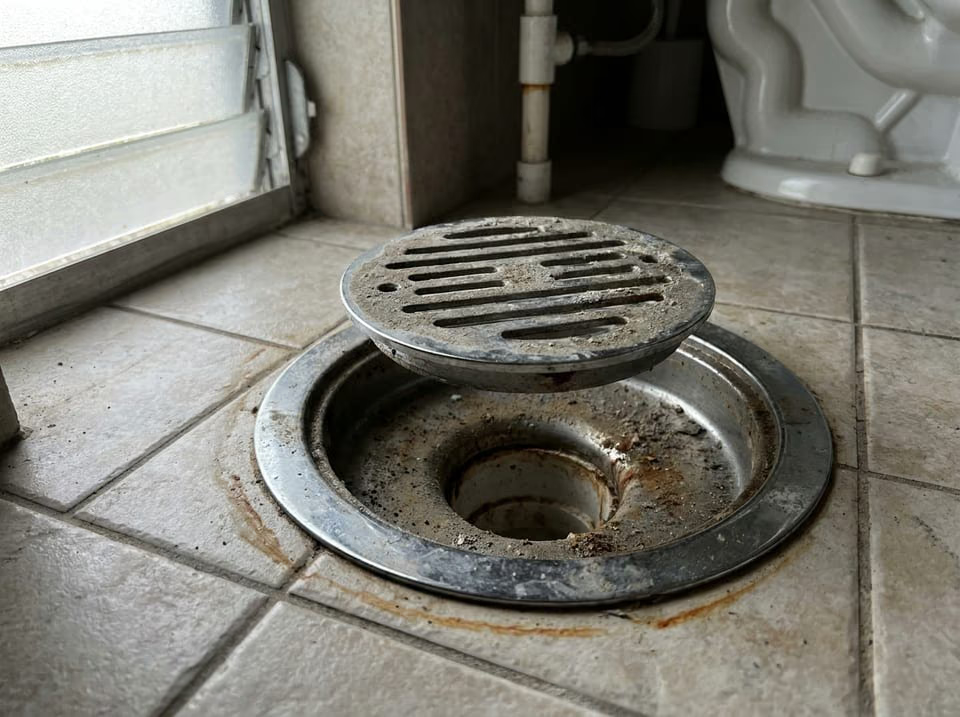
What could be causing a sewer smell in the bathroom of a Florida home?
A sewer smell in the bathroom of a Florida home is caused by drain gas reaching the room, and the most common reason is a P-trap that has dried out in a fixture nobody uses. Every drain in a house is sealed against the sewer by a small amount of standing water: in the U-bend under a sink, inside the toilet’s built-in trap, and in the floor drain. That water is the only thing between the room and the gas in the pipe. A P-trap holds its seal by holding water, and water in an air-conditioned Florida house evaporates faster than most homeowners expect. A guest bathroom used twice a year, a laundry-room floor drain, or a second-bath shower in a seasonal home can lose its trap seal in a matter of weeks, at which point the drain becomes an open pipe to the sewer. That is why a guest bathroom smells and the main bathroom, used every day, does not.
The test is free. Run the fixture for thirty seconds, or pour about a quart of water down the floor drain, and wait a day. If the smell goes and stays gone, the trap was dry and nothing is broken. If the smell returns within a day or two on a fixture that is being used, the trap is being siphoned or the vent is blocked, and that is a plumbing defect rather than a maintenance one.
Snowbird and rental properties across Broward see this constantly, which is why it is worth ruling out before paying anyone to diagnose it. The homeowner threads collected for this site make the same point: the top-voted resolution to a “smells like sewage” post was, in the homeowner’s own words, “It was the wax ring!” A dry trap and a failed toilet seal between them account for most bathroom sewer smells, and neither involves the sewer line.
Three things separate a trap problem from a pipe problem:
- Location. A trap smell sits at one fixture and is strongest right at the drain. A pipe smell fills a room or a hallway and cannot be traced to any opening.
- Timing. A trap smell is constant until the trap is refilled. A pipe smell comes and goes, and in South Florida it tends to track rainfall.
- Company. A trap smell arrives alone. A pipe smell often arrives with drain flies, a gurgling fixture, or a floor that sounds hollow.
Broward’s housing stock makes the pipe case worth taking seriously once the free checks fail. Hollywood’s housing stock has a median year built of 1969 and Fort Lauderdale’s is 1972, according to U.S. Census ACS 2024 five-year data, table B25034, and a house from that era is very likely draining through original cast iron. The rest of this page walks through the causes in the order they should be checked, so the expensive diagnosis happens only after the cheap ones are exhausted.
How do I get rid of the sewer smell in my house?
To get rid of a sewer smell in a house, refill every P-trap first, then check each toilet for a failed wax ring, then have the vent stack checked if several fixtures gurgle together, and only then have the drain line under the slab camera-inspected. The order matters because the causes run from free to expensive, and because the cheap causes are also the common ones. A camera inspection is the right answer to a smell that persists after the trap and toilet checks, and the wrong answer to a guest bathroom nobody has used since March.
| Cause | Where the smell shows | Rough cost | How it is confirmed |
|---|---|---|---|
| Evaporated P-trap | One rarely used fixture or floor drain | $0 | Refill the trap; smell gone in 24 hours |
| Failed toilet wax ring | At the base of one toilet, often with a rocking bowl | $150–$350 | Toilet pulled and reset; base checked for movement |
| Blocked or cracked vent stack | Several fixtures at once; gurgling with the smell | $300–$1,200 | Vent smoke-tested or scoped from the roof |
| Cracked drain or sewer line under the slab | Whole room or hallway; worse in wet weather; sometimes with a soft or sinking floor | $1,500–$18,000 | Camera inspection of the line |
The cost figures are ranges reported across South Florida work and homeowner accounts, not a price list.
Refilling traps takes ten minutes for the whole house. Run every sink, tub and shower for thirty seconds, flush every toilet, and pour a quart of water into every floor drain, including the one behind the washing machine and the one in the garage if there is one. A tablespoon of mineral oil floated on top of a floor drain that is never used slows the evaporation.
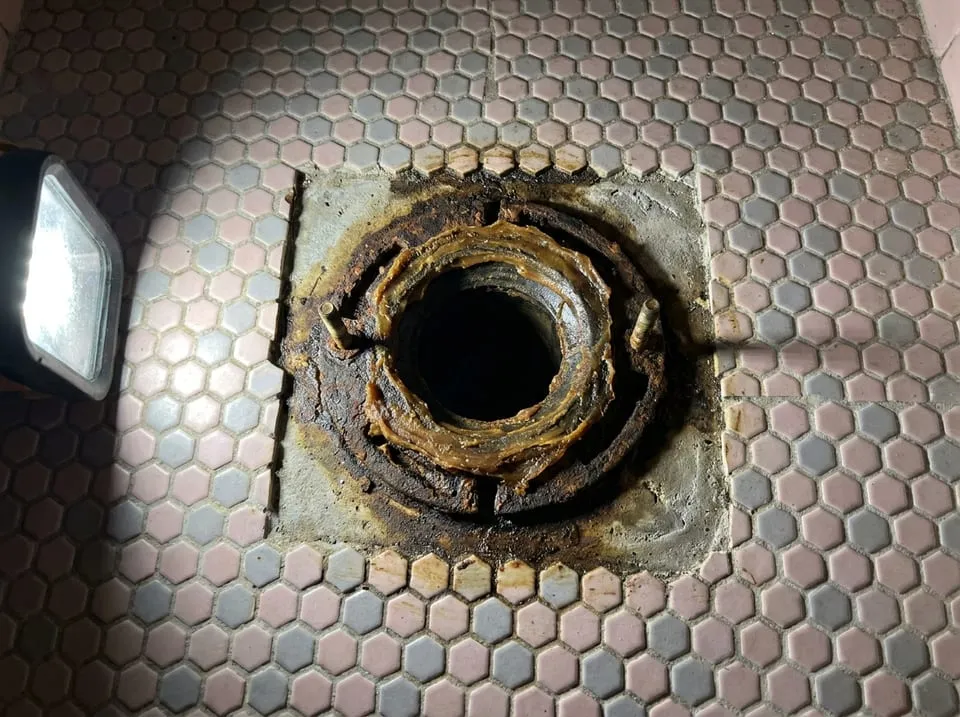
The wax ring fails when a toilet rocks. Grab the bowl and try to move it; any play means the seal underneath has broken and gas is escaping around the base, usually with a faint dampness on the floor. Pulling and resetting a toilet on a new ring is a short job, and on an older Broward house the closet flange is often corroded cast iron, which is worth checking while the toilet is off.
The vent stack carries gas out through the roof. When it is blocked by a bird’s nest, leaves, or a collapsed section, the drains pull air through the nearest trap instead, which is the gurgle that so often accompanies a smell. A smoke test or a camera down the vent finds it.
The line under the slab is the last check because it is the expensive one, and because everything above it has to be ruled out for the footage to mean anything. A camera on a push rod enters through the cleanout, travels the line, and a surface locator marks any crack, offset or belly on the floor with a depth. The recording should name the defect and the distance, and it should go to the homeowner. Ask for the file before the crew leaves. A report that says the line is bad without a distance and a depth cannot be checked by a second contractor and should not be quoted against, and a smell that has survived the trap and toilet checks deserves a named defect rather than a guess.
Why do I keep randomly smelling sewage?
A sewage smell that comes and goes with no fixture as its source, and that gets worse after heavy rain, is the signature of a drain line that has cracked under the slab, and in Broward County the material that puts a house in this category is original cast iron. When a cast iron line opens beneath a slab, the gas does not come from a fixture. It comes up through the slab itself, through expansion joints and hairline cracks, and it tends to be worse after a downpour when the water table rises and pushes gas upward. A smell that fills a hallway rather than a bathroom, that has no single source, and that tracks the weather is a line that has already failed.
The Cast Iron Soil Pipe Institute puts cast iron’s service life at 50 to 75 years, and in South Florida’s sandy fill and high water table the practical figure runs closer to 40 to 50 years, according to bioresponsecorp.com. Roughly 35% of the living units in South Florida built during the 1960s and 1970s went in with cast iron drain lines, per the same source, and PVC did not become standard in Florida residential construction until the late 1970s. A house from that era is at or past the end of its original drainage system regardless of how well it has been maintained.
The failure mode explains the randomness. Sewer gas condenses into sulfuric acid at the top of the pipe and corrodes cast iron from the crown downward, while wet sand corrodes the outside of the invert. The end state is channeling, where the bottom of the pipe is gone and waste runs along a trough in the fill. Gas escapes through the opening continuously, but it only reaches the living space when something pushes it there: a rising water table after rain, a change in barometric pressure, or the air conditioning cycling and drawing air from under the slab. A homeowner in a Plumbing forum wrote of a smell that “comes randomly and occasionally, not consistent,” after replacing every toilet seal in the house. Seals were the right first check; the randomness is what pointed past them.
Two things usually appear alongside a slab-level smell: small dark drain flies breeding in the soil around the break, and a floor area that sounds hollow or feels soft underfoot where the surrounding fill has washed into the pipe. Outside, the same break often shows as a sunken or unusually green strip of lawn along the line’s route toward the street.
The check for this case is the camera, and there is no substitute. A slab cannot be opened on a smell. A camera run through the cleanout finds the crack, the surface locator marks it on the floor with a depth, and the repair, whether a spot repair under the slab, a liner through the run, or a replacement, is quoted against a specific location rather than a hallway.
Is sewer smell in a house toxic?
Sewer smell in a house is an irritant at the concentrations a dry trap or a cracked drain line produces in a ventilated room, and the serious hazards from sewer gas occur in confined spaces such as manholes and tanks, not in an open bathroom. Sewer gas is a mixture, and the part responsible for the rotten-egg smell is hydrogen sulfide. At household concentrations the usual complaints are headache, nausea and eye or throat irritation, which stop when the source is fixed. The practical risk is different from the toxicological one, and it comes in two forms.
First, hydrogen sulfide is heavier than air, so it collects at floor level, which is where small children and pets spend their time. A smell an adult notices at standing height is stronger on the floor of the same room.
Second, and more consequential, a smell that has continued for weeks is evidence of an opening that is also letting water out of the pipe and soil into it. That is a structural problem developing quietly under a slab, whatever the air quality reading says. The void that forms as fill washes into a broken line is what produces the hollow floor and, eventually, the settled slab, and it does not stop growing on its own.
What to do while working out the cause:
- Refill every trap in the house before spending money on a diagnosis
- Check whether the smell tracks rainfall; drain-line breaks usually do
- Look for drain flies, which breed in the wet soil around a break rather than in clean water
- Note whether more than one fixture gurgles, which points at the vent or the main line
- Ventilate the affected room and keep children and pets off the floor there until the source is found
- Do not seal or caulk a slab crack that is venting gas: it hides the symptom and nothing else
Homeowners searching this symptom also ask whether it is safe to stay in a house that smells like sewer. The honest answer is that a dry-trap smell is safe to live with for the ten minutes it takes to refill the trap, a wax-ring smell is safe to live with until the toilet is reset, and a slab-level smell is safe to breathe but expensive to ignore, because the break under the floor is also the reason the yard is sinking and the drains are slowing.
What does a sewer camera inspection actually show?
A sewer camera inspection shows the inside of the drain line under the slab, run through the cleanout with the homeowner watching the monitor, and for a sewer smell it either finds a located crack, offset or belly or it confirms the line is intact and sends the search back to the fixtures. It is the only way to see whether a line under a slab is cracked, offset, bellied, or intact, and it is also the step that separates a $200 wax ring from a $14,000 repipe, which is why it comes before any quote for work rather than after one. A standard residential inspection is reported at $150 to $400.
The Sewer Line Repair Broward field team puts it this way: “The camera goes in through the cleanout and the homeowner watches the monitor with us. If the line is intact and the smell is coming from a fixture, we say so and we are done: there is nothing under the slab to sell. Recording the run matters because the footage is what a second opinion gets to look at.”
The inspection itself runs in a fixed sequence. A self-leveling camera head on a semi-rigid push rod enters through an existing cleanout and is fed down the line while the operator watches a monitor. A footage counter on the reel records distance traveled, so every observation is tied to a number. The camera head carries a small transmitter, and a locator on the surface picks it up; that is how a defect thirty-four feet down the line becomes a mark on the floor with a depth written beside it. If no cleanout exists, which is common in pre-1970 Broward construction, access is through a pulled toilet.
A useful report names the defect in specific vocabulary, every item of which is visible on video: belly or sag, offset joint, crack, root intrusion, channeling, scale, collapse. Rust and heavy scale on fifty-year-old cast iron are the expected condition of the material and are not a verdict on it. A smell diagnosis that rests on the pipe looking rusty rather than on a located crack deserves a second read, and the recorded footage is what makes that second read possible.
What the homeowner should leave the inspection with:
- The recorded video file, not stills and not a summary
- A written note of each defect with its distance from the cleanout and its depth
- A mark on the floor or the lawn where any repair would be made
- A statement of what was ruled out, in the same detail as what was found
Where the footage shows an intact line, the smell goes back to the fixtures and the vent, and the inspection has still paid for itself by taking a slab repair off the table. Where it shows a crack or a channeled section, the repair is quoted against a location, and the same footage can go to a second contractor for a competing bid.
If the smell has outlasted the free fixes, request a free quote and we will confirm what a camera inspection covers before anyone is scheduled.
Frequently asked questions
What are the warning signs of a broken sewer line in a Florida home?
Florida homes are slab-on-grade, so the signs differ from basement guidance. Look for a sinking or soft strip in the yard along the line, sewer odor rising through slab joints, drain flies indoors, repeat backups, and a floor area that sounds hollow underfoot.
Related services
- Main Sewer Line Clog: How to Tell It From a Single Blocked DrainA clog in the main sewer line affects more than one fixture and backs up at the lowest d…
- Broken Sewer Line: The Signs, and What They Look Like in FloridaA broken sewer line shows itself through repeat backups, a persistent sewer smell at flo…
- Sewer Camera Inspection Cost and What the Footage ShowsA residential sewer camera inspection typically costs $150 to $400. A camera on a push r…
- Cast Iron Pipe Repair: When a Section Can Be SavedCast iron can be spot-repaired when the defect is isolated and the surrounding pipe stil…
- Is a Gurgling Toilet Dangerous? What the Sound Actually MeansA gurgling toilet is not dangerous in itself. The sound is air being pulled through the…