Emergency Sewer Repair in Broward County
We handle active sewer backups in Broward County homes: the line is opened first by cable or hydro jetting, then camera-inspected once it is flowing, with the recorded footage handed to you. Cleanup and repair are quoted separately after the line is clear, never off a line nobody has seen. We Fix It Right the First Time or It's Free.
What does emergency sewer repair in Broward County include?
Emergency sewer repair in Broward County includes containment, opening the line, diagnosis, and then a separate decision about repair, in that order. Containment is what the homeowner does in the first hour: stop using every fixture, keep people and pets out, and photograph the extent. Opening the line is the first thing a crew can do on arrival, by cable or hydro jetting through a cleanout or a pulled toilet. Diagnosis comes after, because a camera cannot see through a backed-up line. The repair, if one is needed, is quoted against that footage once the room is dry.
The first hour, before anyone arrives:
- Stop using every fixture in the house. Every flush, every load of laundry, every shower adds volume to a line that cannot take it. This is the single most effective thing a homeowner can do and it costs nothing.
- Keep people and pets out of the affected rooms. Sewage carries bacterial contamination; the flooring is the smaller problem.
- Do not pour drain chemicals into a standing backup. They do not clear a main line, and they make the water hazardous for whoever has to work in it.
- Note which fixtures are affected and in what order. That sequence tells a plumber where the blockage sits before anyone arrives.
- Photograph the extent before cleanup, in case an insurance claim follows.
On arrival, the line gets opened. Access is through an exterior cleanout where one exists, and through a pulled toilet where it does not, which is common on pre-1975 Broward houses. A cable bores a channel through the obstruction and restores flow fast; hydro jetting scours the bore back to the pipe wall and is the choice where scale, grease or a root mat is the cause. Reported South Florida ranges run $200 to $450 for a cable and $400 to $900 for jetting. Restoring flow stops the situation getting worse and is the only thing that can be done immediately.
Diagnosis follows. Scoping a backed-up line produces footage of the backup and nothing useful. Once the line is clear and flowing, the camera run identifies what caused it, and a surface locator marks the defect’s distance and depth on the ground. The recording leaves with the homeowner. That order matters commercially as well as technically: a repair quoted off a line nobody has been able to see is a quote for the contractor’s guess.
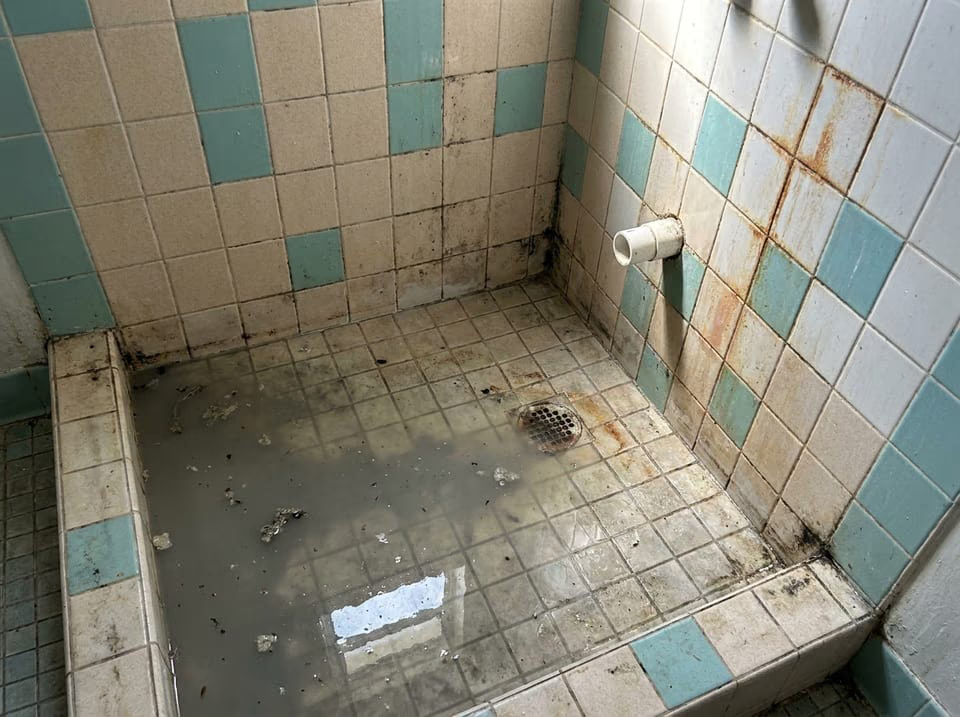
The photograph above is the Broward version of a backup. Waste backs out at the lowest opening below the blockage, and there are no basements here, so the overflow point is a first-floor shower pan, a tub, or a laundry-room floor drain. A finished room, in other words, which is why the cleanup cost so often exceeds the plumbing cost, and why acting at the gurgle stage is a service call while acting at the backup stage adds remediation.
Is a broken sewer line an emergency?
A broken sewer line is an emergency when sewage is coming into the house or standing in the yard, and a scheduled repair when the line is still flowing. The distinction decides what happens first. An active backup gets the line opened the same visit, by cable or jet, because containment cannot wait for diagnosis. A line that is slow, gurgling, or sinking a strip of lawn but still draining gets a camera inspection on a normal appointment, and the repair is planned rather than improvised. The break is the same either way; the urgency is set by where the water is.
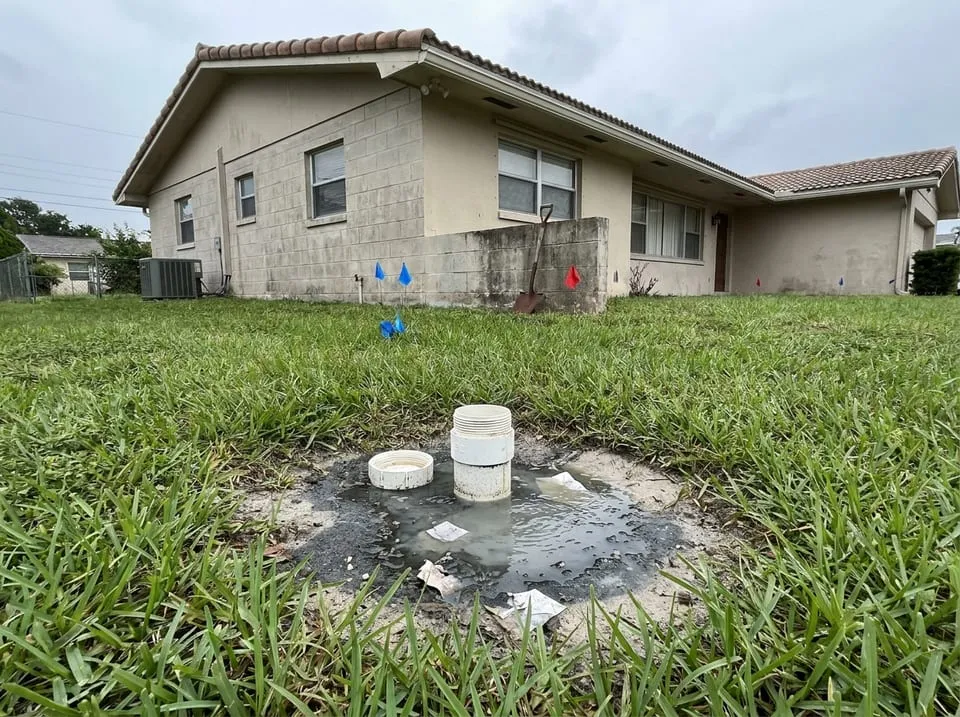
The Florida failure signature is different from the basement guidance most national websites give, because Broward houses are slab-on-grade:
- Standing gray water in a shower pan, tub or laundry floor drain that appears when another fixture is used. Active backup. Emergency.
- Sewer odor rising through slab joints, a floor drain, or an unused guest bathroom. Not yet an emergency, and worth a camera run.
- A sinking or soft strip in the yard along the line’s route toward the street. A break below grade is letting sandy fill wash into the pipe. Schedule a camera run with a surface locate.
- Drain flies indoors with no obvious source. A leak under the slab is a common cause.
- Two fixtures interacting, a toilet that makes the tub gurgle. The main line is restricted and the backup is weeks away, not months.
The yard sign is the one homeowners ask about most, and the reason it is specific to here is the ground. A widely upvoted reply on a landscaping forum gave the right instruction: “Get a plumber to run a camera through your line and see if it’s broken or sinking.” When a line breaks below grade in sand rather than clay, the soil washes into the pipe and is carried away, leaving a void that settles at the surface. Florida’s Building Code, Plumbing Chapter 7, writes its material rules for exactly this: on filled or unstable ground the building sewer must conform to a standard for ABS, cast iron, copper or copper-alloy, PVC or PP pipe.
Heavy rain is the other local tell. When a line is already cracked, a high water table and a storm push groundwater into the pipe, and a line running near capacity gets pushed past it. A backup that arrives with a storm and clears when the weather does is strong evidence of a break rather than a blockage.
The age of the pipe sets the odds. Cast iron is rated at 50 to 75 years by the Cast Iron Soil Pipe Institute, with regional contractor reporting putting South Florida practice at 40 to 50, and roughly 35% of South Florida living units built in the 1960s and 1970s went in with cast iron, per bioresponsecorp.com. Hollywood’s median year built is 1969 and Fort Lauderdale’s is 1972, per U.S. Census ACS 2024 five-year data, table B25034. A first backup in a twenty-year-old PVC house is usually an event. A second backup in a 1968 house with original cast iron is a pipe telling you something.
Is a bubbling toilet a plumbing emergency?
A bubbling toilet is a warning rather than an emergency, and it is the most useful warning a house gives. Air bubbling up through the bowl when a shower, tub or washing machine runs means water from another fixture is pushing air back through the toilet’s trap, which only happens when the pipe both fixtures share is restricted. That pipe is the main line. The backup that follows is usually weeks away, and clearing the line at this stage is a service call rather than a remediation job.
The test that confirms it takes a minute and costs nothing: run one fixture and watch a different, lower one.
| What you see | Where the blockage is |
|---|---|
| One sink slow, nothing else affected | That fixture’s trap or branch |
| Flush the toilet, the tub or shower gurgles or rises | Main line, downstream of both |
| Run the washing machine, the tub or floor drain backs up | Main line (a washer discharges a large volume fast) |
| Every fixture slow, lowest drain backs up first | Main line, likely well downstream |
| Toilet bubbles and the water level drops on its own | Venting or main line partially blocked |
If only that toilet gurgles when it is flushed, the problem is local and small: the toilet’s own trap, or a vent. If a shower, tub or floor drain reacts when the toilet is flushed, or the toilet bubbles when the washer drains, two fixtures are interacting and the restriction is in the line they share.
What the bubbling stage buys is time and money. At this point the line is still draining, so the work is a clear-and-scope on a scheduled visit: cable or jet, reported at $200 to $900 depending on method, then a camera run at a reported $150 to $400 that names the cause. At the backup stage the same plumbing work is joined by a contaminated finished floor, a drying-out, and often a flooring replacement, in a house where nobody can use the bathroom until the line is open.
The bubbling also says something about what is likely in the pipe. On a fifty-year-old cast iron line the bore is rough and scaled, so lint, grease and paper catch on it continuously and the line does not so much block as gradually close. Bubbling that has crept in over months on a pre-1975 house is that closing in progress. Bubbling that started suddenly is more often a foreign object or a root mat that has finally bridged the bore.
Chemical drain cleaners do nothing at this stage that helps. They act on the fixture drain they are poured into, and the restriction is forty feet away in a four-inch pipe. Boiling water is the same story. The useful action at the bubbling stage is a call while the floor is still dry.
“Open it first, diagnose it second, and never quote a repair off a line nobody has been able to see.”
Why does my toilet overflow when my washing machine drains?
A toilet overflows when the washing machine drains because the washer pumps 15 to 30 gallons into the drain system in under a minute, faster than any other fixture delivers water, and a main line that is partly restricted cannot pass that volume. The water has to go somewhere, and it comes back up at the lowest opening below the restriction. In a Florida slab home that is usually a shower pan, a tub or a laundry floor drain; a toilet overflowing on the washer’s discharge is the same event at a slightly higher opening. The washer is the trigger, and the main line is the problem.
That is also why the washing machine is the best diagnostic appliance in the house. A sink runs at a trickle by comparison, and a toilet flush is a gallon or two. A line that handles both without complaint and fails on the washer is a line with its capacity reduced, and the reduction is in the shared pipe downstream of the laundry, since the toilet and the washer share nothing else. Because the washer discharges through a pump rather than by gravity, it finds a restriction earlier than any other fixture will.
The immediate response is the same as for any backup: stop the machine, stop using every other fixture, keep people out of the water, and note which openings the water appeared at and in what order. If the tub filled first and the toilet rose second, the restriction is downstream of both and the sequence is useful to the crew.
Then the sequence of work, in the order it happens:
- Open the line: cable at a reported $200 to $450, or hydro jetting at $400 to $900 where scale, grease or roots are the cause
- Camera-inspect once it is flowing, at a reported $150 to $400, and keep the footage
- Locate the defect on the surface, with a distance and depth marked on the ground
- Quote the repair, if the footage shows one is needed, with excavation, restoration and permits as separate lines
What the camera usually finds behind a washer-triggered backup on an older Broward house: scale and channeling in cast iron narrowing the bore, a root mat at a joint the roots entered through, grease cooled along the pipe wall, or a belly holding solids at a low point. Wipes and non-flushables snag on any of those. The first two are pipe defects producing blockages, and clearing them restores flow while leaving the cause in place, which is why the camera run after the clearing is the step that decides whether this happens again on the next wash day.
One thing the washer does not do is damage the line. A homeowner reading a backup as “the washing machine broke the pipe” has it backwards: the machine found a restriction that was already there and would have shown up at the next heavy use anyway. Reducing load sizes buys a little time. It does not change what is in the pipe.
If a line is backing up now, request a free quote and note which fixtures are affected. If it is bubbling and still draining, the same form books a clear-and-scope before it stops.
What are the warning signs of a collapsed or broken sewer line?
The warning signs of a collapsed or broken sewer line in a Florida home are a sinking or soft strip in the yard along the line’s route, sewer odor rising through slab joints or an unused bathroom, drain flies indoors, repeat backups at the lowest fixture, two fixtures interacting when one is used, a backup that arrives with heavy rain, and a floor area that sounds hollow underfoot. Broward houses are slab-on-grade, so the basement floor-drain signs national websites describe do not apply. The Florida signature is water where it should not be, in the yard or on the slab, and ground that is moving.
What each cause looks like, what clears it, and whether it comes back:
| Cause | Immediate fix | Whether it recurs |
|---|---|---|
| Wipes or foreign object | Clear the line | Not if habits change |
| Root mat closing the bore | Jet and cut | Yes, without repairing the opening |
| Grease | Jet | Gradually |
| Collapsed section | Clearing may not work at all | Requires excavation |
| Belly full of solids | Clear, but it refills | Yes |
| Heavy rain plus a broken line | Clear | Yes, on the next storm |
The bottom three rows are the ones that separate a broken line from a blocked one. A collapse sometimes cannot be cabled at all, because the cable meets pipe rather than debris; that is the case where the emergency visit becomes a locate and an excavation. A belly refills because solids settle at its low point no matter how clean the pipe is. And the storm row is specific to here: a high water table pushes groundwater into a cracked pipe, and a line that runs fine in dry weather backs up on the next heavy rain.
Roots are a sign in their own right. Roots do not bore through cast iron or PVC; they follow moisture and enter where the pipe is already open. A widely upvoted forum reply put it in one line: “Definitely roots. They can only get inside from a break in the pipe.” Finding roots on the camera is finding a crack or a failed joint, which is why a root clearing in an emergency comes with a repair conversation rather than just an invoice.
The yard sign deserves its own note because it is the one that shows before any water does. A break below grade in Broward’s sandy fill lets soil wash into the pipe and get carried away, leaving a void that settles at the surface. A depression, or a strip of greener grass, that follows the line’s route from the house toward the street is worth a camera run with a surface locate before it becomes a backup.
After the line is flowing and the room is cleaned, the question is whether this was an event or a symptom. A camera run answers it, and the footage is the homeowner’s to keep and to show a second contractor. The repair, if one is needed, is spot repair, lining, pipe bursting or replacement, quoted against that footage with excavation, restoration and permits itemized. The guarantee covers it: We Fix It Right the First Time or It’s Free. If the section we repaired fails again from the same defect, we come back and redo the work at no charge.
Frequently asked questions
Why does my bathtub back up when I wash clothes?
A washing machine pumps 15 to 30 gallons through in under a minute, faster than any other fixture. That volume overwhelms a partly blocked line. Because the tub and the washer only share pipe downstream, water appearing in the tub places the blockage in the main line.
Should I call a plumber for a gurgling toilet?
If only that toilet gurgles when flushed, the problem is local and small. If a shower, tub or floor drain reacts when the toilet is flushed, two fixtures are interacting and the restriction is in the main line. That case is worth clearing before it backs up.
Can a sinking spot in the yard mean a broken sewer line?
Yes, and it is one of the clearest signs. When a line breaks below grade, sandy fill washes into the pipe and is carried away, leaving a void that settles at the surface. A depression following the line's route toward the street warrants a camera inspection.
What happens if the repair doesn't hold?
We fix it right the first time or it's free. If the section we repaired fails again from the same defect, we come back and redo the work at no charge. The camera footage from the original visit is what settles whether a new problem is the same defect returning or a separate one.
Related services
- Main Sewer Line Clog: How to Tell It From a Single Blocked DrainA clog in the main sewer line affects more than one fixture and backs up at the lowest d…
- Broken Sewer Line: The Signs, and What They Look Like in FloridaA broken sewer line shows itself through repeat backups, a persistent sewer smell at flo…
- Main Sewer Line Cleaning in Broward CountyWe clear main sewer lines for Broward County homes where two fixtures back up together,…
- Washing Machine Drain Backup: Why the Tub Fills When You Do LaundryA washing machine drain backup happens because the washer pumps out a large volume fast,…
- Contact Sewer Line Repair BrowardContact Sewer Line Repair Broward using the form on this page to request an inspection o…